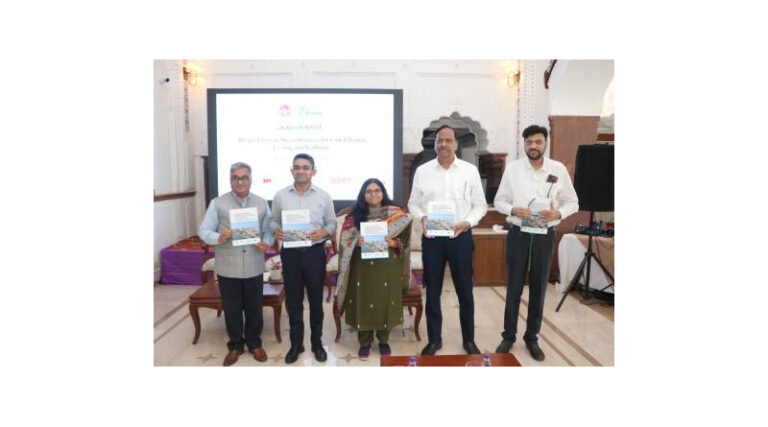
09 June 2026, New Delhi: As India endures one of its most severe summers on record — with most of world’s hottest cities, and temperatures crossing 47°C— Bhopal today released the first analysis of how an Indian city can cool itself, citywide, at scale. Launched on World Environment Day, the work on Bhopal Citywide Smart Surfaces for Cost-Effective Cooling and Resilience and is the first study to quantify the potential of citywide Smart Surfaces to cool an Indian city.
Citywide Smart Surfaces could reduce temperatures by up to 2.8°C in Bhopal’s dense, built-up core—where the impacts of extreme heat are most severe.
Why air conditioning alone cannot be the only answer
The International Energy Agency projects over 10x growth in Air-Conditioning units to 1 billion by 2050. But even with growth, this half of Indians would still lack AC in 2050. AC exacerbates temperature issues by dumping heat outside and can directly heat cities by an additional ~2°C, leaving those without access to AC even more vulnerable to heat illness and death. An AC-only strategy leaves the majority unprotected while making the city hotter for everyone outside.
The solution: citywide Smart Surfaces
Smart Surfaces offer the only viable, cost-effective path to protect every city dweller at scale: highly reflective and emissive roofs, reflective roads, porous and green surfaces, trees, and rooftop solar. By raising citywide reflectivity — measured as “albedo” surfaces can reflect much more heat out of the atmosphere, lower temperatures, and cut energy bills. Fully adopted, they could cut projected growth in air-conditioning demand by more than a third. The framework built for Bhopal is designed to be scalable and replicable across all Indian cities.
In a city where lower-income neighborhoods run 5–6°C hotter, the largest cooling reaches exactly where it’s needed most.
First-of-its-kind heat data and modelling for an Indian Cities
The report is built on the first detailed, citywide surface-heat analysis ever produced for an Indian city. Working with atmospheric-scientists, the team combined Indian satellite data and high-resolution urban-morphology data to map Bhopal’s surfaces — their area, reflectivity (albedo), and heat-radiating properties (emissivity)— and to model temperature change at resolutions of one to thirty meters. Across the 463 sq km municipal area, the average albedo is just 0.165 — meaning most surfaces absorb roughly 83% of the sunlight that strikes them.
These outputs feed a Benefit-Cost Analysis Tool (BCAT) tailored to Bhopal —allowing the city to model intervention scenarios and prioritize where cooling is needed most.
Citywide adoption would lower peak summer temperatures by up to 3°C. For Bhopal, in the dense, highly built-up urban core, peak cooling reaches up to 2.8°C, exactly where heat is most dangerous.
The interventions would return 3.5 times their cost over ten years, with the largest benefit-to-cost ratios of 7:1 for trees and 5:1 for cool roofs and solar PV.
Implementing this strategy would cut Bhopal’s global-warming impact by 11 million tons of CO₂e by 2046, aligning with India’s climate goals.
Phased targets over a decade include converting 50% of roofs to cool roofs, 10% of roads to reflective surfaces, 10% rooftop solar PV, and a 5% increase in tree cover.
Major gains are not even counted in that 3.5 ratio — higher worker productivity, protection of Bhopal’s tourism economy, cooler schools (3–4°C lower indoors) with better learning outcomes, and reduced heat-related illness and death — so the true return is larger still.
Crucially, the largest gains accrue in lower-income neighborhoods, which are commonly 5–6°C hotter in summer than wealthier parts of the same city. Smart Surfaces is therefore not only a cooling strategy — it is an equity strategy. This strategy would cool over 50 Bhopal schools, protecting students from rising heat. Madhya Pradesh has been among the worst-hit states. The threat is no longer distant: it arrives earlier each year, and it falls hardest on outdoor workers, children, the elderly and the urban poor.
What the leaders are saying
“This is a defining opportunity for Bhopal. We are not waiting for the heat to dictate our future — we are redesigning the fabric of our city to meet it. With this report and the planning tool behind it, we can act on data, prioritize the neighborhoods that need cooling most, and lead India in building a cooler, greener and more resilient city for generations to come.” — Chief Executive Officer, Bhopal Smart City Development Corporation Ltd.
“Indian cities are among the hottest on Earth, and this work with Bhopal demonstrates the economic logic of citywide cooling. It is too late to hold warming to 1.5°C, but this work demonstrates that Bhopal and other Indian cities can get cooler even as the world gets hotter. Bhopal is showing how.” — Greg Kats, Chief Executive Officer, Smart Surfaces Coalition
“Bhopal’s leadership, and the support of the Government of Madhya Pradesh, demonstrate a highly cost-effective and scalable approach to India’s urban cooling vision. Bhopal is the first city in India to adopt a scientific approach, based on advanced satellite data and modelling, to address urban heat stress. Through this initiative, the lives and livelihoods of citizens at large — and especially of vulnerable groups such as outdoor workers and school children — are protected. I am confident that many other cities across the country will emulate this approach. On behalf of TERI, I congratulate the Government of Madhya Pradesh on this noble initiative.” — Sanjay Seth, Senior Director, TERI
“Extreme heat is one of the gravest public-health threats facing India today, and it falls most heavily on the vulnerable. By cooling cities citywide, Smart Surfaces directly reduce heat-related illness and death and clean the air that shortens urban lives. This is preventive public health at the scale of a city.” — Dr. K. Srinath Reddy, Public Health Foundation of India (PHFI)
The road ahead
The project was made possible by the MacArthur Foundation. Building on the work in Bhopal and ten major US cities, SSC and TERI — with partners including GRIHA, PHFI and WRI — now intend to scale Smart Surfaces to other Indian cities, including, and to upgrade and cool Indian municipal schools. SSC and TERI will continue to support Bhopal with technical expertise, training and data.
As Bhopal demonstrates, the choice before Indian cities is not whether to cool, but how. Smart Surfaces offer a path that is far cheaper than air conditioning alone and far richer in benefit — cooler streets, lower electricity bills, safer students and healthier workers and families, and a meaningful contribution to slowing global warming.
Global Agriculture is an independent international media platform covering agri-business, policy, technology, and sustainability. For editorial collaborations, thought leadership, and strategic communications, write to pr@global-agriculture.com