India’s National Research Centre for Grapes Fails Inspection, Minister Flags Concerns
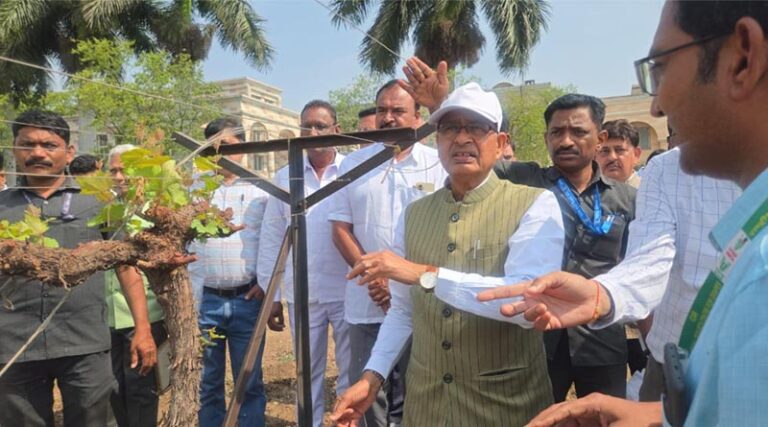
16 May 2026, Pune: Indian Council of Agricultural Research’s National Research Centre for Grapes (NRCG) in Pune has come under sharp scrutiny after Union Agriculture Minister Shivraj Singh Chouhan conducted a surprise inspection during his visit to Maharashtra and raised concerns over nursery performance, varietal development and the slow progress of the Clean Plant Centre.
The minister’s visit assumes significance as Maharashtra accounts for nearly 80% of India’s grape production and remains the country’s leading grape-exporting state. India exported fresh grapes worth more than $300 million in recent years, with markets including Europe, the Middle East and Bangladesh depending heavily on Maharashtra’s production belt in districts such as Nashik, Sangli and Pune.
During the inspection at the ICAR-National Research Centre for Grapes in Pune, Shivraj Singh Chouhan reviewed the institute’s nursery systems, varietal development programmes, disease-free planting material initiatives and technical support being provided to farmers. According to the minister, several shortcomings were observed, including failed nursery performance, limited acceptance of developed grape varieties among farmers and unsatisfactory progress at the Clean Plant Centre.
The Union minister expressed strong displeasure over the situation and stated that institutions working in the interest of farmers must deliver measurable outcomes on the ground rather than function only in name. He also sought explanations from institute director Dr. Kaushik Banerjee regarding concerns raised by grape growers.
Climate Change and Virus Pressure Increasing Challenges
The inspection comes at a time when grape cultivation in Maharashtra is facing increasing pressure from erratic weather patterns, excessive rainfall events and virus-related crop losses. In recent years, unseasonal rains and humidity fluctuations have affected berry quality, shelf life and export compliance, particularly for premium table grapes destined for European markets.
Shivraj Singh Chouhan noted that climate change, excessive rainfall and virus attacks are creating serious challenges for grape growers and said research institutions must focus on practical solutions for farmers. He indicated that the review was conducted not merely as an administrative exercise but in the context of real challenges faced in vineyards.
India’s grape sector has increasingly focused on export-quality production, residue compliance and disease-free planting material. Against this backdrop, the role of the National Research Centre for Grapes becomes strategically important for sustaining export competitiveness and supporting growers with climate-resilient and high-yielding varieties.
Questions Raised Over Nursery and Variety Development
One of the key observations during the inspection related to the institute’s nursery operations and the adoption of grape varieties developed by the centre. The minister stated that although several varieties had been developed, some failed to gain popularity among farmers.
The comments highlight a broader concern often raised within India’s horticulture sector — the gap between laboratory research and field-level adoption. In grape cultivation, farmers generally prefer varieties that offer high productivity, export suitability, better shelf life and tolerance to diseases and weather variability.
The minister said discussions were held on developing higher-yielding and export-oriented grape varieties that align with current market and climatic requirements.
Slow Progress at Clean Plant Centre Draws Concern
Another major focus of the inspection was the Clean Plant Centre being developed to provide healthy, disease-free and certified planting material to grape growers. Clean plant programmes are considered critical globally for perennial horticulture crops such as grapes because virus-infected planting material can reduce vineyard productivity and fruit quality over multiple years.
Shivraj Singh Chouhan expressed dissatisfaction over the pace of work at the centre, stating that progress was too slow despite the importance of ensuring disease-free planting material for farmers. He added that several aspects of the facility require improvement.
The issue is particularly relevant as India’s grape exports depend heavily on traceability, quality assurance and compliance with phytosanitary standards in importing countries. Availability of certified disease-free planting material is increasingly becoming an important requirement for sustainable vineyard management and export competitiveness.
Farmers Raise Concerns Over Technical Guidance
During interactions with the minister, grape growers reportedly raised concerns regarding limited technical guidance and the practical usefulness of some varieties developed by the institute. Farmers also indicated that declining confidence in the public system was pushing many growers towards private nurseries and private planting material suppliers.
The minister reiterated that farmer welfare remains the government’s top priority and that institutions associated with agricultural research and development would be evaluated based on their effectiveness in addressing farmers’ problems.
The inspection has brought renewed attention to the role of public agricultural research institutions in supporting India’s horticulture sector at a time when climate variability, export market standards and disease pressures are reshaping production systems. The developments at the National Research Centre for Grapes are likely to trigger closer evaluation of research delivery, accountability and technology adoption mechanisms within the grape sector.
Also Read: UPL Limited FY26 Revenue Climbs 11% to ₹51,839 Crore, Advanta Surges 23% YoY
Global Agriculture is an independent international media platform covering agri-business, policy, technology, and sustainability. For editorial collaborations, thought leadership, and strategic communications, write to pr@global-agriculture.com