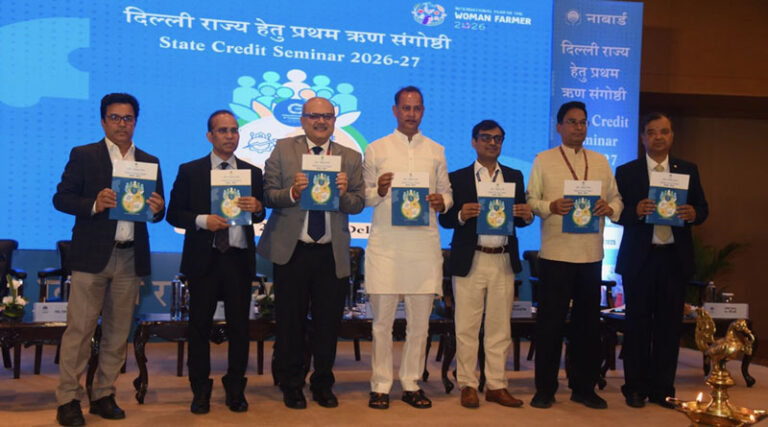
13 April 2026, New Delhi: The National Bank for Agriculture and Rural Development (NABARD), New Delhi Regional Office, organised the first State Credit Seminar for the National Capital Territory (NCT) of Delhi on 13 April 2026. The seminar marked a shift towards a district-driven approach to credit planning, integrating district-level Potential Linked Credit Plans (PLPs) into the State Focus Paper (SFP) 2026–27.
The initiative follows NABARD’s nomination of officers as District Development Managers for all districts of Delhi. The meeting was chaired by Ravinder Singh (Indraj), Minister (Social Welfare, Welfare of SC & ST, Cooperative, Election), Government of NCT of Delhi.
Participants included Chandan Kumar, Chief General Manager, Reserve Bank of India; Ch. Srinivasa Rao, Director, ICAR–IARI; Rashmi Singh, IAS, Secretary, Department of Women and Child Development, GNCTD; and officials from GNCT of Delhi.
Representatives from RBI, SBI, Punjab National Bank, Bank of Baroda, Canara Bank, Union Bank, SIDBI, and the SLBC Convener attended. Vibha Dhawan, Director General, TERI, and representatives from financial institutions, research bodies, academic institutions, artisans, and farmers also participated.
Stalls displaying products supported by NABARD for GI registration were set up to showcase crafts and support livelihood opportunities through coordination between institutions and banking support.
Nabin Kumar Roy, Chief General Manager, NABARD, New Delhi Regional Office, addressed the gathering and highlighted the role of credit planning based on district-level data. He referred to efforts to align priority sector lending with district-level credit potential.
The State Focus Paper 2026–27 estimates total priority sector credit potential at ₹2.62 lakh crore. The agriculture sector, including allied activities, has a potential of ₹4284.20 crore, including ₹568.64 crore under crop loans, ₹230.72 crore for agriculture infrastructure, and ₹2833.11 crore for allied activities. MSMEs account for ₹2.42 lakh crore, housing ₹3,82,5.05 crore, export credit ₹2,03,7.20 crore, renewable energy ₹867.09 crore, and social infrastructure ₹5927.92 crore.
The CGM stated that MSMEs are a major component of credit demand in Delhi. He noted the scope for forms of agriculture such as vertical farming and kitchen gardening and referred to the need for banks to consider these areas. He also referred to the need for a banking system with improved processes.
The Chief General Manager of the Reserve Bank of India stated that the seminar provides a platform for coordination among stakeholders. He noted that credit planning in Delhi needs to focus on MSMEs and services. He referred to the shift towards a district-based approach and alignment between PLPs and Annual Credit Plans.
He also mentioned issues such as uneven credit access, lack of documentation among MSMEs, and challenges in accessing collateral-free finance. He referred to the use of digital platforms such as TReDS and the Unified Lending Interface (ULI) for credit delivery and called for review of regulatory processes and participation at SLBC and district levels.
Ravinder Singh (Indraj), Minister, Government of NCT of Delhi, addressed the seminar and referred to its role in strengthening the credit and cooperative system. He spoke about the role of MSMEs, services, and heritage-based livelihoods in Delhi.
He referred to the promotion of traditional crafts and GI-tagged products through marketing and platform support. He also referred to planning, skill development, technology, training, and market linkages, and called for coordination among banks, cooperatives, and institutions. He stated that the Government of Delhi will support such initiatives.
During the event, the State Focus Paper (SFP) 2026–27 for Delhi was released, and district-wise PLPs were presented. Sanction letters were issued for activities including GI registration, EV skill development, and financial literacy. A digital catalogue “Kala Kumbh – परंपरा से रोशन प्रगति पथ” and a booklet on NABARD’s Diwali Haat were also released.
A panel discussion on “Credit Ecosystem for Inclusive Growth through MSMEs, SHGs and Youth: Granular Focus on Nano and Mini Enterprises” was held, focusing on credit access and coordination among stakeholders.
Global Agriculture is an independent international media platform covering agri-business, policy, technology, and sustainability. For editorial collaborations, thought leadership, and strategic communications, write to pr@global-agriculture.com