TERI–ETC Reports Back AgriPV to Reduce India’s Fossil Fuel Dependence
30 June 2026, New Delhi: As India seeks to reduce exposure to volatile fossil fuel prices and strengthen long-term energy resilience, new analyses by The Energy and Resources Institute (TERI) and the Energy Transitions Commission (ETC) position agrivoltaics (AgriPV), the co-location of solar power and agriculture, as a strategic solution to expand low-cost domestic energy generation while addressing land and food system pressures.
New analysis highlights both the scale of opportunity and the urgency of deploying agrivoltaics (AgriPV) in India. An estimated 7.5 million hectares of cropland—around 14% of the country’s land area, comparable in size to Spain—is technically suitable for AgriPV. Harnessing this potential could generate up to 20,000 TWh of electricity, nearly four times India’s projected power demand of 5,250 TWh by 2050. Consequently, a 44% decline in solar installations in 2023 due to land acquisition challenges highlights the need for innovative, land-efficient solutions. Pilot projects further demonstrate water savings of 30-50%, a critical benefit in a sector that accounts for nearly 90% of India’s freshwater use.
The reports foreground India’s structural advantage as a solar-rich, land-constrained economy enables it to deploy AgriPV at scale, thereby unlocking dual-use land systems that can simultaneously generate clean power and sustain agricultural productivity. By reducing land acquisition barriers and enabling distributed energy generation, AgriPV can accelerate renewable deployment while enhancing farmer incomes and climate resilience. Two flagship publications released by TERI and ETC are:
- AgriPV Potential in India – Pathways for Sustainable Energy-Food Solutions
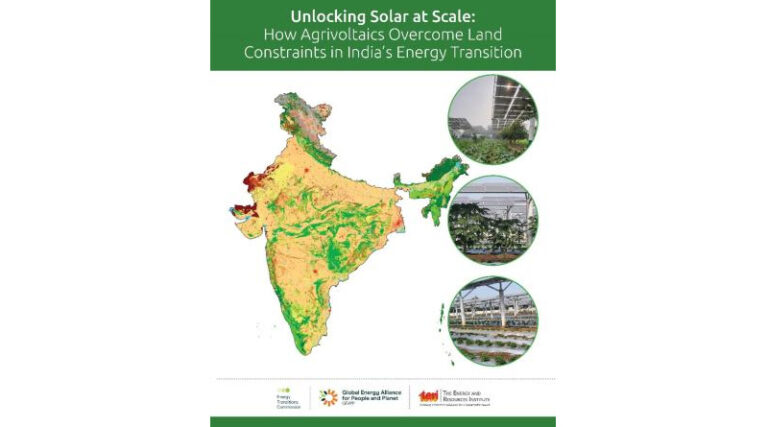
- Unlocking Solar at Scale: How Agrivoltaics Overcome Land Constraints in India’s Energy Transition
These reports offer one of the most comprehensive assessments of India’s agrivoltaic potential to date. The analyses highlight that integrating solar with agriculture can significantly ease land constraints, lower system costs, and support scalable clean energy expansion in a volatile global energy landscape.
Live Newsroom
Ms Ita Kettleborough, Director, ETC, highlighted India’s strong structural position in the global energy landscape and said, “AgriPV brings together many wins: clean power at scale, stronger farmer incomes, and protection of ecologically sensitive land, while helping communities manage heat, water stress, and global energy volatility – building the kind of energy security that no geopolitical shock can take away. It is a vivid reminder that the energy transition is not just about gigawatts, but about livelihoods and systems that are built to last and work for people. This future can be built – field by field, state by state, and partnership by partnership.”
Lord Adair Turner, Co-Chair, ETC said, “India has abundant solar resource and AgriPV offers a practical way to harness it at scale without taking land out of agricultural use. AgriPV alone could deliver up to 3 times the amount of electricity required in India in 2050. Applied globally, the potential for AgriPV is enormous, with the capacity to accelerate the energy transition at scale.”
The reports emphasize that agrivoltaics can serve as a critical lever in reducing India’s exposure to global fossil fuel volatility, particularly as geopolitical tensions disrupt traditional energy supply chains. By leveraging abundant solar resources, India can build a more self-reliant, cost-effective, and resilient power system.
Highlighting the role of AgriPV in advancing a sustainable energy–food future, Dr Vibha Dhawan, Director General, TERI, emphasised the need to view solar deployment through a broader development lens, “AgriPV represents an opportunity to move beyond the conventional approach of land competition by enabling agriculture and clean energy generation to coexist on the same land resource.” She noted that successful scaling of AgriPV will require solutions that are sensitive to local agricultural practices, farmer needs, and regional conditions, while creating pathways for improved resource efficiency, livelihood enhancement, and sustainable energy growth.
Underscoring the evidence base behind AgriPV deployment in India, Dr Arunendra Kumar Tiwari, Fellow, TERI, highlighted the importance of transitioning from theoretical potential assessments to practical implementation pathways, “The future of AgriPV in India depends on demonstrating that solar generation can be integrated with agricultural productivity through scientifically informed designs and site-specific solutions.” Dr Tiwari added that findings from land suitability assessments and pilot projects indicate significant potential for AgriPV to contribute to India’s clean energy transition, while emphasizing the need for stronger policy frameworks, financing mechanisms, and implementation models to enable large-scale adoption.
Key Insights from the TERI–ETC Analyses
The reports identify agrivoltaics as a system-level solution with multiple co-benefits:
- Addresses land constraints at scale: Enables dual-use land systems, reducing competition between energy and agriculture.
- Strengthens energy security: Expands domestic renewable generation, reducing dependence on volatile global fuel markets.
- Enhances farmer incomes: Creates diversified and stable revenue streams for rural communities.
- Builds climate resilience: Supports crop productivity under heat stress while improving microclimatic conditions.
- Enables distributed energy systems: Supports grid flexibility and decentralized power generation.
Global Agriculture is an independent international media platform covering agri-business, policy, technology, and sustainability. For editorial collaborations, thought leadership, and strategic communications, write to pr@global-agriculture.com