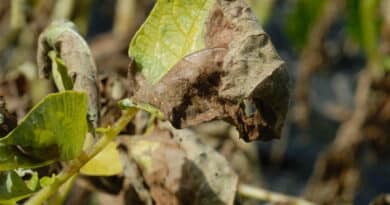
10 June 2026, UK: Scottish potato growers and agronomists need to be be aware of more aggressive blight strains and the risk of fungicide resistance developing this summer, warns Syngenta Technical Manager, Andy Cunningham.
Speaking to Scottish and Northumberland growers in the borders last week (4 June), Andy highlighted that in recent seasons the blight population strains affecting crops in Scotland have been more mixed, compared to England that is dominated by the EU_36 strain.
“Mixed populations bring their own challenges, with the increased potential to adapt and evolve, which reinforces the importance of a blight strategy that covers all the known strains,” he said.
“But Scottish growers must still remain vigilant against EU_36 developing further, since it’s highly aggressive and quick to develop. That highlights the priority to start spray programmes early and maintain them through to full senescence,” he advises. “Fortunately, it has is no known resistance to blight fungicides in the UK.”
That means making best use of the most effective fungicides throughout the season, including a strategy to fully utilise the strength and reliability of Revus, advocates Andy.
The confirmation of a single case of EU_43 blight in the UK at the end of last year, where some resistance to the CAA group of fungicides, further focusses minds on putting together highly effective blight control programmes for this season, and the future.
While previously the EU_43 strain had become a serious issue in parts of Europe, a switch there to mixing fungicide actives in each application and alternating modes of action with each spray had successfully countered the problem – as well as minimising the risk of new strains developing, he points out.
“Such measures are already seen as good practice and widely recommended by growers and agronomists.
“It’s highly positive that the UK approach of alternation and mixing blight fungicides can be very effective against new strains of blight, even those which show some levels of resistance.”
Andy reported that independent trials at Eurofins have shown the importance of keeping Revus (mandipropamid) at the forefront of any late blight programme. In those trials, using the maximum number of mandipropamid applications permissible under FRAC Guidelines, mixed with various fungicide partner combinations in a 12-spray programme, gave the best results in terms of overall blight control.
Incorporating a higher number of Revus applications into a programme, consistently delivered higher levels of blight control and green leaf area protection.
Andy’s blight advice for the 2026 season
Always apply Revus in mixture with a fungicide with a different mode of action.
Apply Revus, or other CAA fungicide, in strict alternation with a fungicide with a different mode of action.
OSBPI fungicides should not be applied in an application preceding or following a CAA.
Use up to six applications of mandipropamid, or other CAA fungicide, making up no more than 50% of the intended number of sprays.
Good mix protectant partners for Revus include: fluazinam; propamocarb; amisulbrom and cyazofamid.
Global Agriculture is an independent international media platform covering agri-business, policy, technology, and sustainability. For editorial collaborations, thought leadership, and strategic communications, write to pr@global-agriculture.com