WA Trial Finds Lime Needs Moisture to Fix Acidic Wheat Soils
25 November 2026, Merredin, AU: A multi-year field trial in Western Australia’s wheatbelt has found that lime applied deep into acidic subsoil only works when there is enough moisture present for it to chemically react, a result that could change how growers time and plan deep-liming programs. The Department of Primary Industries and Regional Development, a Western Australian state agency known as DPIRD, presented the findings on November 4 at the Soil Science Australia National Conference in Perth.
Subsoil acidity is a longstanding problem across much of WA’s sandy wheatbelt, built up over decades from the use of ammonium-based fertilizers and the removal of alkaline material in harvested grain. As soil acidity increases below the surface, aluminium already present in the soil becomes more soluble and toxic to plant roots, and it does so precisely in the deeper layers where a crop’s roots would otherwise reach stored moisture during dry spells, limiting a plant’s ability to draw on subsoil water when it is needed most.
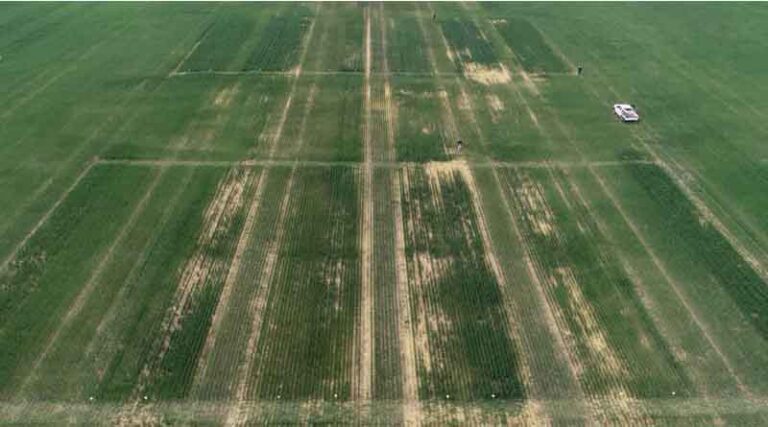
The trial, led by DPIRD research scientist Shahin Rahman as part of a five-year collaboration between DPIRD and the Grains Research and Development Corporation called the Soil Water and Nutrition program, began in 2025 at a paddock-scale site at Hines Hill, about 20 kilometers west of the town of Merredin, on deep acidic sandy soil planted to Scepter wheat. Researchers mixed lime into the soil at rates of 4, 8 and 12 tonnes per hectare, incorporated to depths of 40, 80 and 120 centimeters respectively, with an additional 2 tonnes per hectare applied at the surface. In soils like these, aluminium concentrations typically sit above 5 parts per million, a level considered toxic to the roots of most crops, and the trial measured progress against a target soil pH of 4.8, the point at which aluminium becomes substantially less available to plant roots.
Dry year masked the lime’s effect
In the trial’s first season, 2025, an unusually dry year in which subsoil moisture stayed below 4 percent, even the heaviest lime and deepest incorporation treatments barely shifted soil pH, which remained below the 4.8 target, and aluminium stayed above the toxic threshold regardless of how much lime had been applied. Earlier laboratory work by the DPIRD team had indicated that subsoil moisture needs to exceed roughly 5 percent before lime can dissolve and react with acidic soil at all, and the 2025 growing season never reached that level at depth.
The following season told a different story. In 2026, the trial site received about 210 millimeters of growing-season rainfall plus roughly 140 millimeters of summer rain, which pushed subsoil moisture up to around 7 percent. Under those wetter conditions, the same lime treatments applied at the same rates and depths brought soil pH close to the 4.8 target and reduced aluminium concentrations below the toxic threshold, even though no additional lime had been added between seasons. Rahman said the results show that lime “requires sufficient water to dissolve, react and neutralise acidic ions,” and that a dry season “may delay the impact of lime” regardless of how much product goes into the ground.
The finding carries a direct practical implication for growers and agronomists who recommend and budget for deep-liming programs, which are a significant upfront input cost given the tonnages and incorporation depths involved. Rahman said growers should now be able to “make more informed decisions when planning soil re-engineering and deep liming strategies so they get the best return on investment and yield responses,” since a program applied heading into a dry year may show little measurable benefit for a season or more through no fault of the lime rate chosen. DPIRD’s broader soil research has previously found that periodically loosening compacted, acidic subsoil and incorporating lime can raise grain yields by as much as fourfold by improving how efficiently a crop uses available water, though this specific trial’s yield outcomes were not yet available at the time of reporting. The research team said it is now waiting on the 2026 harvest results to see how the measured changes in soil chemistry translate into grain yield, with the trial set to continue for two more growing seasons.
Also Read: ADAMA Shuts Brazil Plant as Pesticide Import Tariff Fight Grows
Global Agriculture is an independent international media platform covering agri-business, policy, technology, and sustainability. For editorial collaborations, thought leadership, and strategic communications, write to pr@global-agriculture.com