Michigan State Builds Camera System to Spot Ready-to-Pick Asparagus Spears
25 November 2026, East Lansing, US: Michigan State University engineers have published a new camera-based perception system designed to help a robot tell which asparagus spears are ready to cut, a technical step toward automating one of the few major vegetable crops still harvested almost entirely by hand. The study, led by Yuzhen Lu, an assistant professor in MSU’s Department of Biosystems and Agricultural Engineering, with co-author Dongyu Liu, appeared in Computers and Electronics in Agriculture on November 20.
Asparagus has resisted mechanization longer than almost any other vegetable crop. The first attempts to build a harvesting machine date back to the early 1900s, and several prototypes developed through the mid-twentieth century were abandoned because none worked reliably enough to replace hand labor, according to MSU’s own account of the broader research program this study belongs to. The difficulty is biological as much as mechanical: spears in a single bed mature at different rates, can grow an inch in an hour on a hot day, bruise easily if handled roughly, and only a portion of a bed’s spears are actually ready for cutting on any given day. That means a harvesting machine cannot simply mow through a field; it has to make a selective, spear-by-spear judgment call the way an experienced hand-picker does.
The economic pressure behind the research is significant. Lu has estimated, based on conversations with MSU Extension specialists, that labor can account for 55 percent of the total cost of producing asparagus, a figure Jamie Clover Adams, executive director of the Michigan Asparagus Advisory Board, has called a fair reflection of the industry’s experience. Lu has also projected that growers risk losing 50 percent or more of a potential yield when fields cannot be picked selectively and thoroughly enough as spears emerge. Michigan alone produces roughly 20 million pounds of asparagus a year, according to the Michigan Ag Council.
A dual-path approach to a cluttered field
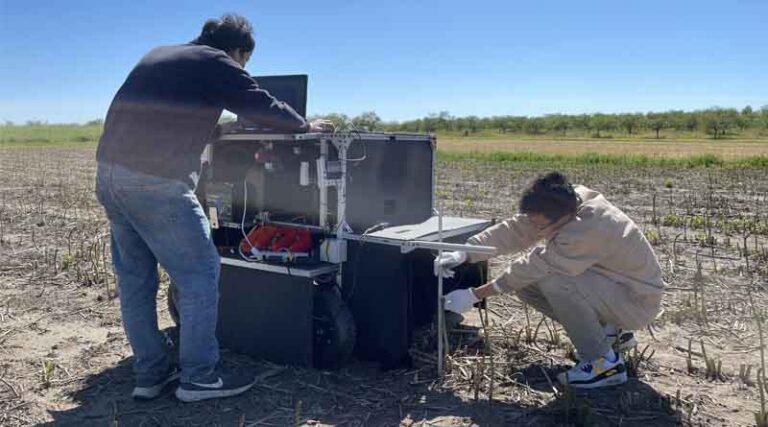
The newly published system is built around an RGB-D camera, a sensor that captures an ordinary color image alongside a depth map recording how far away each point in the scene is, giving a robot the three-dimensional information it needs to locate a spear precisely enough to cut it without damaging the plant’s crown underground. The researchers describe their detection approach as “dual-path,” meaning the system runs two complementary detection methods together rather than relying on a single model, an approach intended to make spear identification more reliable in the kind of cluttered, unevenly lit field conditions where a single detection method is more likely to miss spears or misjudge their position.
The paper also introduces what its authors call point-cloud-free measurement for estimating each spear’s height and diameter, the two traits that typically decide whether a spear is ready to harvest and what quality grade it will meet. Conventional three-dimensional vision systems usually build a full point cloud, a dense map of thousands of individual three-dimensional coordinates describing a scene’s surfaces, before they can measure an object within it, a processing step that is computationally demanding and can be too slow for a machine that needs to make cutting decisions continuously as it moves down a row. By estimating spear dimensions directly from the RGB-D camera data instead of first constructing a point cloud, the system is designed to cut that processing burden, a detail that matters commercially because any harvesting robot has to operate at a pace close to a human crew’s to be worth adopting. The paper’s publisher had not made the full study text accessible at the time of reporting, so specific detection accuracy or measurement error figures could not be confirmed; this account is based on the study’s verified bibliographic record and Lu’s publicly described research program.
The asparagus vision work began under a 197,000 dollar grant awarded in 2024 from the United States Department of Agriculture’s National Institute of Food and Agriculture, through its Hatch Multistate Research Fund and administered by MSU AgBioResearch, with funding running through 2026. Lu has worked alongside Zachary Hayden, an associate professor in MSU’s Department of Horticulture, and the team has said it is building a reference database of field images from MSU’s West Central Michigan Research and Extension Center in Hart, Michigan, to train and test the detection system under real growing conditions. A related project applies similar camera-based technology to blueberries, another Michigan specialty crop that shares asparagus’s high reliance on manual labor at harvest.
Also Read: ADAMA Shuts Brazil Plant as Pesticide Import Tariff Fight Grows
Global Agriculture is an independent international media platform covering agri-business, policy, technology, and sustainability. For editorial collaborations, thought leadership, and strategic communications, write to pr@global-agriculture.com