Why Crop Breeding Is Entering An Era Of Collaboration With AI
By Jawoo Koo, Senior Research Fellow, IFPRI, for CGIAR Digital Transformation Accelerator.
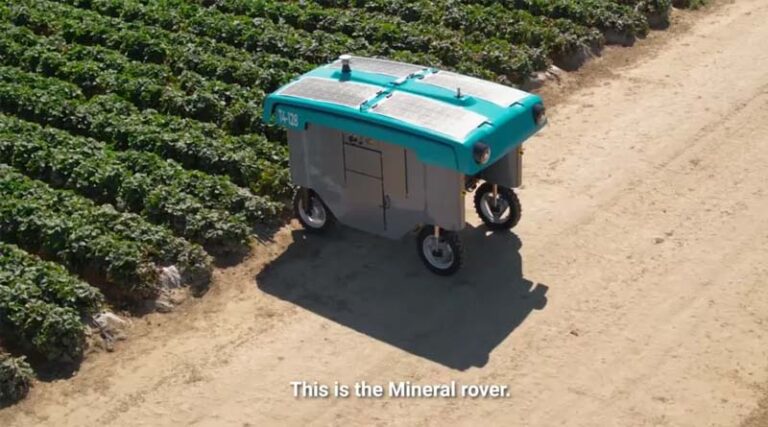
29 May 2026, Colombia: At first glance, the cover image of this op-ed might look AI-generated.
A futuristic robot moves through a breeding field, scanning plants with multiple sensors as if it came straight out of a science fiction movie. But the image is real. It was taken in Colombia, in CGIAR forage breeding plots, during one of our early experiments with the robotic phenotyping systems Mineral, developed through a partnership with Google.
Around 2022, we began testing robots like this across breeding programs to help scientists collect field data faster and more accurately. The robot was equipped with sensors designed to support breeders in measuring crop traits and identify diseases directly in the field.
This is only one experiment among many.
Over the past several years, CGIAR scientists and partners have explored a wide range of digital technologies for crop breeding, from genotyping platforms in laboratories to drone-based phenotyping systems in breeding plots. Some technologies proved too expensive. Others were difficult to adapt to local environments and breeding conditions. Not every innovation reached meaningful scale.
But the work continued.
Today, these efforts are helping us move much closer to a reality that once seemed distant: AI-accelerated crop breeding.
CGIAR, the world’s largest publicly funded agricultural research network, is home to 9,000 scientists across 90 countries, primarily in the developing world. A large share of them focuses on crop breeding: developing improved crop varieties that can better withstand climate shocks, pests, diseases, and changing market demands.
Crop breeding is one of the most powerful tools we have to fight hunger and malnutrition. But it is also a very demanding process. Releasing a new variety can take more than a decade, and much of that time is spent on phenotyping.
Phenotyping is the process of measuring plant characteristics that breeders use to make selection decisions. This work is still largely manual. Breeders walk through fields with notebooks or tablets, visually assessing plants one by one. The process is time-consuming and sometimes inconsistent across locations and seasons.
This is where AI is beginning to change the equation.
CGIAR breeding programs will soon be able to use computer vision models capable of analyzing images collected through mobile phones, drones, and robotic systems. These AI tools can rapidly extract key trait information from thousands of plots at a scale impossible through manual observation alone.
Breeders are still central to the process. Human expertise remains irreplaceable. But AI-generated measurements can complement field observations, improve data consistency, and dramatically accelerate breeding pipelines.
The implications are significant. Faster phenotyping means faster breeding decisions. Faster decisions mean faster delivery of improved varieties to farmers facing urgent climate and food security challenges.
Large language models are also opening entirely new possibilities.
In the near future, our breeding partners on the ground may be able to identify the most suitable seeds for farmers and request them simply through conversations with an AI chatbot, replacing slow and fragmented email-based processes.
We are also beginning to use AI language models to understand farmers’ needs, which informs variety development. Breeders can record conversations with farmers in local languages and use AI tools to identify patterns in preferences, challenges, and adoption barriers of improved varieties.
Partnerships enable AI advancement in breeding.
These advances are the result of partnerships between agricultural scientists, national breeding programs, governments, national research and extension systems (NARES) and technology organizations. Collaborations with technical partners like Google have provided access to state-of-the-art AI infrastructure. Support through initiatives backed by the UK Government helps our scientists apply AI models to predict phenotypes directly from genotypes.
Also, importantly, our partnerships with national breeding programs aim to strengthen their research and operational capacities. We provide enabling data platforms and infrastructure to collaborate on research and standardized data so that we can advance together using AI tools.
Shifting paradigm from “AI for Breeding” to “Breeding with AI”
So far, most conversations have focused on “AI for breeding” – using AI systems to improve breeding efficiency. And fundamentally, this remains the goal: AI should enhance and accelerate breeding processes.
AI tools are increasingly becoming adapted to real breeding workflows. This democratization of AI may ultimately become one of the biggest accelerators of agricultural innovation. However, to reach this goal faster, we should be ready to make changes on both sides.
There are specific situations where operational adjustments may help AI systems perform better. For example, in certain disease screening trials or specialized phenotyping experiments, modifying planting arrangements or field layouts could improve image quality and reduce errors in AI-based measurements. Similarly, at another conference recently, plant phenomics researchers discussed canopy shape traits that improve harvesting efficiency by robots.
The long-term vision for AI in breeding could go far beyond digitizing existing workflows or measuring manual traits faster and more accurately.
Another opportunity may lie in enabling entirely new forms of collaboration. AI systems could help breeders connect information across data domains that remain separate, linking genomics, phenotyping, environmental conditions, farmer feedback, market signals, and operational data in ways that humans alone struggle to synthesize.
Expertise developed in one region of the world could be transferred and adapted to support breeding decisions elsewhere. Lessons from one environment or production system could inform another through AI-assisted analysis and knowledge exchange.
In this sense, the two sciences should progress in synergy, in practical and scientifically meaningful ways.
There is still much research needed: realizing the ambitious goal of AI-accelerated breeding will require openness to experimentation, exploring new technical options, adapting AI tools to local conditions, and, where possible and appropriate, reconsidering aspects of breeding protocols or field design that may limit the potential of AI-assisted approaches.
The earlier these collaborations begin, the faster we can unlock the full potential of AI to accelerate breeding at the scale and speed required to address global challenges.
Also Read: China’s Fertilizer Trade Sees Strong Export Growth in Jan–April 2026, Potash Imports Remain Critical
Global Agriculture is an independent international media platform covering agri-business, policy, technology, and sustainability. For editorial collaborations, thought leadership, and strategic communications, write to pr@global-agriculture.com