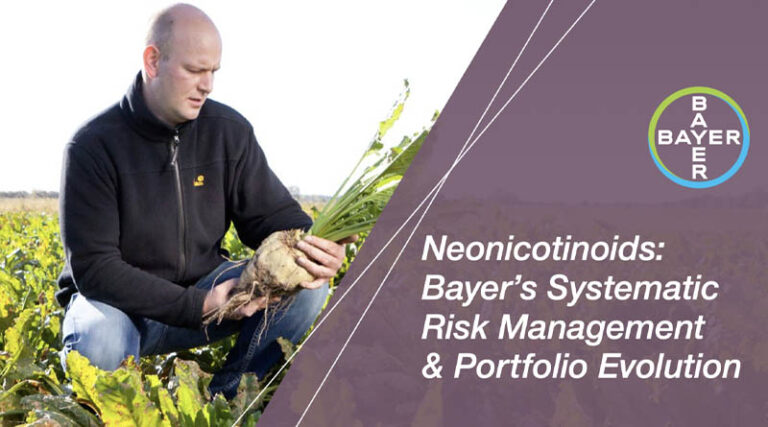
16 May 2026, Leverkusen: Bayer has released the sixth edition of its report titled “Neonicotinoids: Bayer’s Systematic Risk Management & Portfolio Evolution,” outlining the company’s position on pollinator safety, stewardship practices, regulatory developments and the continuing agricultural importance of neonicotinoid insecticides.
The 2026 report comes at a time when neonicotinoids continue to face scrutiny in several markets, particularly in Europe, while remaining widely used in countries such as India, Brazil, the United States, Canada and Australia. Bayer stated that the updated report reflects recent developments and removes outdated information from earlier editions.
According to the report, neonicotinoids introduced in the 1990s brought a new mode of action for pest control and supported the shift toward seed treatment-based crop protection systems. Bayer said these products helped reduce reliance on older insecticides and enabled more targeted applications with lower environmental exposure.
The company’s neonicotinoid portfolio includes imidacloprid, clothianidin, thiacloprid and acetamiprid. Bayer differentiates between nitro-substituted neonicotinoids such as imidacloprid and clothianidin, and cyano-substituted products including thiacloprid and acetamiprid, which the company says have comparatively low toxicity to bees.
A major focus of the report is the mitigation of risks to pollinators, particularly after incidents in Europe in 2008 where dust released from treated corn seed during planting affected bee colonies in Germany’s Upper Rhine Valley. Bayer said those events triggered internal reviews, new stewardship measures and modifications in research and development processes.
The report details several mitigation approaches developed over the last decade. These include the adoption of the Heubach test to measure dust abrasion from treated seed, advanced polymer seed coatings, planter box lubricants and the use of deflectors on sowing equipment to direct dust into the soil. Bayer stated that improved seed coatings can reduce dust emissions by up to 95%, while deflectors can lower airborne emissions by up to 90%.
Bayer also highlighted the expansion of seed treatment certification systems such as the European Seed Treatment Assurance (ESTA) scheme and similar standards in Canada and other regions. The company noted that stewardship and training programs now operate across Europe, North America, Latin America, Africa and Asia-Pacific markets, including India.
The report places significant emphasis on label-based mitigation measures for foliar applications. Bayer said nitro-substituted neonicotinoids should not be applied on bee-attractive crops during flowering and stressed the need to avoid spraying flowering weeds. Updated labels now include pollinator safety warnings, guidance on minimizing seed-treatment dust emissions and resistance management information.
On research investments, Bayer mentioned that it has funded more than 50 pollinator-related collaborations globally over the past decade, including the Healthy Hives and Salud Apícola initiatives. The company reported investments exceeding $4.5 million in bee health and pollinator programs. In 2023, Bayer also entered a research partnership with the Free University of Berlin to study sublethal effects of insecticides on honeybees using digital technologies.
The report further notes that Bayer has integrated pollinator toxicity screening earlier into its product development pipeline. According to the company, novel compounds are now assessed for toxicity to bees and other non-target organisms at an earlier stage to support pollinator-safe product development.
Safe-use training remains a major component of its stewardship approach. The company said it reached approximately 4.1 million external stakeholders worldwide in 2025 through safe-use programs, including around 3.4 million smallholder farmers.
The report also outlines Bayer’s internal adverse incident reporting platform, CAIRnew, which is used to document and analyse product-related incidents globally. Bayer said the system supports product stewardship and helps identify areas requiring additional mitigation or training.
On the agronomic side, Bayer argues that neonicotinoids continue to play a significant role in pest management for crops such as corn, soybean, canola, cotton, cereals, potatoes and sugar beet. The company cited a 2015 North American study estimating that neonicotinoid seed treatments generate more than $1.4 billion in value for farmers and contribute to measurable yield gains across crops.
The report also references experiences in Europe following restrictions on neonicotinoid use. Bayer said some farmers reduced or abandoned cultivation of crops such as oilseed rape due to pest pressure and limited alternatives. It also cited yield losses in French sugar beet production linked to beet yellow virus outbreaks after restrictions on neonicotinoid seed treatments.
Regarding the regulatory landscape, Bayer noted that neonicotinoids remain registered in more than 80 countries. The company highlighted that India completed a nine-year review between 2013 and 2022 and continued to allow the use of six neonicotinoids — clothianidin, thiamethoxam, imidacloprid, dinotefuran, acetamiprid and thiacloprid — with the caution statement “Do not spray on flowering stage of crop” included on labels.
At the same time, the report documents tightening restrictions in the European Union, including reduced maximum residue levels (MRLs) for certain neonicotinoids and limitations on emergency authorizations after a 2023 European Court of Justice ruling.
Beyond neonicotinoids, Bayer said it is investing in integrated pest management (IPM), precision agriculture and digital farming systems. The company highlighted FieldView™ and partnerships around water-efficient farming technologies as part of its broader sustainability strategy.
Global Agriculture is an independent international media platform covering agri-business, policy, technology, and sustainability. For editorial collaborations, thought leadership, and strategic communications, write to pr@global-agriculture.com