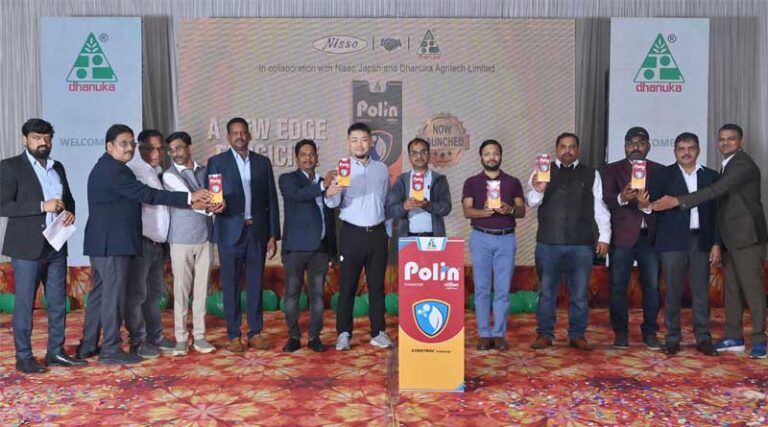
Dhanuka Agritech Rolls Out Polin Fungicide With Nippon Soda for Rice Blast Control in India
25 September 2026, New Delhi: Dhanuka Agritech Limited has announced the commercial rollout of Polin, a new fungicide for paddy developed through its technical collaboration with Japan’s Nippon Soda Co. Ltd. (NISSO), targeting Leaf and Neck Blast disease of rice. The launch follows an initial disclosure to the Bombay Stock Exchange on September 22, 2026, with the fuller commercial and technical details released this week.
Dhanuka describes Polin as powered by what it calls Kiniprol Technology, introducing a mode of action the company labels DHODHI and classifies under Fungicide Resistance Action Committee (FRAC) Group 52, a comparatively new site of action in commercial fungicides. FRAC Group 52 compounds work by inhibiting dihydroorotate dehydrogenase, an enzyme fungal pathogens need to synthesize the pyrimidine building blocks of DNA and RNA; blocking it stops the pathogen from growing and reproducing.
The Kiniprol name closely tracks Kinoprol, the brand under which the US EPA registered a Nippon Soda DHODH-inhibitor fungicide, ipflufenoquin, in 2022 for use on pome fruit and almonds, with blast listed among the diseases it controls, indicating Polin likely draws on the same or a closely related Nippon Soda compound adapted for the Indian rice market.
The formulation carries dual translaminar and systemic mobility, meaning it moves through crop tissue to reach leaf areas that were not directly sprayed as well as newly emerging growth, extending the protection window. Dhanuka recommends a dose of 100 ml per acre in 200 liters of water, applied at the first sign of infection during critical crop growth stages, and says the extended residual activity allows growers to reduce their overall number of fungicide sprays, cutting both labor and chemical costs.
Polin has been launched in parts of Karnataka and Andhra Pradesh, where Dhanuka says it has also begun farmer awareness drives on managing Leaf and Neck Blast, rather than a simultaneous nationwide rollout.
Rahul Dhanuka, Managing Director of Dhanuka Agritech, said the company was bringing “patented Japanese chemistry with a completely new mode of action for control of rice blast” to Indian growers, offering what he described as deeper and more durable protection that cuts down on repeat spraying costs. He added that the company plans to launch further new products in the coming months, without giving specifics.
The launch extends a long-standing partnership between the two companies. Dhanuka’s list of technology collaborators names Nippon Soda alongside earlier jointly developed products such as Nissodium and Zanet, part of a wider pattern in which Japanese agrochemical innovators rely on Indian formulators and distribution networks to reach the country’s fragmented retail base.
New modes of action matter more than usual in Indian rice fungicide markets right now. Blast, caused by the fungus Pyricularia oryzae (also known as Magnaporthe oryzae), is notorious for developing resistance to widely used chemistries such as strobilurins (FRAC Group 11) and triazoles (Group 3) after repeated seasons of exclusive use, a particular concern in intensively rice-cropped states. Introducing a fungicide with a distinct site of action gives growers and resistance-management programs another tool to rotate into spray schedules, reducing selection pressure on any single chemistry class.
Also Read: India Approves Pioxaniliprole, First Insecticide Active Ingredient Discovered in India
Global Agriculture is an independent international media platform covering agri-business, policy, technology, and sustainability. For editorial collaborations, thought leadership, and strategic communications, write to pr@global-agriculture.com