India Left Behind in Agrochemical Innovation Due to No Data Protection: CropLife India
24 April 2026, New Delhi: India is missing access to newer agrochemical technologies because it still lacks a regulatory data protection framework, according to CropLife India. The industry body says this policy gap has delayed innovation and kept farmers dependent on older molecules introduced decades ago.
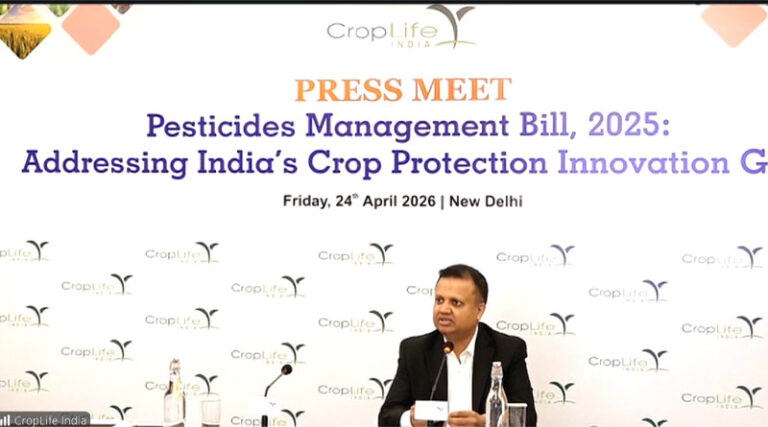
Speaking during an interaction, Ankur Aggarwal, Chairman of CropLife India and Executive Chairman & Managing Director of Crystal Crop Protection Ltd., said no major new agrochemical innovations are coming to India because there are no data protection measures. He said the industry has been seeking such provisions for the last few years.
Aggarwal added that data protection would also strengthen product stewardship by enabling companies to invest more confidently in farmer training, safe use practices and lifecycle management.
Farmers Still Using Older Chemistries
CropLife India said many of the 338 molecules currently registered in India were introduced three to four decades ago. At a time of rising pest resistance, changing pest behaviour and climate pressures, farmers continue to rely on older chemistries.
The association mentioned that China offers six years of data protection after first registration, while the European Union, Brazil and the United States provide 10 years. India has no comparable statutory framework.
According to CropLife India, launching a new molecule requires major investment in safety, efficacy, residue and environmental data. Without protection for that data, innovators struggle to recover costs, reducing incentives to launch new technologies early in India. CropLife India has recommended a limited, time-bound Regulatory Data Protection framework of about five years from first registration for new molecules and new uses.
Aggarwal said Indian agriculture cannot be expected to meet modern pest challenges and export standards with older chemistries alone. He said the proposed Pesticide Management Bill 2025 should create a science-based, time-bound pathway for newer and safer crop protection technologies to reach farmers faster.
Exports and Farmer Safety
CropLife India said dependence on older molecules can accelerate resistance, increase spray intensity and make it harder to meet stricter residue norms in export markets. It cited concerns from Assam that nearly 40 million kilograms of premium tea exports to Europe and the UK are exposed to tighter residue requirements.
The association said access to newer and more targeted crop protection tools would help Indian farmers improve productivity while supporting export competitiveness in markets with tightening residue standards.
Support for Pesticides Management Bill 2025
On the Draft Pesticides Management Bill, 2025, Aggarwal said the government’s effort to modernise pesticide regulation is timely. He welcomed provisions such as digitisation and stronger action against fake and spurious products.
He said stricter penalties for fake pesticides are in line with expectations and would help farmers receive quality products. He added that accredited laboratories are equipped, but effective implementation will require close coordination between government and industry.
CropLife India also mentioned continued recognition of accredited laboratories, including qualified private laboratories, subject to safeguards against conflicts of interest. It recommended periodic third-party audits of testing laboratories by agencies designated by the Central Government.
Other Recommendations
CropLife India has sought explicit regulation of online pesticide sales, including verification of licensed sellers, valid Principal Certificates, traceability, territorial compliance, digital transaction records and notice-and-takedown obligations for platforms. It has proposed a dedicated e-commerce chapter in the Bill.
The association also recommended that liability should rest with nominated persons responsible for a specific facility or branch, rather than directors with no operational role. It also called for a decriminalisation framework that separates minor procedural lapses from wilful violations, with a rectification mechanism before penalties are imposed.
On emergency prohibition provisions, the association said the draft allows provisional prohibition for one year, extendable by 180 days, with restrictions continuing until a final decision. It warned this could become a de facto long-term ban without conclusive scientific findings. CropLife India has recommended limiting the emergency period to 60–120 days, followed by mandatory scientific review.
It further said decisions on review, restriction or prohibition of pesticides should remain based on structured scientific evaluation, expert inputs and defined timelines, including independent expert review for molecule-level decisions.
Also Read: Amazon Signs Deal with Bayer-Backed The Good Rice Alliance, Commits to 685,000+ Carbon Credits
Global Agriculture is an independent international media platform covering agri-business, policy, technology, and sustainability. For editorial collaborations, thought leadership, and strategic communications, write to pr@global-agriculture.com