Agricultural Output in OECD Countries Rises Over 30% Since 1990 as Environmental Trends Remain Mixed
16 May 2026, London: Agricultural production across member countries of the Organisation for Economic Co-operation and Developmentincreased by more than 30% between 1990 and 2023, even as agricultural land area declined, according to the 2026 update of the OECD’s report on the environmental performance of agriculture.
The OECD includes 38 member countries comprising major agricultural economies from North America, Europe, Asia-Pacific and Latin America. These countries include the United States, Canada, Mexico, the United Kingdom, France, Germany, Italy, Spain, the Netherlands, Australia, New Zealand, Japan, South Korea, Türkiye, Colombia, Chile, Costa Rica and others.
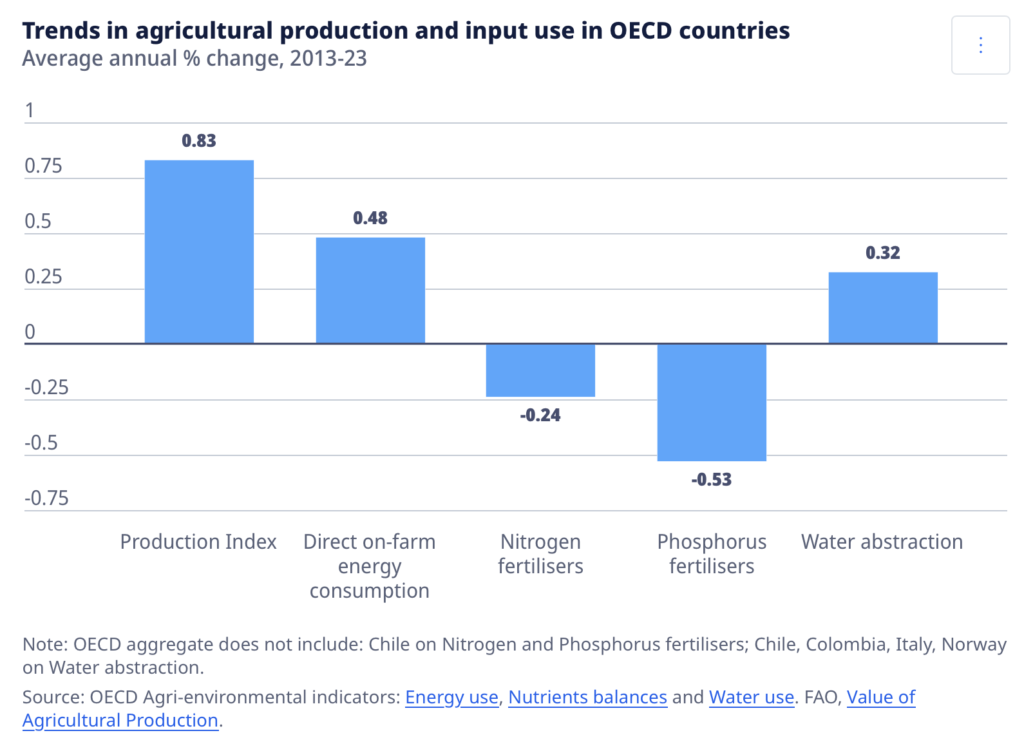
The report noted that since 2013, agricultural production in OECD countries has grown faster than the use of key inputs such as energy, freshwater and fertilisers. The trend indicates relative decoupling between agricultural growth and environmental pressures linked to production inputs.
Data from the report showed improvements in several environmental indicators over the last decade. Nitrogen and phosphorus balances, along with agricultural ammonia emissions, declined in absolute terms. These indicators are closely linked to fertiliser use and nutrient management in farming systems.
However, the OECD cautioned that recent improvements in nutrient balances may partly reflect fertiliser price increases seen since 2021, which reduced fertiliser use in several countries. The organisation indicated that these gains may not necessarily continue over the long term if input use rises again.
Agricultural greenhouse gas emissions across OECD countries remained broadly stable between 1990 and 2023 despite higher agricultural production levels. This means emissions intensity per unit of production declined, although total emissions did not record significant reductions. The report also observed that the pace of improvement in emissions efficiency has slowed compared to the 2000s.
The report highlighted farmland biodiversity as an area of concern. Indicators tracking biodiversity trends in agricultural landscapes showed continued deterioration in many OECD countries reporting data. The OECD linked this trend to agricultural intensification, habitat loss and changes in land use patterns.
According to the report, the data suggests that agriculture in OECD member countries is becoming more efficient in the use of environmentally sensitive inputs. At the same time, some environmental indicators, particularly biodiversity, continue to deteriorate, while progress in other areas is slowing.
The OECD stated that achieving sustained improvements in agricultural environmental performance will require stronger and more targeted policy measures aimed at reducing environmental pressures while maintaining productive and resilient food systems.
Also Read: UPL Limited FY26 Revenue Climbs 11% to ₹51,839 Crore, Advanta Surges 23% YoY
Global Agriculture is an independent international media platform covering agri-business, policy, technology, and sustainability. For editorial collaborations, thought leadership, and strategic communications, write to pr@global-agriculture.com