Challenging The Status Quo For Positive Change At Cranmore Park
28 March 2026, AU: A broad world view and an understanding of the supply chain help Western Australian growers Tracy and Kristin Lefroy target continuous improvement in their farming operations and premium markets for their crops.
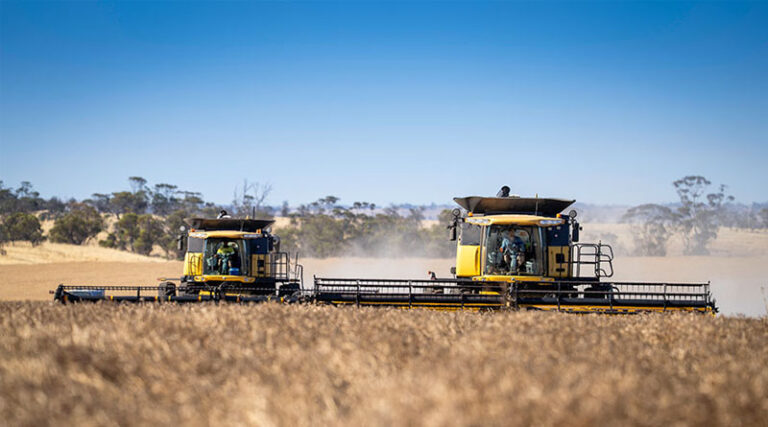
With eyes firmly on the big picture and international supply chains, Tracy and Kristin Lefroy have transformed farming operations at Cranmore Park at Bindi Bindi near Moora, Western Australia, over the past 20 years.
When the couple took over management of Kristin’s family’s farm, it was all livestock. Today, they crop 5,000 ha – or 70% of their total farm operations.
The Lefroys have been early adopters of new technologies, including automation and networked farm systems. And their farm philosophy is to continually interrogate their farm decisions, even when things are going well, to improve farm viability.
“We realised early on that we didn’t want to do things on the farm because ‘that’s the way we’ve always done it’. It was a real turning point in how we approached our farming business. It’s very easy to get complacent and almost habitual in the way that you choose to operate. And that’s not how we want to farm,” explains Tracy.
“I’m a fourth-generation farmer and Kristin is a fifth-generation farmer. We have an intergenerational legacy that recognises farming as a privilege, and we’re proud to produce food and fibre for the world.
“But farming is also a business that needs to be profitable and sustainable, making the most efficient and effective use of the resources that we have.”
Transition to cropping
The transition to cropping was one of their first decisions in pursuit of more viable farming systems. Tracy had been helping to manage her family’s cropping operation 200 km north-east, at Irwin, before they married.
Their decision was also based on the success of long-established no-till practices in WA, which they knew would allow them to achieve reliable harvests despite an average annual rainfall at Bindi Bindi of just 400 mm.
“No-till allowed a lot of people to make the switch to cropping in marginal areas. And over the past 20 years, crop genetics has also improved enormously,” says Tracy.
The varieties we now have at our disposal are far and above what we had even as recently as 10 years ago, and the agronomic packages to support those improved crop varieties have also improved greatly.
A typical cropping program at Cranmore Park is about 800 ha of oats and oaten export hay, 1,500 ha of wheat, 1,500 ha of barley, 1,200 ha of canola, with 200 ha of lupins for livestock feed. Wheat yields average 3.5 t/ha, barley 4 t/ha, canola 1.8 t/ha and hay 7.5 t/ha. The Lefroys expect to reduce the area planted to lupins as they have reduced their sheep numbers and will need less feed.
They planted 50 ha of lentils for the first time in 2025 to help with soil nitrogen fixation and as a break crop. Chickpeas and field peas are other options they’re considering, with a long-term goal of 20% pulses in rotations.
Keen to better understand the breeding process and contribute a grower’s perspective, Tracy has been a non-executive director of the cereal plant breeding company InterGrain since 2023.
Delivering despite the season
“Vixen and Ninja wheats have been really reliable for us. The grain quality has been very good, despite the varying seasons. Having that flexibility within a variety to cope with a really good season and a really poor season is invaluable, particularly as we find our climate is getting more erratic,” Tracy says.
Both wheats are suited to the noodle market, where premiums are available if the grain meets the quality standards. From the “best ever” season in 2022, they went to one of the worst in 2023 (245 mm total) and 2024 (347 mm total with no rain after August). In both years, the wheats achieved noodle grade and average yields of around 3.5 t/ha.
In 2025, yields were looking “exceptional” prior to harvest, following a late, wet start to the season. A soft finish has made all the difference.
Varieties target premium markets
Tracy says they grow the best wheat they can, targeting the premium Japanese noodle market.
As chair of the Grain Industry Association of Western Australian (GIWA), she has regular contact with the Japanese Ministry of Agriculture Forestry and Fisheries, which has helped her understand the Japanese market requirements.
Other crops the Lefroys grow are also aimed at export and premium markets. This includes the malting barley Maximus CL and GM canola, which is certified for European markets. Yallara has been the preferred oat variety so far for producing both grain and hay for export.
“We are always monitoring closely not just the quality of our grain, but also where it ends up. So when China had tariffs on barley, the barley industry did well by diversifying its end point markets.
“While we always sell to the highest bidder, it’s important that we retain that diversification in our markets for our premium malt barley. That allows us to pivot if there are unexpected geopolitical changes and send our high-quality barley into a market that understands it’s a premium product and can make the most of that quality.”
Expanded perspectives
Tracy says she loves to understand the supply chain and how what they grow in the paddock makes it to someone’s dinner table.
This desire to understand the bigger picture was fostered early in her career through a Nuffield Scholarship in 2005, sponsored by CBH. Visiting diverse agricultural businesses in Europe, Canada, China, New Zealand and the UK as part of the scholarship helped to broaden her world view.
“I went from a farm in Irwin, WA, to seeing agriculture around the world. And I think the broader you can make your worldview, the deeper your understanding of different issues can be. My topic was environmental credentials, which is still applicable. And my learnings through that experience have certainly given me the courage to step off the farm and into industry roles.”
Like Tracy, Kristin has continued to build his skills, with industry study tours to the Middle East, including one with CBH. He has a Master of Accounting degree and has also completed Rabobank’s Executive Development for Primary Producers Program.
The value of industry involvement
Both are members of GIWA and their local Moora Miling Pasture Improvement Group.
“We have this thirst to continue learning, through formal qualifications, travel, industry involvement and networking,” Tracy says.
“We are always looking for ways to upskill and diversify our business. Like other growers, we need to be increasingly nimble and responsive.
“I spend a lot of time thinking about how farming, community and industry intersect – and how we shape our own future rather than having it shaped for us. That is why I choose to engage in off-farm roles such as the GrainGrowers western region National Policy Group and, more recently, the National Farmers’ Federation’s Sustainable Development and Climate Change Committee.
“Understanding ‘how the sausage is made’ with regard to policy that impacts ag and broader considerations guides the decisions we make on-farm.”
Agronomic practices
Tracy says the malting barley and the GM canola are chosen for their herbicide resistance and yields as part of the farm’s weed control program. It allows them to use a broader spectrum of herbicides, which is an important factor in their crop rotations, reducing herbicide resistance and keeping weed populations low.
When it comes to soils, the Lefroys have had a liming program in place for 30 years, started by Kristin’s father, Bruce, which has been integrated into no-till cropping practices.
“Our soils are slightly acidic, and we find that if we can get our soil pH to a more neutral range, crops are better able to use fertiliser. It improves our fertiliser efficiency, and the soil is healthier, with more microbial activity,” says Tracy. “We also do comprehensive soil tests each year analysing nutrient status.”
Technology and new opportunities
The Lefroys undertake extensive monitoring with a meshed internet network that connects a wide range of sensors, farm equipment, weather stations and even a staff safety tracking system. The extensive data collected allows them to constantly assess the results of previous years’ decisions to inform the season ahead.
Tracy says providing on-farm connectivity through the meshed networks has helped to improve data gathering and farm efficiencies, although it can’t entirely overcome the poor internet and mobile phone coverage in the region.
“These are essential enabling technologies and the lack of connectivity is an ongoing issue that urgently needs addressing to ensure the agricultural sector is as productive, efficient and competitive as possible.”
The whole farm has been mapped, setting GPS boundaries that will allow the Lefroys to move towards autonomous vehicles as part of future plans.
They are also part of a 10-member group of landowners in their region who are looking at opportunities to diversify their business income and improve their resilience with “income that is not reliant on rainfall”.
Tracy says this grower joint-venture is investigating green energy options, particularly windfarms.
“Again, it’s about growers being nimble and trying to understand a new industry that is coming to our region, and how our communities and we can be part of that,” she says.
Also Read: MIT-WPU Researchers Develop AI Models to Boost Oil Recovery Amid Global Energy Volatility
Global Agriculture is an independent international media platform covering agri-business, policy, technology, and sustainability. For editorial collaborations, thought leadership, and strategic communications, write to pr@global-agriculture.com