Inoculating Prior Cereal Crops To Improve Dry-sown Legumes
29 October 2026, AU: Researchers are exploring ‘head-start inoculation’ on barley the year prior to dry-sown vetch. Early results are showing promise, with vetch developing substantially larger nodules than vetch following non-inoculated barley.
Dry sowing has become a standard and essential practice for many growers, but when it comes to dry sowing legumes, the strategy has its challenges. As rhizobia bacteria-inoculated seeds need cool, wet soil conditions for the bacteria to thrive, dry sowing options are limited.
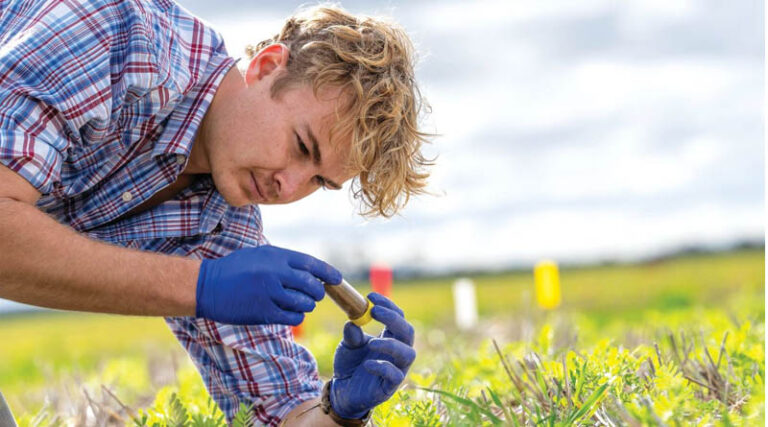
To overcome this challenge, Murdoch University honours student Jake Taylor, based within the Legume and Rhizobium Science (LRS) research group, has been investigating inoculation strategies.
He believes he has found a way to enable growers to sow legumes into dry soils while ensuring good nodulation. As part of a GRDC co-investment with the Western Australian Agricultural Research Collaboration (WAARC), Mr Taylor’s honours project has trialled a technique that builds up the rhizobia population in the soil by inoculating a non-legume crop grown in the season prior to the legume. The technique is termed ‘head-start inoculation’.
Head-start inoculation on barley shows promise
Barley seeds were inoculated with WSM4643 – a rhizobium strain for inoculant Group E (lentils, field peas, vetch). This was released in 2024 with improved tolerance to low soil pH and dry soil conditions. Mr Taylor set up a field trial in 2024 at Lake Grace, Western Australia, to see how the inoculated barley seeds sown into moist soil would help the following season’s 2025 vetch crop with nodulation.
“We’ve had some interesting results so far. From genetic analysis we were able to confirm that the significantly larger nodules on the vetch contained the WSM4643 strain that we applied to the barley seed,” Mr Taylor says.
“Meanwhile, the uninoculated barley and the nodules on the following season’s vetch were a lot smaller and contained a strain that I couldn’t match to anything in the genetic database. That’s why researchers ask growers to regularly inoculate with the best up-to-date commercial strains.”
Doubling inoculant leads to sixfold population increase
Mr Taylor says further to assessing the nodules, the research looked at the population of rhizobia in the soil – which is rarely studied due to the associated lengthy and complex evaluation process.
“We looked at doubling and halving the commercial rate of the inoculant on the barley seed and found that by doubling the rate, we saw up to sixfold increases in the rhizobia population in the soil compared with the standard commercial rate,” he says.
“Doubling the rate is quite common practice these days in any case, as it can help ensure the right colonisation from the bacteria, particularly in drier conditions, but this work shows that a double rate doesn’t just lead to a double difference – it can be much higher.
“We wondered whether the root system of the barley was going to host the WSM4643 strain, and it actually supported it – with the population around the root system about 45 times higher than in normal soil. This information should give confidence to use barley for this strategy.”
Mr Taylor says the findings from his research have the potential to be another tool to improve dry sowing legumes, as well as opening the possibility of growing more legumes in low pH soils.
“Previously, a lot of farmers wouldn’t grow field pea in very low pH soils, as the rhizobia can’t cope with it and the field pea would struggle to nodulate. But now with the new Group E inoculant, you can go down to pH 5 or just under and it survives well. This can create new opportunities to diversify with other legumes,” he says.
Mr Taylor says the research will continue to evaluate nodulation as well as measure nitrogen composition of the plant and seed yield.
Validating the technique for growers
Dr Ron Yates, Mr Taylor’s supervisor and Principal Research Scientist at the WA Department of Primary Industries and Regional Development (WA DPIRD) and Murdoch University, says this study is part of a larger program that aims to validate the head-start inoculation technique.
“We want to be able to recommend it to growers with scientific backing,” Dr Yates says.
“The technique also provides options to use coatings on the legume seed, such as pesticides, which are mostly toxic when establishing with a rhizobia slurry with live cells.
At the end of the day, we want growers to seriously contribute to growing their own nitrogen by biological nitrogen fixation. I believe any approaches where we can lower risk in farm production, like reducing synthetic nitrogen inputs, is a good initiative.
Legume options for biological nitrogen fixation
This study is part of the GRDC and WAARC co-supported ‘Harvestable annual legume options’ (HALO) project, which brings together expertise of Murdoch University, WA DPIRD and CSIRO.
Set to finish in 2027, the project has delivered 4 new harvestable annual legume cultivar options, and a further 3 cultivars are in advanced stages of development. As project leader of HALO, Dr Yates is proud to see the new options offer growers more flexibility in decision-making, enhance biological nitrogen fixation and increase yields and quality of following crops.
“We all know there is an increased reliance on synthetic nitrogen, but this is exposing Australian growers to risk of rising costs and sometimes lack of supply, and there are future implications for on-farm carbon emission assessments,” he says.
“HALO has provided an improved choice of low-cost legumes that tolerate a drying climate and are adapted to a range of soil types – some of which are particularly challenging – which can help enhance biological nitrogen fixation and reduce fertiliser nitrogen inputs.”
Dr Yates says the aerial-seeded species can be harvested and multiplied inexpensively and can be reliably sown dry in summer or autumn to exploit early seasonal breaks. He says this highlights the importance of head-start inoculation and why researchers explored other ways of achieving successful nodulation when establishing legumes in dry soil.
Also Read: India Tops $4.39 Billion Emerging-Market AgTech Funding
Global Agriculture is an independent international media platform covering agri-business, policy, technology, and sustainability. For editorial collaborations, thought leadership, and strategic communications, write to pr@global-agriculture.com