01 September 2026, AU: Independent analyst from Global AgriTrends Simon Quilty outlines the potential implications of President Trump’s proposed temporary removal of US ground beef import duties, and what it could mean for Australian cattle producers.
President Trump announced last week that all ground beef duties would be removed. This provision would last 90 days and would allocate 300,000 metric tonnes (mt) of beef access under the policy.
The purpose is to lower the cost of ground beef to consumers by 25 per cent, and President Trump said he would hold retailers accountable. His statement offers little detail on how he would achieve this.
Since the announcement, there has been strong backlash across America from farmer groups, including the National Cattlemen’s Beef Association, which argue that lower tariffs will lower the price of domestic beef and, therefore, domestic US cattle prices, and in fact would therefore delay the US herd rebuild. They argue this policy will achieve the opposite of its intention and slow the rebuild, stating that higher cattle prices are needed to incentivise cattle producers, not lower prices.
When assessing which import countries would benefit from a reduction in tariffs, Brazil is the only country with any real opportunity to benefit from this policy. They currently face a 26.4 per cent duty on beef imports.
The table below shows the percentage of beef quotas and volume remaining in Argentina, Australia, New Zealand, Uruguay and others based on year to 24 August 2026. Source: GlobalAgritrends.
As shown in the table above, Australia, New Zealand, Uruguay, and Argentina are on track to fill this year’s quota allocation, but it is likely to be in October and November.
The impact will be minimal, as all countries will ship into the next quota year.
Argentina has an additional 20,000 mt to be allocated in Q4. Australia has an additional allocation if it does not reach 378,214 mt by 1 October, for a total access of 449,909 mt for this calendar year.
The real concern for Australia is the ongoing super-saturation of the US imported lean trim market by Brazil.
Since October 2025, Brazil has shipped 255,787 mt, of which 52,000 was duty-free. So, close to 204,000 mt has entered under a 26.4 per cent duty. As a result, imported Brazilian prices in the US have been dragged down by the excess volume of Brazilian lean beef and unfortunately Australian lean beef has been dragged down with it.
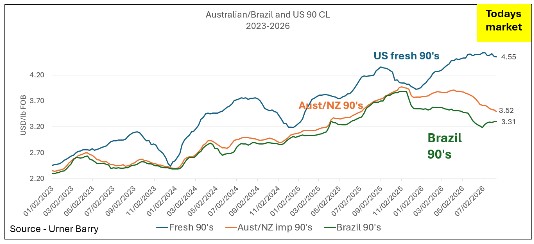
Interestingly, US fresh 90CL (meat trim that is 90 per cent lean meat) has jumped 7 US cents/lb (22 ac/kg) overnight, reflecting the ‘hand-to-mouth’ buying at the moment and the peak in demand for the grilling season.
This graph shows comparison between US, Brazil and Australia/New Zealand 90CL meat between 2023 and 2026. Source: Urner Barry and Global AgriTrends.
The next three months traditionally see US demand for ground beef fall, and it’s not until Thanksgiving and the Christmas period that demand picks up. Fresh 50CL (trimmings of 50 per cent lean meat) is likely to fall by 50 per cent.
Ironically, ground beef might fall 25 per cent on its own without the removal of tariffs on Brazilian beef, due to fresh 50CL falling in value and seasonally low demand. Removing tariffs on Brazil will add more lean beef to an already saturated market, with little short-term effect, but it could delay any price recovery in 2027 by several months.
I expect it could dampen the impact on cow prices in Australia, which are expected to rise, but at a slower pace and with little impact on most other categories.
Global Agriculture is an independent international media platform covering agri-business, policy, technology, and sustainability. For editorial collaborations, thought leadership, and strategic communications, write to pr@global-agriculture.com