23 June 2026, AU: Grain growers are urged to maintain mouse monitoring throughout winter and, if required, consider additional baiting ahead of the spring breeding season.
Western Australian growers are being urged to maintain mouse monitoring throughout winter and into spring as serious outbreaks are threatening the 2026 crop’s yield and quality.
As early as April, growers in the north and south of WA were reporting 3,000 to 4,000 burrows per hectare, equating to 6,000 to 8,000 mice per hectare. Crop damage and economic losses are generally anticipated when levels reach 200 to 300 mice per hectare.
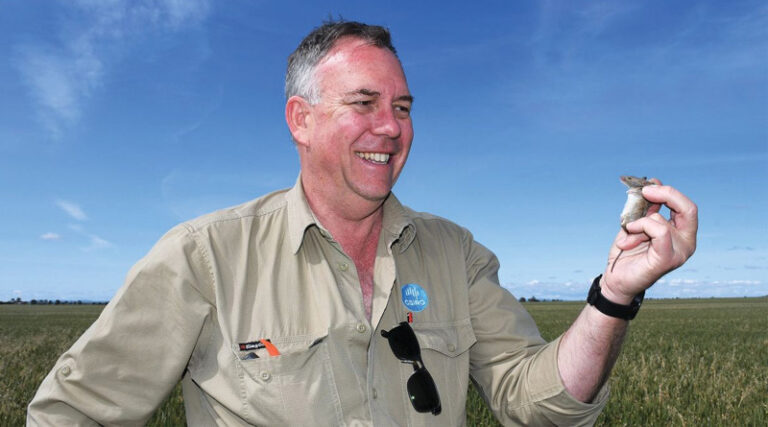
CSIRO mouse expert Steve Henry says the worst-affected areas in April were between Mingenew and Northampton in the northern wheatbelt, an almost 500 km stretch between Albany and Esperance in the south, and around Hyden in the eastern wheatbelt.
“Historically, mouse outbreaks have not been as frequent in WA as in the eastern states (where there have also been reports of increased mouse activity),” Mr Henry says.
“This outbreak appears to be worse than when I was visiting WA farmers in 2022. Certainly, in my very limited experience in WA, this is a very significant outbreak.”
Monitoring critical during winter
Mr Henry says mice could damage crops in outbreak areas if growers have not baited paddocks at sowing. Baiting at sowing, combined with low overwinter survival, limits the potential for damage to ripening crops in the spring.
“However, if control measures are ineffective in autumn and there is a high level of overwinter survival, we would expect to see numbers increase rapidly in the spring, and there is potential for mouse-related damage as the crop matures,” he says.
In areas where numbers have been high in the autumn, Mr Henry says monitoring is critical during winter to assess the effectiveness of baiting and inform future control options. The use of chew cards, which measure mouse activity when food is scarce, is one practical option. Information on local prevalence can be uploaded to the MouseAlert website.
In addition to chew cards, growers are urged to continue to look for burrows and for signs of browsing on tillers on cereals, or entire plants missing in canola or pulse crops.
“Chew cards work best in the developing crop due to the crop making it difficult to see burrows and the general lack of food on the ground, which makes the chew cards more attractive to mice.”
Additional baiting an option
Mr Henry says additional baiting using zinc phosphide, following label directions, is an option if mouse activity remains high.
It’s important to bait when there is the least amount of alternative food in the system and Mr Henry adds that once crops start to fill, it is almost too late to bait.
The success of baiting is based on the probability of a mouse discovering a lethal dose. Lots of alternative food acts as a distraction from the mouse finding the toxin.
Favourable conditions
The 2026 plague follows multiple years of bumper crops in WA. Grain loss before and after the most recent harvest left abundant food in paddocks. Combined with shelter from retained crop residues and favourable summer weather, this created ideal breeding conditions.
Mr Henry says it is difficult to accurately estimate crop losses associated with mice. Anecdotally, losses can range from 10% to 100% in the severest of outbreaks.
“In 2021 in NSW, I heard of an account of total canola crop loss across a 460 ha paddock. Already this year, we are starting to hear accounts of losses in northern WA,” he says.
Mr Henry says high numbers of mice have also been reported on the Adelaide Plains and Yorke Peninsula regions of South Australia. CSIRO’s rodent research team has been recording increasing numbers in their trapping through late summer and autumn, although numbers in that state have yet to reach plague proportions.
A united approach to control
Reducing the impact of mice in crops is a key focus for GRDC crop protection investments. In 2025, a multi-year $11 million investment was made in 2 projects led by the CSIRO rodent research team.
The team’s focus is on understanding cropping practices and undertaking research to develop strategies to reduce the impact of mice in Australian cropping systems.
Mr Henry is part of the CSIRO team leading one of those projects, ‘Mouse surveillance and monitoring to inform leading practice’, a 4-year initiative aimed at improving early detection and outbreak forecasting through improved monitoring and predictive modelling.
“The predictive models are progressing well and are being used to inform the update messages that we put out 3 times per year.”
Latest update – 19 May 2026
Grain Producers Australia (GPA) has been issued a ZnP50 emergency use permit (PER97414) from the Australian Pesticides and Veterinary Medicines Authority allowing grain producers to access stronger mouse bait as significant mouse numbers plague several regions.
To access the higher concentrate bait under the permit conditions, growers will need to:
complete a free online stewardship training course through Grain Producers Australia
be located in regions meeting mouse activity thresholds under a rapid assessment monitoring network being established by GRDC
purchase through participating retailers.
The permit has been developed as a targeted emergency response. The strict permit conditions are designed to ensure the product is used where pressure is highest; stewardship requirements are maintained; supply is targeted and traceable; and regulator needs are met.
Global Agriculture is an independent international media platform covering agri-business, policy, technology, and sustainability. For editorial collaborations, thought leadership, and strategic communications, write to pr@global-agriculture.com