16 September 2026, Westminster: The Weed Science Society of America (WSSA) has highlighted the growing collaboration between weed scientists and the Aquatic Plant Management Society (APMS) in advancing research and management approaches for aquatic plants and weeds.
APMS, an affiliate society of WSSA, has a significant overlap in membership with WSSA, creating opportunities for collaboration across research, education and aquatic weed management.
The collaboration was highlighted during the 66th APMS Annual Meeting, held July 13–16 in Phoenix, Arizona, under the theme “Water in the Arid Southwest – Policies, Allocation & Ecosystem Challenges.” The meeting brought together 113 participants and featured 41 research presentations and 15 posters covering a range of aquatic management issues, including weed control.
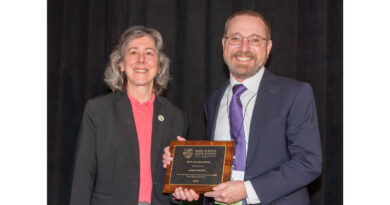
Among the scientists recognised at the meeting was Ramon Leon, Ph.D., of North Carolina State University, who received the APMS T. Wayne Miller Distinguished Service Award. Leon was recognised for his work in transitioning the Journal of Aquatic Plant Management from a print-only publication to an open-access digital journal. He serves as the journal’s editor and is also an APMS board member and WSSA member.
Chris Mudge, Ph.D., of the U.S. Army Corps of Engineers (USACE), received the APMS Outstanding Research Contributor Award, the society’s top research honour, for his contributions to advancing aquatic plant management initiatives aimed at protecting water resources in the United States.
WSSA members are also taking on several leadership positions within APMS. Lyn Gettys, Ph.D., University of Florida, serves as APMS Past President, while Gray Turnage, Ph.D., Mississippi State University, is Vice President. Greg MacDonald, Ph.D., University of Florida, serves as Secretary, and Mirella Ortiz, Ph.D., Utah State University, and Benjamin Sperry, Ph.D., University of Florida, serve on the APMS Board of Directors.
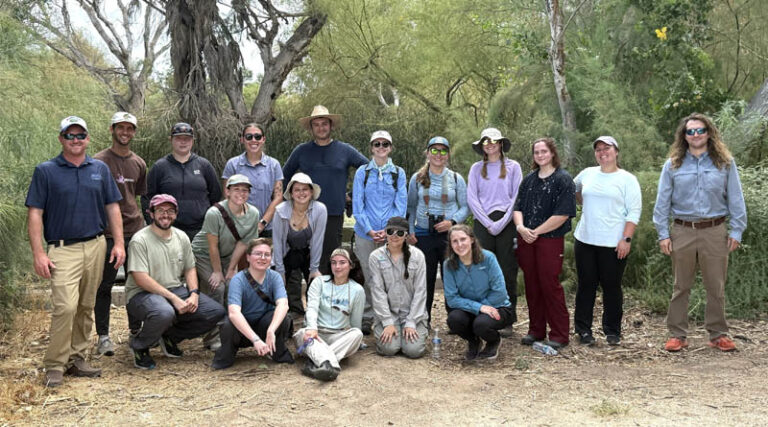
The annual meeting also provided graduate students with an opportunity to examine aquatic management challenges in the U.S. Southwest. Seventeen students from eight universities visited the Tres Rios Wetlands, an environmental restoration project developed by the USACE that encompasses nearly 700 acres around the Salt River.
As part of the field exercise, students mapped populations of invasive saltcedar (Tamarix spp.) to identify locations targeted for subsequent removal as part of efforts to improve bird-nesting habitat. The exercise offered practical exposure to invasive plant management, ecological restoration and the challenges associated with water scarcity.
A panel discussion titled “20 Years of Aquatic Plant Management: What’s Changed?” examined developments in the field over the past two decades. Discussions covered volatility in federal funding for aquatic plant management, emerging technologies, research priorities and increasing interest in non-chemical approaches to aquatic weed control in some regions.
WSSA and APMS have also expanded their engagement with policymakers and government stakeholders. Earlier this year, representatives of both organisations met with agriculture and environmental officials and legislators in Washington, D.C., to discuss issues relevant to their respective missions. The organisations said such scientific, educational and legislative engagement will continue through the remainder of 2026 and into 2027.
“Working with APMS gives us a stronger voice in communicating the funding needs of aquatic weed research and management,” said Ian Burke, Ph.D., WSSA President. He added that sustained investment is important for developing the science, tools and scientific workforce needed to protect water resources.
Global Agriculture is an independent international media platform covering agri-business, policy, technology, and sustainability. For editorial collaborations, thought leadership, and strategic communications, write to pr@global-agriculture.com