From Seasonal to Year-Round: Can India Build a More Reliable Strawberry Supply?
Guest Author: Ketan Sodha, Partner, Berry Fresh Agrotech LLP
17 June 2026, New Delhi: Every season, it happens the same way. Hundreds of growers across the same region reach harvest at roughly the same time. The market floods. Prices fall sharply — sometimes within days. A year of careful cultivation, input costs, and labour delivers far less than it should. Not because the fruit was poor. Because everyone arrived at the door together. This is the structural reality of seasonal strawberry production in India and it is a reality that a growing number of growers, buyers, and industry observers are beginning to question.
Based on India’s 2022 import of 27.86 lakh frigo (mother) strawberry plants, and after accounting for natural mortality at different stages, an estimated 6.29 crore healthy plants were available for commercial cultivation. Assuming each mother plant produces 25 runners and a plantation density of 22,500 plants per acre, these plants could cover approximately 2,796 acres of strawberry cultivation. With an expected yield of 0.51 kg per plant (or about 11.5 tonnes per acre) during the October–March season, the maximum potential strawberry production from these imported mother plants is estimated at around 32,082 tonnes.
India’s annual strawberry production is estimated at around 32,000 metric tonnes, based on the cultivation potential generated from imported frigo (mother) plants and current production practices. A significant share of this output comes from Mahabaleshwar, which accounts for nearly 85% of Maharashtra’s strawberry production and remains one of the country’s leading strawberry-growing regions. However, almost the entire crop is harvested within a narrow November-to-March window of about four to five months. As a result, domestic strawberry availability declines sharply during the remaining seven to eight months of the year, creating a seasonal supply gap in the market.
Historically, this was simply the nature of the crop. Strawberry cultivation in India developed around open-field farming in agro-climatically favourable regions — Mahabaleshwar in Maharashtra and a handful of temperate pockets. These regions built strong production traditions, but their output has always been at the mercy of weather and season. That dependence is becoming harder to manage. Rising temperatures, unseasonal rainfall, and increasing pest pressure are already disrupting production outcomes — in recent seasons, high heat has caused fruit to ripen prematurely and yields to fall.
Meanwhile, the market has moved on. Organised retail chains, premium hospitality, and urban consumers no longer think in seasons the way farmers do. They want consistent quality, reliable volumes, and year-round availability. A retailer building a premium fruit category cannot plan around a four-month supply window. A hotel group sourcing for its restaurants cannot schedule around harvest uncertainty.
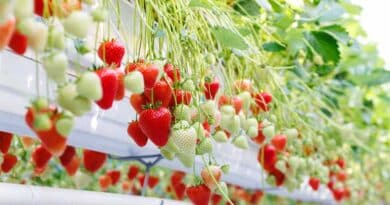
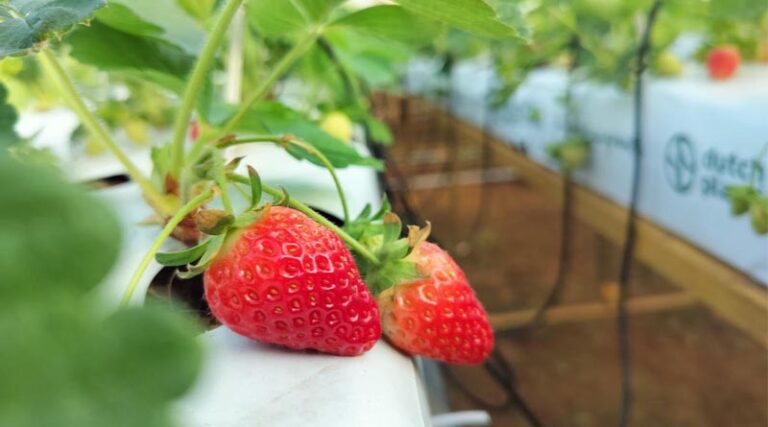
This is where protected cultivation and hydroponics enter the conversation. Through cocopeat-based substrate systems, precision fertigation, climate monitoring, and structured planting cycles, growers can begin to extend their productive windows — not by fighting nature, but by working around its constraints more deliberately. The goal is not to manufacture strawberries in a laboratory. It is to spread supply more evenly across the calendar, reducing the seasonal flood that crashes prices and filling the long months of absence that push buyers towards imports.
Planting material remains one of the most critical constraints in this transition. India’s premium strawberry sector is heavily dependent on imported mother plants and frigo material — a supply chain vulnerable to phytosanitary compliance issues, shipping delays, and cost pressures. Any disruption cascades quickly into delayed planting and lostproduction windows. The cost of this gap is visible in the numbers: off-season strawberries imported into India carry an average price of approximately USD 9,088 per tonne — more than eight times the average domestic season price. That premium exists precisely because a consistent domestic supply does not.
Varietal suitability adds a further layer of complexity. Strawberry genetics bred for European or American conditions do not always perform predictably under Indian temperatures, humidity levels, and protected cultivation environments. Adaptability, fruit quality, shelf life, and consistency under local growing conditions vary considerably across varieties. As a result, growers are increasingly running their own trials — building an evidence base from the ground up rather than relying on international performance data alone.
If these challenges can be addressed systematically, the commercial opportunity is real. A more reliable, year-round domestic supply system would not only serve the growing premium segment at home — it would strengthen India’s position in regional and international berry supply networks where consistency and volume reliability are the entry requirements.
None of this will move quickly. Capital requirements are significant, the technical learning curve is real, and building a year-round supply system in a region shaped by decades of open-field seasonal tradition is as much a cultural shift as a technical one. But the direction of travel is becoming clearer.
Ultimately, the real transition may not simply be from seasonal to year-round production — but from a market shaped by harvest calendars to one built around reliability.
Also Read: Corteva Plans Exit from Spain Manufacturing Site, Raises Restructuring Cost
Global Agriculture is an independent international media platform covering agri-business, policy, technology, and sustainability. For editorial collaborations, thought leadership, and strategic communications, write to pr@global-agriculture.com