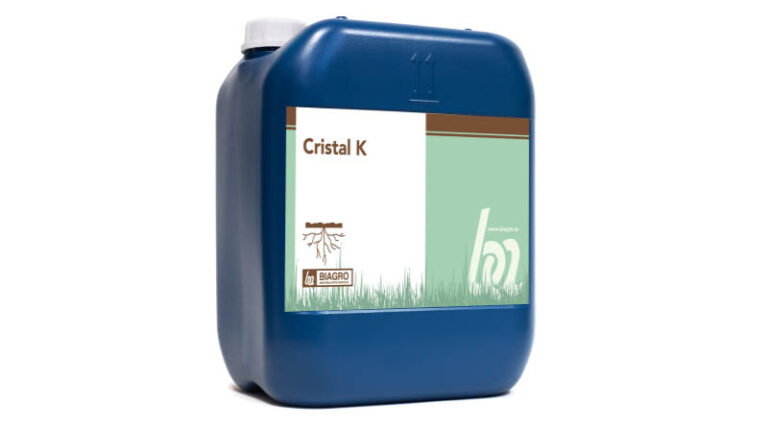
Cristal K — NK Solution with Amino Acids
02 August 2026, Valencia: Potassium is often called the “quality nutrient” in crop production, and for good reason: it governs water regulation within the plant, activates dozens of key enzymes, and plays a central role in sugar transport, fruit sizing, and color development. Yet potassium demand is not static — it spikes dramatically during fruit fill and ripening stages, precisely when many nutrition programs are already stretched thin managing multiple competing priorities. Cristal K was designed to meet this demand efficiently, combining potassium with amino acids and organic matter in the form of fulvic acids to deliver both nutritional and soil-regenerating benefits in a single fertigation product.
At its core, Cristal K supplies potassium in a readily available liquid form suited to drip irrigation and fertigation systems. But what distinguishes this product from a standard potassium fertilizer is the inclusion of amino acids in the formulation. Amino acids serve as the direct building blocks for plant proteins, and supplying them exogenously — rather than relying solely on the plant’s own nitrogen metabolism to synthesize them — can reduce the metabolic energy cost the plant would otherwise spend on protein synthesis. This is particularly valuable during periods of stress or high physiological demand, such as fruit development, when redirecting energy away from amino acid synthesis and toward growth and fruit quality can have a measurable impact on outcomes.
The third pillar of the formulation, fulvic acid-based organic matter, rounds out Cristal K’s function as a true “edaphic regenerator” rather than a simple nutrient delivery product. Fulvic acids are humic substances known for their capacity to improve cation exchange in soil, enhance the permeability of root cell membranes, and stimulate beneficial microbial activity in the rhizosphere. When combined with potassium, fulvic acid can also assist with potassium mobility in the soil profile, helping counter the fixation that potassium ions can experience in certain clay-rich soils. In effect, the fulvic acid component works to make the soil environment more receptive to nutrient uptake generally, not just for the potassium delivered by this specific application.
This three-part formulation — potassium, amino acids, and fulvic organic matter — positions Cristal K as a versatile tool across multiple stages of the crop cycle, though it delivers particular value during fruit development and ripening phases when potassium demand is highest. Growers commonly integrate it into fertigation schedules in the weeks leading up to and during fruit fill, when adequate potassium supply directly influences fruit size, sugar content (Brix), and coloration — all attributes that determine market quality and price premiums for many horticultural crops.
Because Cristal K is delivered as a soil-applied, fertigation-compatible liquid, it offers the practical advantage of continuous availability as roots explore the treated zone, rather than the one-time surface effect typical of foliar sprays. This is especially relevant for potassium, which needs to be present in adequate concentration in the root zone over an extended window to support the sustained demand of a developing fruit load. Liquid fertigation also allows growers to fine-tune application rates and frequency according to real-time crop needs and irrigation scheduling, offering more precision than a single bulk granular application.
The regenerative aspect of Cristal K also has longer-term implications for soil health beyond the current season. Repeated applications of fulvic acid-enriched products contribute incrementally to soil organic matter and microbial activity, both of which support better structure, water-holding capacity, and nutrient cycling over time. For growers on soils with historically low organic matter — common in many intensively cropped, sandy, or heavily tilled fields — this cumulative benefit can be just as valuable as the immediate nutritional boost the product provides in any single application.
In summary, Cristal K offers growers a way to address a critical, high-demand nutrient — potassium — while simultaneously supporting protein metabolism through amino acid supplementation and improving soil biology through fulvic acid enrichment. For crops entering fruit fill and ripening stages, or for operations looking to build long-term soil fertility alongside their seasonal nutrition program, Cristal K provides a well-rounded, fertigation-ready solution that addresses both immediate crop performance and underlying soil regeneration.
Also Read: Bayer Launches New Insecticide Trance for Cotton in India
Global Agriculture is an independent international media platform covering agri-business, policy, technology, and sustainability. For editorial collaborations, thought leadership, and strategic communications, write to pr@global-agriculture.com