02 August 2026, Guyana: Guyana marked two conservation milestones this month: The launch of a new Environmental Education Curriculum (EEC) for Regions 4 and 6, and the conclusion of the Sustainable Wildlife Management (SWM) Programme’s Phase 2 — representing eight years of engagement in the country.
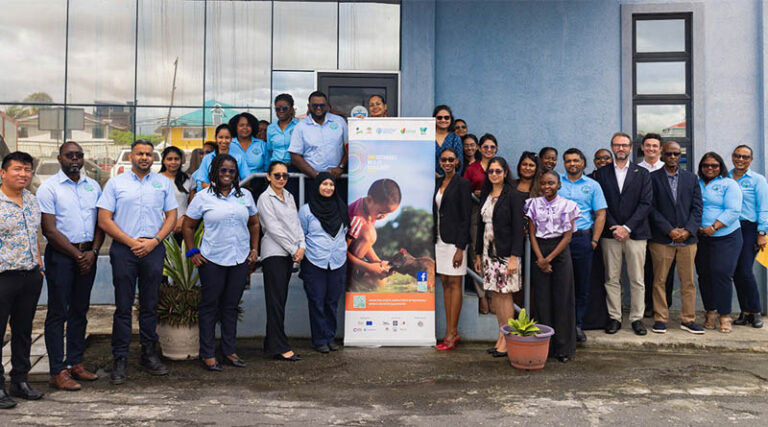
At the closing event in Georgetown, SWM Programme Country Coordinator, Oswin David, praised the years of collective achievements, thanked key stakeholders, and set the scene for ongoing impacts.
“This eight-year initiative…has provided a roadmap for how we can effectively balance conservation and human development in Guyana,” he said.
The Landscape Alliance led the SWM Programme work in Guyana, and activities were implemented through the Guyana Wildlife Conservation and Management Commission (GWCMC) with support from the European Union, the Food and Agriculture Organization (FAO), and local partners such as the South Rupununi Conservation Society (SRCS) and Caiman House Inc.
Alona Sankar, Commissioner of GWCMC, echoed her support for the Programme’s work:
“From the Commission’s perspective, the SWM Programme has been instrumental in supporting our core mandate to conserve, protect, manage, and sustainably utilize wildlife, as well as regulate both internal and external trade,” she said.
“Furthermore, the addition of the Biodiversity Component in 2024 has been invaluable. Its goal of developing cost-effective, scientifically verifiable monitoring methods aligns perfectly with the initiative launched by His Excellency at the Global Biodiversity Alliance Summit. These findings will guide our national policies and bolster our efforts in sustainable development and conservation.”
The Biodiversity Component Sankar mentioned has engaged seven villages across the Rupununi to evaluate the cost-effectiveness of six monitoring methods: camera trapping, passive acoustic monitoring, bird counts, environmental DNA (eDNA), local ecological knowledge, and fish stock assessments.
Over 700 individual species have been identified so far, and the team has created a regional Artificial Intelligence (AI) model capable of identifying 445 species classes — one of the largest regional identifying databases available.
PRESS RELEASE: How smarter biodiversity monitoring is helping protect the ecosystems people rely on
Investing in the future with environmental education
At an event earlier that week, Director of the National Center of Educational Resources Development (NCERD), Omwaittie Ramdin, spoke on behalf of the Minister of Education to highlight the importance of the freshly minted Environmental Education Curriculum (EEC) for Regions 4 and 6:
“Today is about an investment; it is about equipping our children with the knowledge, values, skills, and a sense of responsibility,” she said. “They will need to protect one of the greatest treasures we possess, our natural environment. The decisions our children make in the future, will depend greatly on what we teach them.”
The model for the EEC in Regions 4 and 6 was originally developed by the South Rupununi Conservation Society (SRCS) for Region 9, where the SWM Programme has supported successful implementation for over seven years.
Global Agriculture is an independent international media platform covering agri-business, policy, technology, and sustainability. For editorial collaborations, thought leadership, and strategic communications, write to pr@global-agriculture.com