Soil Health Key to India’s Food and Nutrition Security: Experts Call for Integrated Policy Action
12 March 2026, New Delhi: As India moves from a focus on basic food security to broader nutritional security, experts from government, academia, and industry emphasized that improving soil health and responsible use of agricultural inputs are critical to strengthening the country’s food system and public health outcomes.
These views were shared during a roundtable discussion held in New Delhi that brought together policymakers, scientists, and industry leaders to deliberate on the interconnected themes of soil health, crop nutrition, responsible use of agri-inputs, and the broader public health implications of agricultural practices.
The discussion highlighted how soil health forms the foundation of the food chain and how balanced nutrient management, improved agricultural practices, and policy coordination can influence both crop productivity and human nutrition.
Dr. Jatinder Singh, Deputy Secretary General of the PHD Chamber of Commerce, set the context for the discussions and stressed the need for strategic recommendations to identify the right pathway for strengthening soil health and ensuring food and nutritional security. Referring to research findings, including reports by the Indian Council for Research on International Economic Relations (ICRIER), he pointed out that soil organic matter in many regions of India is steadily declining. At the same time, nitrogen consumption remains high while the efficiency of nitrogen uptake by crops remains relatively low, raising concerns about sustainability and nutrient balance.
N.K. Aggarwal, Chairman Emeritus of the Crystal Group, emphasized that soil “recharging” has become essential as farmers cultivate crops multiple times a year. He noted that India grows crops in two to three seasons annually and produces a wide range of commodities, placing a responsibility on the country not only to feed its own population but also to contribute to global food supplies. Aggarwal highlighted that sustainable farming practices can only be achieved through close collaboration between the government and the private sector.
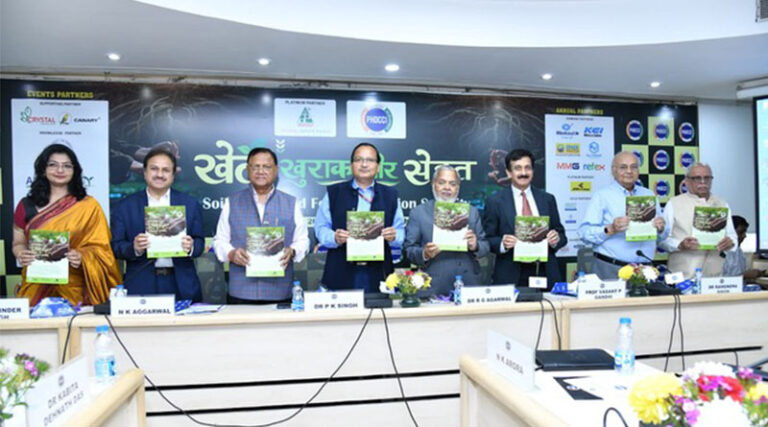
N.K. Arora, Secretary, Governing Council of the Kisan-Vigyan Foundation (KAKV), presented the theme paper titled “Soil Health, Food Production, and Nutritional Security in India: An Integrated Analysis.” The white paper was inaugurated by Dr. P.K. Singh, Agriculture Commissioner at the Department of Agriculture and Farmers Welfare, Government of India.
Professor Vasant Gandhi, Chairman of the Governing Council of KAKV, emphasized that India’s soil health plays a critical role in determining the country’s capacity to produce adequate food. While India has achieved self-sufficiency in major food grains and has emerged as a limited exporter of staples such as rice and wheat, the broader challenge of nutritional security remains significant.
According to the Ministry of Agriculture and Farmers’ Welfare, India’s total foodgrain production has crossed 350 million tonnes, while the public distribution system supports food access for nearly 800 million people. However, Gandhi pointed out that food availability alone does not guarantee improved nutritional outcomes.
He cited data from the National Family Health Survey (NFHS-5, 2019–21), which shows that 35.5 percent of children under five years are stunted, 32.1 percent are underweight, and 19.3 percent suffer from wasting. Additionally, more than 53 percent of women aged 15–49 are anaemic, highlighting persistent nutritional challenges.
Experts also noted that declining soil health is a major underlying factor. Fertiliser statistics indicate significant nutrient imbalance in Indian agriculture. Total nutrient consumption of nitrogen, phosphorus, and potassium reached 29.84 million metric tonnes in 2022–23, with the NPK ratio skewed at 11.8:4.6:1, reflecting excessive nitrogen use compared to other nutrients.
Dr. P.K. Singh, Agriculture Commissioner in the Ministry of Agriculture and Farmers Welfare, said the government is preparing state-wise roadmaps to improve soil organic carbon levels, with state governments expected to define their own targets and strategies.
He also highlighted that several government initiatives related to agriculture and allied sectors can contribute to improving soil health. Schemes related to micro-irrigation, fisheries, and integrated farming systems can collectively improve soil quality, crop productivity, and the quality of food produced in the country. He also underlined the importance of technologies such as seed coating, which can enhance seed vigour and plant growth.
R.G. Agarwal, Chairman Emeritus, Dhanuka Agritech, pointed out that agricultural productivity varies significantly across districts and states even when the same seed varieties are used. According to him, these differences arise largely due to variations in cultivation practices and the level of scientific guidance available to farmers.
He explained that progressive farmers and those cultivating high-value crops often work closely with consultants or scientists who guide them throughout the crop season based on soil testing and field conditions. Agarwal stressed that similar advisory systems should be extended to small and marginal farmers so that they can make better decisions based on the potential of their soils.
Participants at the roundtable emphasized that strengthening soil health must remain central to India’s strategy for ensuring sustainable food production and improved nutrition outcomes in the coming years.
Also Read: From Rust Threat to Wheat Expansion in Ethiopia
Global Agriculture is an independent international media platform covering agri-business, policy, technology, and sustainability. For editorial collaborations, thought leadership, and strategic communications, write to pr@global-agriculture.com