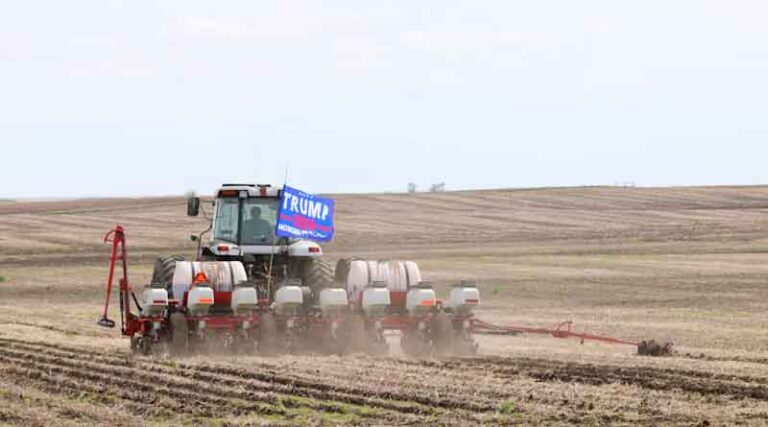
12 October 2026, Washington, D.C.: President Trump signed an executive order on October 7 aimed at easing record US diesel prices for farmers and truckers, expanding access to tax-exempt “dyed” diesel and temporarily deferring the federal 24-cent-per-gallon diesel tax until the end of the year. The move comes as average pump prices for diesel have climbed to $6.30 a gallon nationally, more than 70 percent higher than a year earlier, according to AAA data cited in Associated Press reporting.
Dyed diesel is a lower-cost, tax-exempt version of diesel fuel that has historically been reserved for off-road uses such as farm tractors, combines and stationary generators, which do not use public roads and so are not meant to help pay for road upkeep through the federal fuel tax. Trump’s order widens the circumstances under which dyed diesel can be used, a step industry groups describe as offering temporary penalty relief and a possible tax deferral rather than outright forgiveness of the tax. Most US states levy their own separate diesel taxes on top of the federal one, and a number of states have already eased enforcement or waived taxes on dyed diesel in response to the price spike.
The price surge itself traces back to the aftermath of US strikes on Iran months earlier, which disrupted global refining and crude supply chains. Those same disruptions have also pushed up costs for other farm inputs, including fertilizer and seed logistics, compounding pressure on farm budgets heading into harvest wrap-up and next season’s input purchasing.
A stopgap, not a fix
Farm groups gave the order a cautious, largely skeptical reception. Matt Perdue, president of the North Dakota Farmers Union, said the measure does not come close to offsetting diesel prices that remain more than two dollars a gallon above year-ago levels. He noted that most farmers already have legal access to dyed diesel for their own equipment, and many had already finished harvest by the time the order was signed, meaning the benefit is likely to flow more toward other parts of the supply chain, such as trucking and logistics firms, than directly to grain producers.
Academic economists raised a related concern: widening access to a limited pool of dyed diesel supply could create new competition for that fuel rather than adding to it. David Ortega, a food economics and policy professor at Michigan State University, warned the change could increase competition for dyed diesel and ultimately backfire on the farmers it is meant to help. Paul Mitchell, an agricultural and applied economics professor at the University of Wisconsin-Madison, pointed to a more basic obstacle: many dyed-diesel pumps are not built to handle large commercial trucks such as semis, which will limit how much of the trucking industry can actually use the exemption in practice.
Doubts from truckers and economists too
Reactions from the trucking industry were similarly muted. Patrick De Haan, head of petroleum analysis at GasBuddy, said the order’s effect would likely be negligible for large trucking companies that operate across multiple states with differing fuel-tax rules. Todd Spencer, president and chief executive of the Owner-Operator Independent Drivers Association, said the benefit for small, independent truckers would be minimal, since they generally pay for fuel upfront regardless of tax treatment; he estimated that every one-dollar-per-gallon increase in diesel costs independent truckers roughly 400 dollars more per week. Henry Hanscom, chief advocacy and public affairs officer at the American Trucking Associations, described the order as offering temporary penalty relief and a potential deferral rather than full tax forgiveness, and said the group would review forthcoming IRS guidance before assessing its real-world impact. Gregg Ibendahl, a farm management specialist at Kansas State University, offered the starkest assessment of the underlying problem, saying global diesel supply is simply short, and that restoring it to more normal levels will likely take at least a year regardless of any tax policy change.
Diesel is one of the most universal input costs in farming anywhere in the world, powering everything from land preparation and harvest to the trucks that move grain, fertilizer and produce to market, which is why a price shock of this scale in the world’s largest agricultural exporter draws attention well beyond US borders. India has long managed its own politically sensitive diesel pricing and subsidy questions for farm machinery and agricultural transport, and higher US and global crude costs tend to feed through into freight and input costs for Indian and Latin American farmers as well, even when the immediate policy response is confined to Washington.
Global Agriculture is an independent international media platform covering agri-business, policy, technology, and sustainability. For editorial collaborations, thought leadership, and strategic communications, write to pr@global-agriculture.com