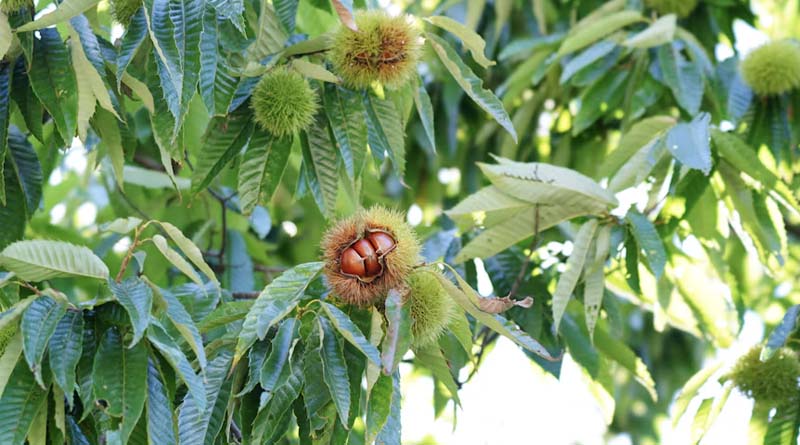
USDA Deregulates GM Blight-Resistant American Chestnut Tree
05 October 2026, New York: The U.S. Department of Agriculture has formally deregulated Darling 54, a genetically engineered American chestnut tree bred
Read More

Get the latest Chestnut Tree news, research and developments covering tree breeding, orchard management, cultivation, pest and disease control, genetic improvement and nut production. Chestnut trees, particularly European chestnut (Castanea sativa), Chinese chestnut (Castanea mollissima) and American chestnut (Castanea dentata), are important for nut production, forestry, agroforestry and ecosystem restoration.
Research focuses on developing productive cultivars with improved nut quality, disease resistance, cold tolerance and adaptation to changing climatic conditions. Major challenges include chestnut blight, caused by Cryphonectria parasitica, and ink disease associated with Phytophthora species. Breeding programmes, genetic resource conservation, grafting, rootstock selection and integrated disease management are helping researchers and growers address these threats while improving orchard productivity and tree survival.
Find updates on new chestnut cultivars, breeding programmes, nursery production, orchard establishment, harvesting, processing and forestry research. Coverage also includes efforts to restore American chestnut populations, develop blight-resistant trees, improve resistance to soilborne diseases and conserve genetic diversity. Advances in genomics, biotechnology and biological control are contributing to research on disease resistance, sustainable chestnut production and the long-term management of chestnut forests and orchards.
05 October 2026, New York: The U.S. Department of Agriculture has formally deregulated Darling 54, a genetically engineered American chestnut tree bred
Read More