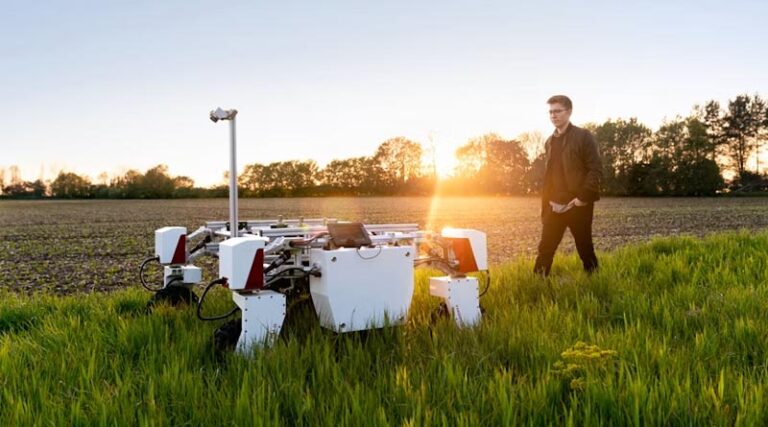
16 October 2026, United Kingdom: A Cambridge, UK-based agricultural robotics company says it plans to have 300 of its ultraviolet-light robots working in fruit fields by 2027, as growers look for ways to control fungal disease without repeated chemical fungicide applications. Antobot Ltd, which has been quietly building the business since 2019, confirmed the target in an October 1 interview with trade publication AgFunderNews, marking one of the clearer signs yet that robotic, light-based disease control is moving from pilot projects to commercial scale in horticulture.
The core idea is straightforward physics rather than biology. Antobot’s machines drive through strawberry fields carrying banks of UV-C lamps, a short-wavelength ultraviolet light that is more intense than the UV-A and UV-B light in ordinary sunlight. When this light hits fungal pathogens such as powdery mildew, a common and yield-robbing disease in strawberries, it damages the organism’s DNA so it cannot replicate and spread across the plant canopy. Because the treatment works on contact rather than through a systemic chemical reaction, it leaves no fungicide residue on the fruit and does not rely on the pathogen absorbing or metabolizing an active ingredient, which is one of the main ways fungal pathogens evolve resistance to conventional sprays over time.
Antobot is not alone in this approach. The AgFunderNews report named three other companies, Saga Robotics, TRIC Robotics, and CleanLight, also building UV-C treatment robots for horticulture, suggesting the technology is attracting a cluster of competing developers rather than resting on one company’s patent. What distinguishes Antobot’s push is the scale of its near-term ambition and the customer base it has already built, including direct supply arrangements with Driscoll’s, the global berry marketing and growing company, and Tiptree, the UK jam and preserves maker that sources fruit from its own farms.
From equipment-as-a-service to equipment sales
Until 2025, Antobot ran its robots as a service, meaning the company itself handled daily operation and maintenance while growers simply paid for the treatment outcome. In 2026 the company is shifting most customers toward buying and operating the machines themselves, a change its executives say is becoming more financially attractive because of capital equipment grants available to horticulture businesses in the UK and Spain. Marc Jones, Antobot’s VP of commercial, told AgFunderNews that some growers already run more than ten machines across a single site, with one worker able to supervise several robots at once rather than dedicating a full-time operator to each.
The company has funded its growth so far through a mix of government grants, a small seed investment round led by Intron Technology Holdings, and revenue from existing customers, and it is now looking for growth capital to support the move to higher-volume manufacturing. Design changes made in response to field use, including swappable battery packs and a simplified suspension system, point to a company iterating on a working product rather than one still proving a concept.
Jones described the results growers are seeing in general terms rather than with published figures, saying the robots deliver “big reductions in chemical spraying and also, interestingly, quite good increases in yield,” along with a healthier-looking plant canopy. Those are real, commercially meaningful claims from a company with paying customers, but it is worth noting plainly that no peer-reviewed trial data, independent university study, or specific percentage figures for disease reduction or yield gain have been published alongside this announcement. Growers and distributors evaluating the technology should treat the current claims as company-reported performance rather than third-party-verified results until such data becomes available.
Beyond strawberries, which remain the company’s priority crop and the one where its customer base is concentrated, Antobot is developing versions of the technology for blueberries, raspberries, and vineyards, and is scoping potential use in ornamentals and vegetable crops. The robots also carry scouting modules that count and measure fruit and estimate ripening timelines, feeding data back into harvest and supply chain planning, a secondary function that gives growers an additional reason to adopt the platform beyond disease control alone. Antobot currently operates in the UK, Spain, Portugal, the Netherlands, Canada, and parts of Asia, with distributor agreements already in place in the UK and Spain and a joint venture established in Asia.
Global Agriculture is an independent international media platform covering agri-business, policy, technology, and sustainability. For editorial collaborations, thought leadership, and strategic communications, write to pr@global-agriculture.com