12 October 2026,New Delhi: Somewhere in Nagpur district, a farmer picks up a basic phone, dials a toll-free number and asks – in his own words, in his own dialect – whether he should spray today or wait for the rain to pass. He gets an answer in seconds. And he is no longer an outlier; over a lakh farmers in that one district have done much the same in the past year. Nobody trained them, nobody sold them a smartphone, and nobody made them download an app. For me, that is the moment Indian agritech quietly changed gear.
For over a decade we have been asking whether technology can genuinely move the needle for a farmer working one hectare on thin margins. We built marketplaces, then full-stack businesses, then digital public infrastructure. Each wave delivered something real and each fell short on some of its own promise. AI is the newest claimant to that promise, and it arrives carrying more hype than any wave before it. So the question deserves to be asked plainly: will AI work for smallholder farmers?
My argument in this article is that AI is already working – in soil testing, pest prediction, weather and price advisory and quality assaying – and that farmer digital readiness is no longer the primary constraint. What follows is a look at how agritech arrived here, how the AI companion can work for a farmer, what is still broken, and four recommendations for making it work at scale. One of them runs squarely against fashion: build small language models, not large ones.
In short: AI is already working for smallholders, and the farmer is ready for it. To make it work at scale: (1) build small, domain-tuned language models, not large ones; (2) wire AI into DPI and open networks so that advice ends in a transaction; (3) put agri-specific AI governance in place now, while the stakes are low; and (4) open up public agricultural data – that is the real moat.
From marketplaces to models: how AI is driving convergence in agritech
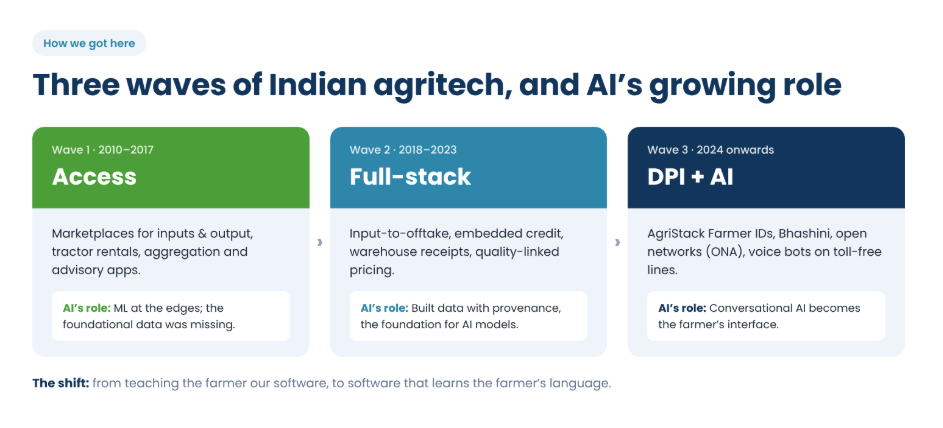
Indian agritech has gone through three distinct phases since its emergence around 2010. The sheer pace of technology evolution and adoption has kept pushing founders and investors to pivot every few years. The emergence of AI has, for the first time, brought a sense of continuity and convergence to those pivots. AI-enabled models, or AI-first innovation, are becoming the new normal across sectors, and agriculture is no different.
The first wave of agritech, roughly 2010 to 2017, was about access. It was characterised by digitally enabled marketplaces for inputs and output, rental platforms for tractors, and aggregation and advisory apps. The thesis was that the smallholder’s core problem was intermediation, and that a digital pipe could disintermediate.
Much of it worked at the edges and stalled in the middle. A farmer working roughly one hectare does not have an intermediation problem so much as a lack of scale, a profitability problem (after paying relatively high interest rates in the late teens or twenties), a risk-mitigation problem in an “unfriendly” – or rather “un-farmerly” – climate era, and a decision-making problem rooted in information asymmetry. In this first phase, machine learning entered business models but stayed on the edges, because the foundational data itself was the missing piece.
The second wave, 2018 to 2023, was full-stack. Companies stopped selling pure digital tools and started owning the value chain: input to offtake, embedded credit, warehouse receipts, quality-linked pricing, data-driven underwriting. This wave produced India’s most durable agritech businesses, though scale came with some expensive lessons in working capital mismanagement. It also, quietly, produced something more valuable than any single company could build: data with provenance – millions of soil samples, quality assays, satellite-verified and geo-tagged plots, repayment histories, mandi price series. Data for decision-making left the bilateral axis and got refreshingly triangulated across multiple use cases. The foundation for mass-scale AI model development was laid in this phase.
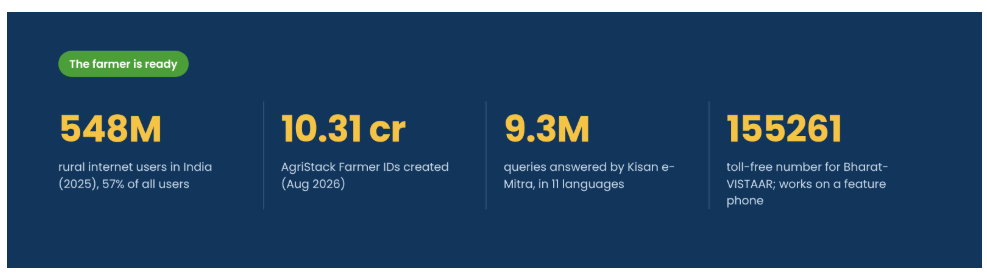
The third wave, the one we are in, is more infrastructural. When I wrote about AgriStack in a December 2017 article in YourStory, it was an idea; it has since evolved into live digital infrastructure, with more than 10.31 crore Farmer IDs created as of 3 August 2026 and a Digital Crop Survey covering more than 31.3 crore plots across 648 districts in Rabi 2025-26.
Bhashini turned Indian-language speech from a research problem into an API. And the Open Network for Agriculture (ONA) pilots have moved from slideware towards real-world deployment. Uttar Pradesh launched a Gemini-powered, Beckn-enabled ONA with Google Cloud, while Maharashtra’s MahaVISTAAR – the platform behind that Nagpur farmer – had reached around 30 lakh farmers by February 2026. Together, these developments strengthen the case for scaling open networks at pan-state and pan-India levels.
AI was always part of the game, but it began to manifest more visibly in the third wave. More than anything else, the arrival of conversational AI as the interface layer for the farmer is turning out to be an inflection point. The farmer who avoids writing and texting, does not fill forms, and does not want an app – or rather, a bouquet of apps thrown at them – has started to engage digitally, meaningfully and intelligently through AI-enabled bots. For over a decade we tried to teach the farmer to use our software. AI lets the software learn the farmer’s language, in their format and dialect, instead.
The precondition nobody planned for: the farmer got digitally savvy
Many arguments against AI for smallholders ultimately rest on assumptions about the farmer: too old, too poor, too offline, or too unfamiliar with digital tools. Those assumptions are now empirically weak, as the data reveals.
India had 958 million active internet users in 2025, of whom 548 million (57%) were rural, with rural usage growing at roughly four times the urban pace. Short-video consumption stood at 588 million users, with rural users marginally outnumbering urban users. Forty-four percent of Indian internet users already engage with some AI-enabled feature.
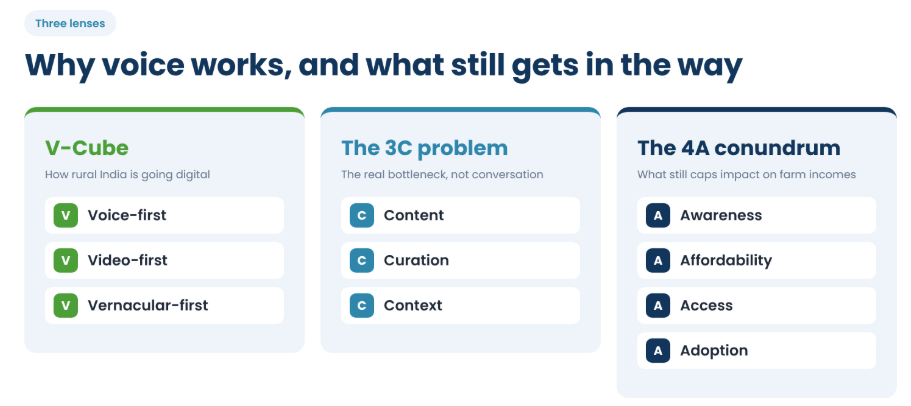
More important than the mega headline numbers is the behavioural fact underneath them. Rural India’s digital habits are voice-first, video-first and vernacular-first – the V-Cube paradigm is compounding the farmer’s digital engagement. A farmer who dictates a WhatsApp voice note, scrolls a reel on drone sprays and pays for urea with UPI has already made the cognitive leap we spent a decade worrying about.
What most farmers still dislike is the long list of data and forms they need to fill. Any digital solution for farmers that runs beyond three clicks becomes a self-goal and a deal breaker. But the farmer is no longer intimidated by digital tools, because they now have the power to experiment, learn and play with AI in private, without being judged on digital literacy, and with hardly any need for a human in the loop. In fact, I believe AI tools can also empower women farmers and agricultural workers through conversational bots they can access anytime, anywhere, in a language they are comfortable speaking. AI as a means of gender inclusion is worth a research paper of its own.
Conversational AI is probably the first computing paradigm that does not require forms
AI-enabled conversational bots are no longer speculative. The proof is already in open-network pilots, where AI bots are being used to offer a bouquet of services and products to farmers in a farmer-friendly format. Kisan e-Mitra, the AI assistant built for PM-KISAN, has resolved over 3 million farmer grievances since its February 2024 upgrade and had answered more than 9.3 million queries – over 8,000 a day – by December 2025, working in 11 Indic languages across 28 states and 8 union territories, with Bhashini integration for multilingual understanding. These are not merely demo queries. They include entitlement disputes – the kind of interaction that previously cost a trip to a block office and a lost day of wages.
Bharat-VISTAAR, inaugurated in February 2026 and rolled out nationwide in March, operates through its e-assistant “Bharati”, reachable on a dedicated toll-free line, 155261. That means a farmer with a feature phone can talk to it without needing a data pack. Bharat-VISTAAR integrates data from government digital ecosystems and ICAR, and is designed to provide personalised information and advisories on crop management, weather, market prices, pest and disease alerts and soil health.
So, what are the lessons learnt from the early phase of these AI deployments? Farmers will converse with a machine if it speaks their language and answers a question they actually have. Adoption friction is far lower with AI bots than the sector assumed. The real bottleneck is a “3C problem” – content, curation and context – and definitely not conversation. Early indicators are that business models built on localised, verified agronomic knowledge will gain adoption and traction. For many smallholders, voice on a toll-free line can beat an app, because it removes installation, literacy and data barriers at one stroke.
The AI companion: multiple jobs, one relationship
The mistake we risk repeating is building an app per problem – a weather app, a soil app, a pest detection app, a mandi price app. That is the 2016 playbook with a transformer bolted on.
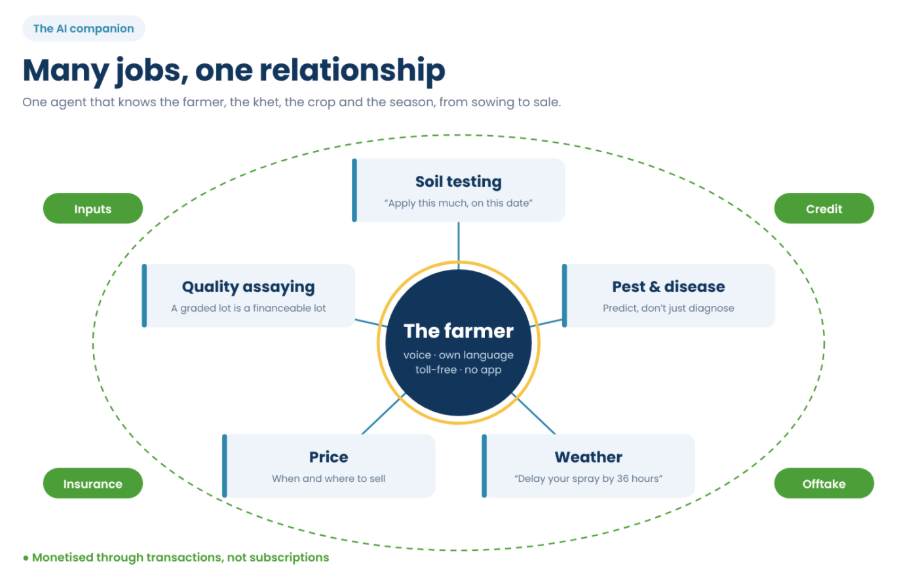
The right unit is a companion: one agent that knows the farmer, the khet, the crop, the season, the soil type and the cattle he or she owns, and that follows the crop cycle from sowing to harvest to sale. An AI companion with this micro-level understanding of the farmer has the power to solve multiple challenges at once. Some of the AI-enabled solutions that are already showing real traction include:
Soil testing. The Soil Health Card scheme generated enormous volume but modest behaviour change, largely because lab reports can arrive late. AI-IoT rapid-testing rigs from startups such as Krishitantra, ScaNxt, SoilSens and Neoperk are compressing turnaround to minutes at village level. The AI value-add is not the measurement; it is turning an NPK-pH-and-micronutrient reading into “apply this much fertiliser, on this date, for the variety you sowed.”
Pest and disease prediction: Indian cotton farmers can lose a significant share of their crop to pests, while productivity remains below the global average. Prediction beats diagnosis here because, by the time a farmer can see the damage, the economic loss may already be difficult to reverse. Wadhwani AI’s CottonAce – a smartphone photo of a pheromone trap, machine-counted and converted into a timed spray recommendation – is a good example of AI working alongside image processing and hardware. Likewise, there are AI tools for disease prediction among cattle, poultry and aquaculture.
Weather advisory: Not the seven-day forecast, which is free and, more often than not, met by the farmer with a shrug and a “so what?”. The value is in nowcasting translated into action: “delay your spray by 36 hours”, “irrigate tonight, not Thursday”. Hyperlocal, plot-referenced, decision-shaped advice works far better than vanilla weather alerts.
Price advisory: The largest income lever, or arbitrage, available to a smallholder is when and where to sell. Mandi arrival and price series, combined with quality assaying, warehouse receipt financing and storage options, can generate defensible and prescriptive hold-or-sell guidance. This is also where advisory must connect to a transaction – advice that ends in a recommendation, and not at a warehouse, a bank and a buyer, is just a nice conversation.
Quality assaying: Vision-based grading, the space where the likes of Upjao, AgNext, Agrograde and Sickle Innovations have built, converts subjective and adversarial assessment at the mandi gate into a machine-readable score. A graded lot can be collateralised, insured, contracted forward and price-discovered on an open network. Assaying, clubbed with traceability, can unlock value for the farmer and the consumer alike.
There could easily be another dozen use cases for an AI companion. Put together, the companion’s economics work in a way no individual app’s ever did. Each interaction can be worth a few extra rupees earned or saved by the farmer. A relationship across a full crop cycle, monetised through inputs, credit, insurance and offtake rather than subscription, could be worth a few thousand rupees in a season.
What isn’t working yet
The “four A conundrum” – awareness, affordability, access and adoption – continues to cap the impact technology can create on farm incomes, and AI does not get a default exemption from it.
Several startup founders I have spoken to estimate that roughly a quarter to a third of farmer queries still go unanswered, often because the underlying content has not been curated. Agronomic advice is also more liability-bearing than a consumer chatbot ever is: a hallucinated spray recommendation can destroy a season, and no disclaimer repairs that.
Willingness to pay directly for advisory is close to zero, so monetisation has to ride on an adjacent transaction.
And the trust layer needs work. Extension workers, along with farmers, remain the highest-value users – a fact to design for rather than apologise for. It is hard to take the human out of the loop, but the bridge to the farmer – an extension worker or a village-level entrepreneur – can be made more efficient and smarter with AI tools. New tech needs to build trust infrastructure with communities, farmer groups and intermediaries, rather than trying to replace them.
None of these challenges, though, is a reason for pessimism. All of them are reasons to be specific about how we build.
Recommendations
These recommendations on the development and deployment of AI models in agriculture come largely from my own field experience.
1. Build small language models, not large ones
This is a critical learning, and it runs against fashion and conventional wisdom.
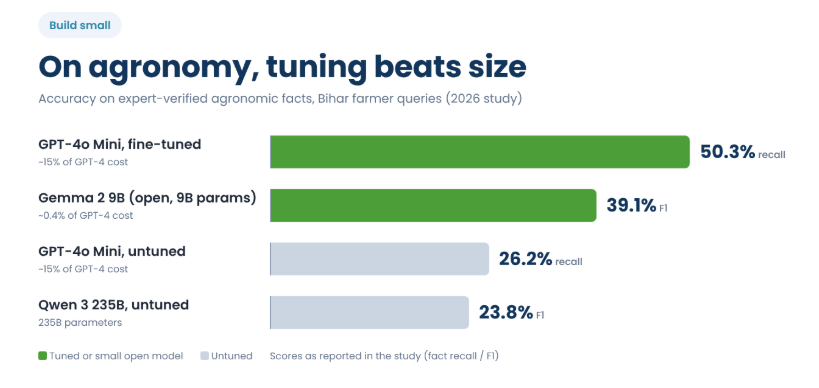
The evidence is now direct. In a 2026 study of conversational agricultural advisory using queries from Bihar, a fine-tuned GPT-4o Mini improved fact recall from 26.2% to 50.3% on expert-verified agronomic facts, while running at roughly 15% of GPT-4’s cost. The largest baseline model tested, Qwen 3 at 235 billion parameters, scored just 23.8% F1 untuned. Gemma 2 9B, a 9-billion-parameter open model, delivered 39.1% F1 at approximately 0.4% of GPT-4’s cost. Human evaluators preferred the fine-tuned GPT-4o Mini in 65.9% of head-to-head comparisons.
On agronomy, domain tuning mattered more than size: smaller, tuned models beat far larger untuned ones, at a fraction of the cost. The open 9B result is arguably the more instructive one – GPT-4o Mini is itself an API-served model, whereas Gemma is the kind of model a startup can host, fine-tune and run on its own infrastructure. Four reasons this is structural and not incidental:
• Domain, not breadth. Kharif paddy in Bihar is not a general-knowledge problem. A model that knows one agro-climatic zone deeply beats one that knows everything shallowly.
• Cost per query must be sub-rupee. At 100 million farmers and a dozen interactions a season, frontier-model inference quickly becomes economically unattractive at population scale.
• Edge and offline. Village connectivity is intermittent. Models running on-device or on a local edge box degrade gracefully; API-dependent ones simply fail.
• Language and sovereignty. Credible sovereign options now exist – BharatGen’s Param2 (17B, mixture-of-experts), Sarvam’s 30B and 105B models, and Gnani’s Vachana TTS across 12 Indian languages, all unveiled at the India AI Impact Summit in February 2026. The base layer is emerging. The work now is to fine-tune and evaluate these models on Indian agronomy.
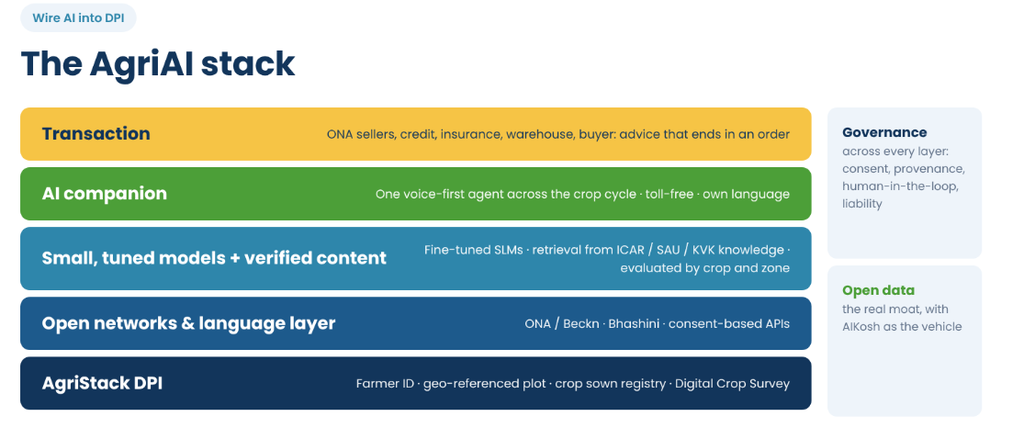
The prescription: use frontier LLMs for what they are good at – synthesising training data, generating evaluations, handling the rare hard query – and serve farmer traffic from small, fine-tuned models with retrieval from verified agronomic content.
2. Wire AI into DPI and open networks, or it stays a demo
An AI advisory that does not know which farmer it is talking to, on which plot, growing which crop, is producing generic content. AgriStack solves exactly this: Farmer ID, geo-referenced plot, crop sown registry. Bharat-VISTAAR’s design is a good indicator of where this goes – AI on top of registry data, not alongside it.
Equally, advisory must terminate in a transaction. “Your soil is zinc deficient” is worth something. “Your soil is zinc deficient; here are three ONA sellers of zinc sulphate within 20 km at these prices; order now” is worth an order of magnitude more.
The ask here is threefold: publish consent-based APIs for Farmer ID, plot and crop registry so any licensed application can personalise with the farmer’s permission; make the advisory-to-transaction handoff frictionless; and ensure AI applications are real, genuine, verified network participants and not walled gardens. The lesson of UPI is that unbundling beats vertical integration at population scale.
3. Put agri-specific AI governance in place now, while the stakes are low
India’s AI Governance Guidelines (MeitY, November 2025) got the posture right: seven principles including Trust, People First, Fairness & Equity and Accountability; a sector-led rather than omnibus-Act approach; and institutional scaffolding through the AI Governance Group, the Technology & Policy Expert Committee and the AI Safety Institute. The DPDP Act 2023 and the DPDP Rules 2025 provide the broader data-protection framework.
What agriculture needs now is a sectoral translation of that framework, owned by a government governance body. The architecture should address:
• Consent that a farmer can actually understand: voice-based, in-language, revocable, with a clear statement of what farm data is used for.
• Provenance and audit trails: every recommendation should be traceable to a logged, validated source – an ICAR package of practice, a state advisory. This is harder than it sounds. The majority of research papers in India, including those in agriculture, are written for publication rather than for use as evidence or as building blocks for AI advisory tools. We need to identify which research is robust enough to translate into actionable advice, and when that advice is wrong, detect the failure quickly and understand why it occurred.
• Human-in-the-loop for irreversible decisions: spray timing, variety choice, harvest timing – route low-confidence outputs to an extension officer rather than guessing.
• Solve for the blurred lines on inference: farmer and farm data collected for advisory must not silently become a credit score or an insurance repricing input without separate, explicit consent. This is the single largest trust risk in the system.
• A liability standard, a grievance redressal mechanism and incident reporting: for advice that causes loss. Nothing kills adoption faster than one well-publicised crop failure with no accountable party.
• Evaluation before deployment: publish accuracy against a benchmark of expert-verified agronomic facts, by crop and by zone. “It uses AI” should be a measured claim, not a marketing one.
4. Open public agricultural data: that is the real moat
India’s agronomic knowledge is not missing; it is locked in PDFs, state agricultural university archives, KVK records, ICAR trial data and vernacular extension bulletins that no model can retrieve. AIKosh, the IndiaAI Mission’s national dataset and model repository, is the right vehicle, and agriculture should be its flagship domain.
Priority datasets to release, machine-readable and openly licensed: ICAR package-of-practices for every crop and zone in all major languages; historical Soil Health Card results at village aggregation; multi-decade Agmarknet mandi arrival and price series; crop-cutting experiment and yield data; pest and disease surveillance; and labelled image libraries for pest, disease and quality grading.
Two design points are worth considering. First, release village- or block-level aggregated data, which is supremely useful across a range of use cases without touching individual privacy. Second, open up farmer-consented data, but only after stress-testing the consent architecture that sits underneath it.
What this means for policymakers, investors and founders
For policymakers: Treat AI as a layer on the DPI the government has already built, not as a separate mission. Fund content curation as diligently as you fund compute – in my view, an INR 100 crore programme to digitise and translate ICAR and SAU agronomic knowledge into machine-readable form could do more for farmer outcomes than an INR 1,000 crore GPU allocation. Publish an agri-specific AI governance addendum in the next twelve months. And keep the toll-free voice channel as a preferred interface: it is what makes this inclusive rather than merely impressive.
For investors: Be careful in underwriting AI advisory as a standalone business – willingness to pay is not there and will not appear any time soon. Underwrite the companies where AI compresses a cost line or unlocks a transaction: assaying that makes a lot financeable, pest prediction that reduces an input bill, price intelligence that lifts realisation. Ask every founder for cost-per-query and accuracy-per-crop, and be sceptical of anyone serving farmer traffic on frontier-model APIs – that is a gross-margin problem disguised as a technology choice. The winners in this cycle are likely to look boring, will be obsessed with curation and contextualisation, and will have unusually good unit economics.
For founders: Pick one crop, one zone, one decision, and be measurably better than the local expert before you expand. Fine-tune small models; do not rent large ones. Build on digital public goods and open networks from day one, wherever available, rather than bolting them on later. Design for the extension worker and the lead farmer, not just the individual smallholder – they are the trust layer every startup needs as its last-mile agent. Document everything: the query you cannot answer today is your roadmap. And treat trust as a product feature with a spec, because in agriculture you get just one season to be wrong.
The CAC math has changed
Watch the CAC math, because it has changed. Agritech’s original sin was always the high cost of distribution. Reaching a farmer meant feet on the street – field executives, village demos, mandi camps – and a customer acquisition cost that never quite paid back against a small first ticket. That is why almost every founder eventually pivoted to B2B or B2B2C, selling through FPOs, dealers, banks and corporates who already owned the last mile. AI companions can materially change that arithmetic, potentially reducing customer-acquisition and servicing costs from dollars to cents. Acquisition, onboarding, servicing and cross-sell can stop being four separate cost lines and collapse into one continuing conversation. For the first time since the first wave, a direct-to-farmer model can be underwritten on economics rather than optimism. Two caveats, though: cheaper contact is not the same as earned trust, and a low CAC only matters if there is a transaction at the other end. Build for the transaction, and let AI carry the cost of getting there.
I believe AgriAI will follow the same trajectory agritech has followed over the past decade: from horizontal solutions towards vertically integrated, crop- and value-chain-specific models. We are likely to see specialised verticals emerge like MaizeAI, PaddyAI, DairyAI, AquaAI, PestsAI, SoilAI, TractorAI etc.
The bigger picture: as we march towards the Viksit Bharat goals of 2047, India has a unique opportunity to build a verticalised sovereign AI for agriculture. There is a good chance that, with appropriate localisation and adaptation, the underlying architectures could serve hundreds of millions of smallholder farmers globally. Policy, capital and entrepreneurship all need to work in tandem to build AgriAI for the globe, not just for India. The only real bottleneck I see is the scale of imagination of our founders. Quite a few are working on this dream in stealth mode, and I remain optimistic that someone will crack it in the not-so-distant future.
Conclusion
Will AI work for smallholder farmers? It will, if we build it small, local, in-language, voice-first, wired into public infrastructure, governed with visible accountability and fed on open data. It will fail if we build another set of beautiful apps running expensive general-purpose models that answer questions no farmer asked.
The farmer is ready – 548 million rural Indians are online, and there are now several toll-free numbers that talk back. The infrastructure is ready too: more than a hundred million Farmer IDs can power a genuinely functioning open network, with sovereign AgriAI and language models on top.
What remains is the last leg of the stack – curating knowledge, tuning small models, publishing data and writing the rules. That is how the next decade of Indian agritech will be defined: built on entrepreneurial energy from founders and farmers alike, in a policy-enabled environment, with its foundation in digital public infrastructure and powered by AI.
Over to you: if you had to pick the first AgriAI vertical to get right – one crop, one zone, one decision – which would it be?
Global Agriculture is an independent international media platform covering agri-business, policy, technology, and sustainability. For editorial collaborations, thought leadership, and strategic communications, write to pr@global-agriculture.com