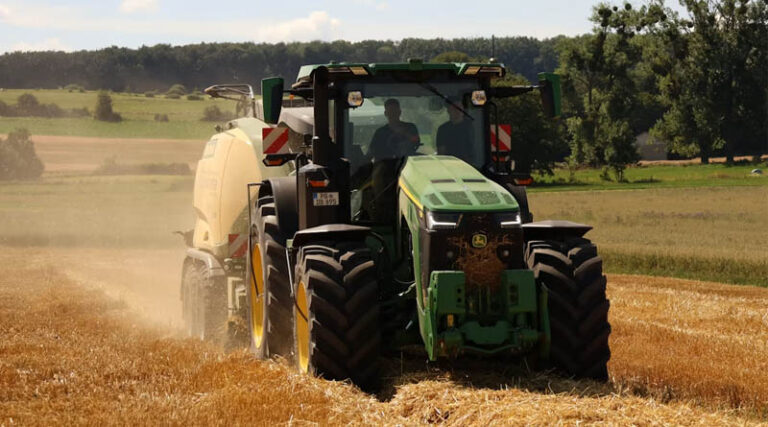
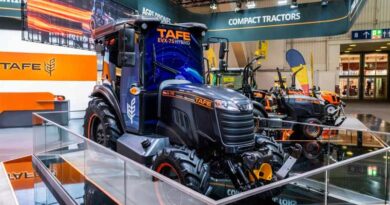
05 September 2026, London: Electric tractors are no longer a concept confined to trade show floors. John Deere, Fendt, New Holland, Case IH, Monarch Tractor and Solectrac all have battery electric models in the field, and India’s own manufacturers are testing 30 to 60 HP electric platforms for the domestic market. But the question farmers actually care about is simpler than the marketing: will an electric tractor get the day’s work done, and can it be charged where the farm actually is. The answer depends heavily on scale, and the published data draws a fairly clear line between what works today and what still needs years of development.
What the power numbers say
Industry sizing splits electric tractors into three broad power output bands. Small farms typically need 20 to 50 HP with 20 to 30 kWh of battery capacity for 4 to 6 hours of light duty work such as mowing, spraying or transport. Medium farms fall in the 50 to 100 HP range with 30 to 50 kWh packs supporting 6 to 8 hours of mixed operations. Large farms generally require 100 HP or more, with recommended battery capacity above 50 kWh and 8 or more hours of runtime, according to industry sizing data compiled by AgriStuff.
A separate market analysis from MarketsandMarkets found that battery packs in the 51 to 100 kWh range currently hold the largest global market share because they balance cost, weight and usable range better than either very small or very large packs, and that this range serves both smallholder plots and larger plantations reasonably well.
The gap widens sharply once heavy tillage enters the picture. A peer reviewed study published in Nature Scientific Reports found that running a 16 row planter for 14 hours to cover 68 hectares of corn in a day would require roughly 1,117 kWh of battery capacity, without even accounting for ploughing.
Separate research by Brenna and colleagues, cited in the same study, put the battery requirement for a full day of plough operation at 660 kWh. For context, that is ten to twenty times the capacity of the packs currently fitted to commercial electric tractors. A study by Du and colleagues concluded that a 75 kW motor paired with a 37.5 kWh battery was workable for medium and heavy duty use, but only within a limited duty cycle, not a full day of continuous heavy draft work. This is the core physics problem: diesel carries far more energy per kilogram than any current battery chemistry, and heavy tillage is one of the most energy intensive things a tractor does. North American market data reflects the same pattern.
Electric tractors in the 30 to 80 HP band held nearly half of the North American electric farm tractor market in 2025 and are growing fastest, while tractors above 80 HP made up only about 18 percent of the market and are growing more slowly, which the market research firm GMI Insights attributed to the technical and economic difficulty of delivering extended duty cycles and rapid recharging in large scale commercial applications.
Multiple charges and downtime for large operations
For a large farm running a 200 or 300 HP class tractor through a full day of primary tillage, one battery charge will not cover the work. Even a 100 kWh pack, charged at a fast DC station, can take close to an hour to reach 80 percent, based on charging curves published for prototype models such as John Deere’s E-Power tractor. Multiply that by two or three recharges during peak tillage season, and the machine spends a meaningful share of daylight hours plugged in rather than in the field, a constraint that shows up repeatedly in techno-economic reviews of battery electric tractors as the main obstacle to large scale adoption.
A total cost of ownership study covering the United States, cited in a recent Science Direct review, found electric tractors were cost competitive mainly for light duty tasks with engine loads below 20 percent, performed roughly on par with diesel for medium duty work, and remained economically unworkable for heavy duty tasks above 60 percent load, largely because of the battery size and downtime such loads demand.
Small farms face a different roadblock: infrastructure, not power
For a small or marginal farmer, particularly in India, the constraint is rarely raw power. A 20 to 30 kWh pack is enough for several hours of ploughing, spraying or haulage on a small plot. The roadblock is getting electricity to the tractor at all. Reports from WRI India and Policy Circle both point to inconsistent rural grid supply, voltage instability during peak irrigation season, and the near total absence of fast charging points in farming regions as the binding constraints on adoption, not battery chemistry.
A market study by Nexdigm noted that farm operations often occur in remote or off grid locations, and that battery swapping or mobile charging solutions remain limited in rural India. Where farms do have a grid connection, subsidised agricultural power tariffs actually make electric tractors cheaper to run than diesel over time, which is why a 10 year total cost of ownership study on a 30 kW electric tractor in India found long term savings despite higher upfront cost, according to the Science Direct review cited above.
Solar powered charging at custom hiring centres and village level charging hubs, an approach several Indian pilots are now testing, sidesteps the grid reliability problem entirely by generating power on site.
Why it matters for India and other emerging agri markets
The realistic near term path is not full replacement of diesel across all farm sizes. It is electrification of light and medium duty work, spraying, seeding, mowing, short haul transport, on small and medium holdings where subsidised power and solar charging hubs already exist, while heavy tillage on large mechanised farms stays diesel or hybrid until battery energy density roughly triples. For India’s overwhelmingly smallholder base, the deciding factor for electric tractor adoption over the next five years will be rural charging infrastructure and financing access, not tractor horsepower.
Global Agriculture is an independent international media platform covering agri-business, policy, technology, and sustainability. For editorial collaborations, thought leadership, and strategic communications, write to pr@global-agriculture.com