The Last Untouched Market in Biologicals and Why It May Stay That Way
Guest Author: Christian Pereira, Agribusiness Strategist at Bizup Strategy, specializing in growth strategies and M&A.
30 May 2026, São Paulo: Everyone is excited about the biological inputs boom. The numbers are impressive, sustainability narratives are attracting investors, and nearly every agribusiness company now has a “transition to biologicals” strategy slide in its corporate presentation.
But there is a question nobody is answering with the seriousness it deserves:
What about herbicides?
Think about it for a moment. Herbicides account for nearly R$ 47 billion of Brazil’s crop protection market, the largest single category, ahead of fungicides and insecticides. They represent the most expensive and most critical input in the management of soybeans, corn, and cotton. And yet they are the only segment where biological solutions simply do not exist commercially. Not a single product at scale. Anywhere in the world.
This is not a coincidence. It is a technical and economic problem the industry has not yet solved and one that deserves a clear-eyed discussion, free of hype.
The Gap Nobody Has Managed to Fill
Brazil’s biological inputs market surpassed R$ 6.2 billion in 2025, growing 15% over the prior year. Treated area advanced 28%. These are strong numbers, reflecting a real transformation in pest and disease management.
But those R$ 6.2 billion refer to biofungicides, bioinsecticides, bionematicides, and inoculants. Herbicides remain entirely in the hands of chemistry without a single commercially established biological product line.
Why has this frontier proven so difficult to cross? The answer combines two challenges that rarely appear together with such intensity – one technical, one strategic.
The technical challenge is well-documented. Steve Pearce, co-founder of Accumont, is direct: hundreds of bioherbicidal actives have already been identified by science, but most never reach the market because they are too crop or timing-specific, with only a narrow spectrum of activity and high sensitivity to environmental conditions. Unlike a biofungicide, which targets a pathogen without affecting the crop, a bioherbicide must be selective enough to spare the cash crop while being broad enough to deliver meaningful weed control. That combination is rare and technically demanding.
The strategic challenge is equally complex. And here, a distinction that is rarely made becomes critical.
It Is Not Just a Glyphosate Price Story
The most common narrative around bioherbicides goes like this: glyphosate became very cheap, so biological alternatives simply cannot compete on price. There is truth in that. Glyphosate prices fell more than 60% between 2022 and 2023 in Brazil, returning to historical levels after the post-pandemic spike, and it remains the most commercially used active ingredient in the country.
But framing the entire bioherbicide debate around glyphosate competitiveness is a strategic mistake.
The herbicide market is composed of dozens of molecules with completely different functions, target crops, application windows, and price points. There are selective herbicides, pre-emergent residuals, post-emergent systemics, contact desiccants. A bioherbicide does not necessarily need to compete with commodity glyphosate, it may find space precisely where conventional chemistry is running out of answers.
Pam Marrone, Ph.D., one of the world’s leading authorities on bioherbicides and co-founder of the Invasive Species Corporation, frames this clearly. What she and other researchers are pursuing is a product with broad-spectrum activity, effective against weed species resistant to multiple chemical modes of action. Not a cheaper substitute for glyphosate, but a new class of mode of action for an era in which herbicide resistance is progressively eroding the efficacy of available chemistry.
The real challenge, therefore, is not price alone. It is spectrum, field consistency, and fit within existing weed management programs.
Two Bets That Deserve Attention
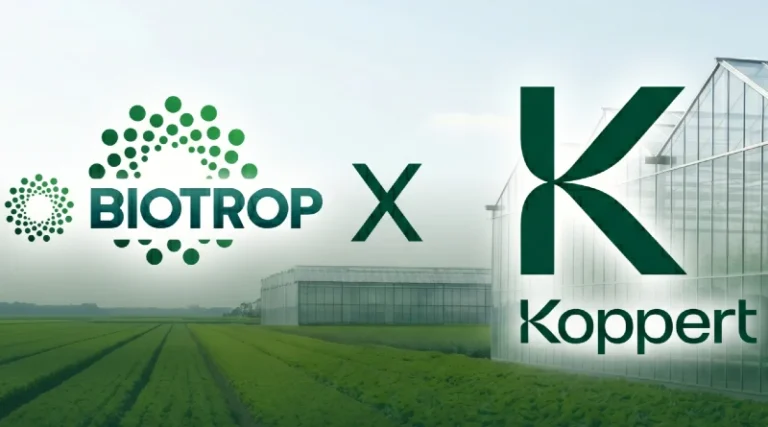
In May 2026, Koppert Brazil confirmed to AgFeed that it had initiated research to develop a biological herbicide based on a fungal organism — unprecedented in the global market. The project involves SPARCBio, the company’s advanced research center in Piracicaba (São Paulo), with 74 internal researchers and partnerships with Universidade Federal de Viçosa, Universidade Federal de Uberlândia, and Wageningen University, one of the world’s leading references in agricultural science.
Koppert’s CEO Danilo Pedrazzoli was precise in calibrating expectations: the pipeline is extensive, and it is very difficult to project when any product will reach the market. The company’s own track record speaks to this, its flagship 2026 launch is the result of 23 years of research. Koppert is focusing on a product with defined targets and controlled selectivity: not a glyphosate replacement, but a biological solution for resistant weeds like Conyza bonariensis and Digitaria insularis, two of the most problematic species in Brazilian soybean and corn farming where chemical resistance is already a concrete and growing field problem.
Biotrop, one of Brazil’s leading biological input companies, announced for 2026 the launch of what its CEO Jonas Hipólito described as “the first bioherbicide in the world at scale.” The company closed 2025 with revenues approaching R$ 900 million, 23% growth in a difficult year for Brazilian agriculture, and more than €15 million invested in R&D. It is a bold claim and like every bold claim in agriculture, it will ultimately be judged in the field, not in the press release.
Two significant players betting on the same frontier, at different timings and with distinct technical approaches. What matters strategically is that both are signaling that the equation is beginning to become addressable.
What the Industry Still Needs to Resolve
Leading experts like Pearce and Marrone are candid about the remaining obstacles. Consistent efficacy across different climates, soil types, and application conditions remains the biggest technical bottleneck. The shorter shelf life of biological products relative to synthetics creates logistics and storage complexity. And the narrower activity spectrum which can be an advantage in specific contexts is a serious limitation when a grower needs a solution for multiple weed species in the same field.
But the most consequential challenge is not technical. It is positioning.
A bioherbicide that enters the market as “a more sustainable alternative to glyphosate” will find itself in a price battle it cannot win. A bioherbicide that enters as “a solution for the problem glyphosate no longer solves”, resistant weeds, compliance with premium export market requirements, reduction of chemical residue in specific crop systems has a value proposition the grower can calculate and pay for.
The difference between those two narratives is not technical. It is strategic.
The Structural Driver That Nobody Had to Create
There is a powerful tailwind that no market player needed to manufacture: herbicide resistance.
Conyza bonariensis and Digitaria insularis resistant to glyphosate and multiple other modes of action are already established realities across Brazil’s Cerrado. This problem will not diminish, it will intensify, because resistance develops precisely through the selective pressure of repeated use of the same mechanisms. The grower facing declining efficacy does not have a biological alternative today. When one arrives consistent, scalable, correctly positioned — adoption will follow.
The market will exist. The question is who will be ready to lead it.
The Questions Every Industry Executive Should Be Asking
For CEOs and senior leaders of input companies, distributors, and investors, this movement raises three concrete strategic questions:
Where exactly does the bioherbicide enter the weed management system? The addressable market changes completely depending on the answer. If the entry point is resistant weeds in broadacre crops, the opportunity is real but much smaller than the R$ 47 billion total herbicide market suggests. If the entry is in high-value crop systems with export traceability requirements, the pricing logic and channel model change entirely. Without clarity on this, any investment in development or distribution is being made without a map.
Is your commercial channel capable of selling a category that still needs to prove its efficacy? The consultative sale of a product with no established benchmark, to a grower accustomed to the predictability of chemical weed control, is completely different from what most distribution networks are built to do. This capability gap is systematically underestimated by companies developing these products.
Are you monitoring what will happen in the first adoption cycles? The biggest risk is not technical, it is reputational. A bioherbicide that enters the market with inconsistent field results will close a window that took decades to open. The first grower experience with this category will define the adoption curve for many years.
A Real Frontier, With Real Challenges
Koppert and Biotrop are betting on a category that does not yet commercially exist. The skepticism of experts like Pearce is legitimate and evidence-based — hundreds of identified actives, very few in the market. The problem is not a lack of science. It is the difficulty of transforming science into a product that works consistently, at scale, at a price growers will pay.
But the resistance problem is equally real. And it will grow every season.
The question is not “will bioherbicides succeed?” It is: what is the specific value proposition that will make growers integrate it into their weed management program, even given current limitations? Whoever has a clear answer to that before launching will build a durable market position. Whoever launches without that clarity will learn from the field and the field is an expensive teacher.
A question worth sitting with: does your company have a clear thesis on where bioherbicides fit — not in the sustainability narrative, but in the actual weed management decisions of real growers? Or are you waiting for the market to define itself before you react?
Global Agriculture is an independent international media platform covering agri-business, policy, technology, and sustainability. For editorial collaborations, thought leadership, and strategic communications, write to pr@global-agriculture.com