EU Council Rejects Unlimited Pesticide Approvals, Agrees 15-Year Cap for Most Active Substances
01 October 2026, Brussels: The Council of the European Union adopted a formal negotiating position on September 29 and 30 that scales back the European Commission’s push to grant indefinite approvals to most pesticide active substances, setting a maximum of 15 years for first-time approval and 25 years for renewals instead. The move, confirmed in an official Council document dated September 30, 2026, marks the next step in the bloc’s “Omnibus X” simplification package covering food and feed safety rules, and it sets up a fight with the European Parliament over how far to loosen pesticide oversight in the name of cutting red tape for farmers and manufacturers.
Under the Commission’s original proposal, most plant protection products, aside from the most hazardous ones, would have received perpetual authorization once approved. The Council’s countervailing text keeps unlimited approval available only for substances classified as low-risk. Every other standard active substance would be capped at 15 years on first approval, with renewals allowed for up to 25 years. Substances approved under the more limited derogation procedure set out in Article 4(7) of the EU’s pesticide framework would be capped even more tightly, at five years for both initial approval and renewal.
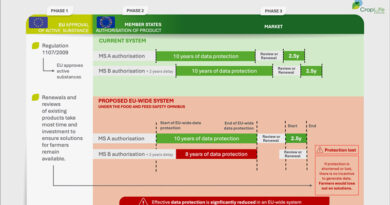
The Council’s text also addresses what happens to products once an approval lapses or is withdrawn. Member states would be allowed to grant grace periods so that existing stocks can still be sold and used: 18 months in standard cases, extended to as long as three years in cases where no alternative product is available in a given member state. A related measure would lengthen the protection period for the test and study data companies submit to support registrations, a change intended to give data owners more time to recoup research costs before competitors can rely on the same studies.
Ireland, which holds the rotating Council presidency this half of the year, steered the file through ministers meeting at the Agriculture and Fisheries Council in Brussels on September 28 and 29, chaired by Irish Agriculture Minister Martin Heydon. Ireland’s Minister of State for European Affairs and Defence, Thomas Byrne, described the agreement as another step forward in the simplification effort, framing it as a way to ease the compliance burden on farmers while preserving health and environmental safeguards. The Council now intends to open negotiations with the European Parliament once MEPs settle their own position, with both sides targeting a provisional political agreement before the end of 2026.
Live Newsroom
Environmental and public health campaigners were quick to push back. The group Pesticide Action Network Europe warned that extending approval windows and easing data and sell-through rules risks keeping substances with known hazards in circulation for longer than current rules allow, arguing the simplification drive prioritizes industry convenience over the precautionary standards that underpin EU pesticide law. Industry groups, by contrast, have broadly welcomed the direction of travel, arguing that Europe’s current renewal process is so slow and resource-intensive that it is contributing to the loss of active substances from the EU market faster than new ones can be approved.
For global agribusiness, the outcome of this negotiation matters well beyond Europe’s borders. The EU’s pesticide approval regime is one of the two or three reference frameworks that regulators in Latin America, Asia, and Africa watch most closely when setting their own rules, and a longer, more predictable approval horizon in Europe could ease registration planning and cost recovery for multinational crop protection companies operating there. At the same time, any perception that the EU is loosening its safety standards could sharpen scrutiny of EU agricultural exports and feed into ongoing debates in Brussels about applying the same pesticide standards to imported food, a parallel policy track that is being negotiated on a separate timeline. Companies exporting into the EU, or competing with EU-registered products in third markets, have a direct stake in how this trilogue concludes.
Also Read: Dhanuka Agritech Launches Adjuvant Wetcit Neo and Rice Blast Fungicide Fujita for the Indian Market
Global Agriculture is an independent international media platform covering agri-business, policy, technology, and sustainability. For editorial collaborations, thought leadership, and strategic communications, write to pr@global-agriculture.com