And the real strategic question is no longer whether this transformation will happen, it already is. The question is who leads it, and who gets swept along.
A Model That Reached Its Limits
For decades, the logic was straightforward: discover a proprietary molecule, secure the patent, monetize the exclusivity window.
The so-called “Big Six”, BASF, Bayer, Dow, DuPont, Monsanto, and Syngenta dominated global markets for generations on the strength of that model.
The problem is that this model has two relentless adversaries: time and market physics.
According to a 2024 study conducted by AgbioInvestor, bringing a new active ingredient from lab to field cost an average of US$152 million in 1995. In the 2014–2019 period, that figure reached US$301 million, nearly double in nominal terms. The average lead time from first synthesis to commercial launch now stands at 12.3 years.
More cost. More time. Fewer molecules reaching the market. Median R&D spending among publicly traded agribusinesses has flatlined over the last fifteen years, with an increasing focus on lifecycle management and formulation differentiation — not on new molecule discovery. The model of controlling the full value chain, from discovery to commercialization, is no longer viable. That is not my assessment. It is what industry executives themselves are saying.
The Wave That Is Coming
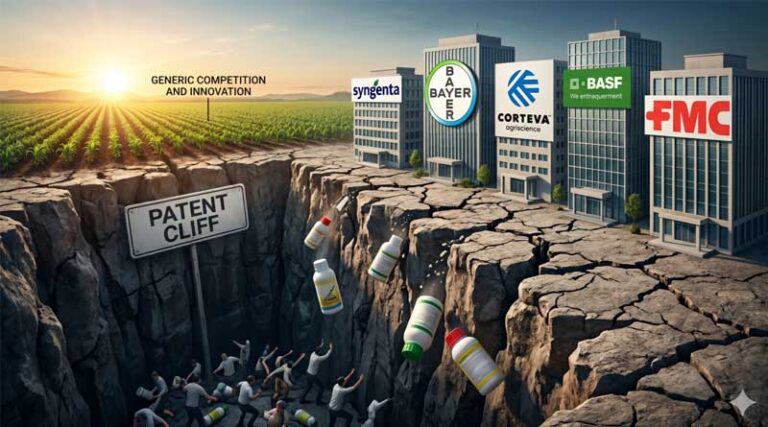
A significant share of the blockbuster products that have underpinned major companies’ revenues for decades is losing exclusivity.
To understand the scale: prothioconazole alone generated US$1.3 billion in global sales in 2023. Chlorantraniliprole, once the world’s largest insecticide saw its compound patent expire in 2022. According to AgroPages, 105 active ingredients lost patent protection globally between 2009 and 2023. The next cycle, running from 2026 to 2028, concentrates some of the highest-value molecules still under exclusivity in a global market worth approximately US$85 billion per year.
For farmers: more options, lower prices, better agronomic flexibility. For multinationals: a forced strategic reset. Which side of that equation are you on?
The Pharma Lesson
Big Pharma went through exactly this. Its own patent cliff broke the vertically integrated model where large companies controlled every step from discovery to commercialization. The response was an admission that they were not efficient at every stage, and a pivot toward scale platforms rather than solitary molecule discovery.
As agtech entrepreneur Matt Crisp frames it: “Pfizer didn’t stop being Pfizer when it stopped doing as much internal discovery. They just got better at what they were already best at.”
Crop protection is arriving at the same crossroads roughly ten to fifteen years behind pharma, with the advantage of being able to learn from a road already traveled.
The structural signals are unmistakable:
FMC reported a Q4 2025 GAAP net loss of US$1.72 billion and, in February 2026, authorized its Board to explore strategic options including a potential sale of the company
Syngenta filed for a Hong Kong IPO in Q2 2026, targeting a launch in Q4 2026 in an offering that could raise up to US$10 billion
BASF is targeting a Frankfurt Stock Exchange IPO of its Agricultural Solutions division, with IPO readiness set for 2027 and estimated unit value of approximately €20 billion
Corteva is on track to separate its crop protection and seed businesses into two independent publicly traded companies in Q4 2026
Bayer continues to manage the enormous overhang of glyphosate litigation, which has constrained its capital allocation for years
This is not a company-specific crisis. It is the structural failure of an entire business model.
China’s Capacity Trap and India’s Hybrid Play
China executed the late-mover playbook with precision: wait for patents to expire, build integrated low-cost supply chains, dominate the global supply of generic active ingredients.
It worked for a time.
When everyone sees the same window, the window closes fast. For compounds like pyroxasulfone and S-metolachlor, Chinese manufacturers’ planned production capacity already far exceeds actual field demand, according to Kynetec data. This is the classic overcapacity trap: everyone arrives with more manufacturing than the market absorbs, driving margins to levels that do not justify the capital deployed.
There is also a structurally unsustainable B2B dynamic: multinationals under margin pressure are asking Chinese suppliers to compress further without offering long-term volume commitments in return. That equation has no good ending for either side.
The strategic response from parts of Chinese industry is to move up the value chain: invest in new molecules, secure own registrations in global markets, develop differentiated formulations, build direct farmer brands. A legitimate ambition. But one that requires a deep cultural shift, from manufacturer to value creator, from price-taker to margin architect. That transition is harder than it looks, and results so far are mixed.
India charts a different course. Companies like UPL and PI Industries have built hybrid models, neither pure generics nor classic innovators that leverage decades of emerging market relationships and relatively agile regulatory frameworks. They are worth watching as a blueprint for what “generics plus” could look like at scale.
The Regulatory Divide That Sharpens the Stakes
One factor that is easy to underestimate outside Europe: the regulatory asymmetry between markets is widening.
The EU’s shift from a risk-based to a hazard-based registration framework has already removed dozens of established chemistries from the European market. New active ingredients face an increasingly narrow approval corridor. The result is a growing divergence between what farmers in Europe can access versus what is available in North America, Latin America, and Asia — and a compound risk for companies whose European registration anchors their global economics.
This regulatory pressure does not slow the patent cliff. It accelerates the urgency of the innovation gap.
Three Vectors That Will Define the Next Decade
The future of crop protection is not the end of chemistry. It is its reinvention — combined with technologies that looked distant just ten years ago.
AI in discovery. At a U.S. congressional hearing in May 2025, Corteva’s VP of Agricultural Solutions described how AI allowed the company to model 10,000 candidate molecules in a matter of weeks, a task that would have taken years through traditional methods. AgPlenus, a subsidiary of Evogene, takes this further with a target-based discovery approach inherited directly from the pharma model, and has active partnerships with both Corteva and Bayer for new modes of action. Predicting the protein structure of a pest in seconds at near-zero marginal cost changes the economics of discovery entirely.
Biologicals as complement, not competitor. The growth of biocontrol is not regulatory fashion — it is a response to real pressure: mounting resistance, shrinking chemistry registrations, and market demand for sustainability. Global biologicals are growing at double-digit rates in key segments, with multinationals accelerating investment in fermentation, microbiome science, and nature-inspired molecules. The winning model integrates chemistry and biologicals in the same management system.
Open innovation ecosystems. Corteva-Micropep (peptide-based biocontrol), Syngenta-Provivi (pheromone-based fall armyworm control), and Syngenta-Enko (new mode of action targeting fungicide resistance) are not isolated deals. They signal a structural shift: majors increasingly acting as scaling platforms, with smaller innovators taking upstream risk. As Mark Brooks, former managing director at both FMC Ventures and Syngenta Ventures, puts it: “A lot of the best innovation is happening outside incumbents right now and they can’t afford to miss it.”
Lead, or Be Led
Replace “R&D model” with “business model” and the sentence applies equally to multinationals, distributors, formulators, and entire market ecosystems.
The transformation is irreversible. The pharma playbook exists, is well documented, and can be adapted. The window for those who move first is still open.
But it will not stay open indefinitely.
Which of these trends do you think will reshape the industry most in the next three years? Share your view in the comments.
Global Agriculture is an independent international media platform covering agri-business, policy, technology, and sustainability. For editorial collaborations, thought leadership, and strategic communications, write to pr@global-agriculture.com