China’s Autumn Grain Harvest Holds Firm Against Storms and Drought
28 September 2026, Beijing: China’s summer grain output reached 150.7 billion kilograms this year, up 0.7 percent from a year earlier and the first time the figure has topped 150 billion kilograms, even as typhoons, flooding and pockets of drought hit major farming provinces through the growing season. The country’s autumn harvest, which accounts for the bulk of annual output, is now underway across Hubei, Henan and Heilongjiang, and officials say China remains on track to meet its annual grain target of roughly 700 billion kilograms (700 million tonnes), according to reporting by Xinhua and People’s Daily published on September 23 and 24.
The resilience has come from a mix of on-farm improvisation and years of state investment in irrigation, drainage and mechanization. In Anhui province, rice grower Lu Weijun said his cooperative watched the weather forecasts for an approaching typhoon and used ten irrigation machines to pump water into the fields in advance, reducing wind damage to standing rice. In Jilin, a historically drought-prone province, farmer Chen Zhanchao described drip irrigation lines that deliver water mixed with fertilizer directly to plant roots, a technique that has spread widely across the region’s grain belt in recent years.
Weather has not been uniformly kind. Shandong faced both excessive rainfall, which pushed up moisture content in standing corn, and a bout of frost that damaged wheat, while other regions weathered flash flooding. To manage the damage, local agriculture departments have deployed large-scale grain drying towers that can cut a batch’s moisture content within twelve hours, alongside satellite and drone surveys that let officials assess losses field by field rather than waiting for harvest tallies. Crop insurance has also absorbed some of the shock: farmer Ma Jianjun received a payout of 203,600 yuan (roughly $28,700) after 581.8 mu, about 39 hectares, of his wheat was damaged.
Precision Tools Reach the Fields
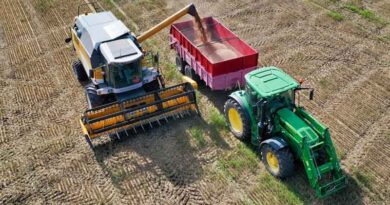
The push toward mechanization is most visible in Heilongjiang, China’s largest grain-producing province, where local authorities say more than 25,000 precision seeders and 33,000 crop-protection drones are now in use, alongside BeiDou satellite-guided autonomous tractors that can plant and till with minimal driver input. Henan, another major grain province, has reported mechanization rates of around 90 percent for both planting and harvesting of its staple crops. Nationally, authorities say more than one billion mu, about 66.7 million hectares, of high-standard farmland, with upgraded irrigation, drainage and road access, has now been built, underpinning the push for steadier yields regardless of weather swings.
Live Newsroom
Fertilizer supply has been a separate pressure point this year. Global fertilizer prices rose roughly 31 percent through 2026, driven largely by tensions around the Strait of Hormuz that disrupted shipping and nutrient exports from the Gulf region. Rather than let domestic prices spike in step with world markets, Beijing released more than 10 million tonnes of state fertilizer reserves during the spring planting window and leaned on a distribution network of more than 4,800 agricultural input enterprises and roughly 280,000 grassroots service outlets to keep supply moving to farmers at stable prices. Liu Huanxin of the National Food and Strategic Reserves Administration said the country’s grain market has “remained generally stable” and that food security is “well guaranteed,” a claim the harvest data so far supports, though the final autumn tally will not be confirmed until later in the season.
Also Read: New US Tariffs on Chinese Drones Raise Costs for Spray-Drone Farmers
Global Agriculture is an independent international media platform covering agri-business, policy, technology, and sustainability. For editorial collaborations, thought leadership, and strategic communications, write to pr@global-agriculture.com