Gene Map of Mustard’s “Self-Rejection” System Could Fast-Track India’s Hybrid Oilseed Breeding
16 September 2026, Gandhinagar: Researchers at the Indian Institute of Technology Gandhinagar (IITGN), working with the ICAR-Directorate of Rapeseed-Mustard Research (ICAR-DRMR) in Bharatpur, have identified and functionally tested the genes that let some mustard plants block their own pollen, a discovery that could remove one of the biggest bottlenecks in producing high-yield hybrid mustard seed. The study, led by Dr. Subramanian Sankaranarayanan of IITGN’s Department of Biological Sciences and Engineering with PhD scholars Hemal Bhalla and Kumari Ankita as co-first authors, was published in Frontiers in Plant Science on July 2, 2026, and highlighted in a EurekAlert release on September 3, 2026.
The work centers on a trait called self-incompatibility, in which a plant’s stigma recognizes and rejects its own pollen, forcing cross-pollination with a different plant. Plant breeders prize this trait because it is the natural mechanism that makes large-scale hybrid seed production possible without the labor of hand-emasculating flowers, a manual process that removes the male parts of each flower one by one to prevent self-fertilization. India’s mustard breeding programs have lacked a clear molecular map of how this rejection system works in local varieties, which has slowed the rollout of hybrid mustard at a time the government is pushing to cut the country’s edible oil import bill.
How the Self-Rejection Switch Works
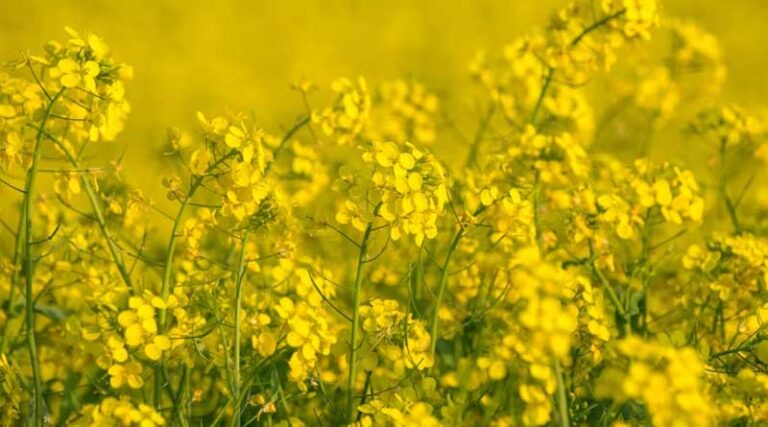
The team compared two related mustard types: toria (Brassica rapa var. toria), which is self-incompatible and rejects its own pollen, and yellow sarson (Brassica rapa var. yellow sarson), which is self-compatible and accepts it. They cloned and sequenced four genes involved in the rejection response, known by the shorthand SRK, FER1, MLPK and ARC1, and used the AlphaFold3 structure-prediction tool from Google DeepMind and Isomorphic Labs to model the three-dimensional shape of the proteins these genes produce. The modeling suggested the four proteins work together as a relay: one acts as a sensor on the stigma surface that detects incompatible pollen, others process that signal, and the last one executes the rejection.
To confirm this in living plants, the researchers used custom antisense oligonucleotides, short synthetic genetic sequences that temporarily switch off a targeted gene, applied directly to the flower stigmas rather than through slower, permanent genetic transformation. When SRK, FER or ARC1 was silenced individually, toria lost its ability to reject its own pollen and began accepting self-pollination, confirming each gene’s role in the rejection pathway. MLPK, by contrast, turned out to play only a minor, redundant role in toria, a finding that differs from its more central role reported in some other Brassica species and suggests the rejection mechanism is not identical across the family.
The team also tracked the plant’s chemical defense response using Nitro Blue Tetrazolium staining, a technique that visualizes reactive oxygen species, highly reactive molecules cells produce as part of stress and defense signaling. This revealed that flowers deploy two overlapping defense routes when rejecting incompatible pollen, an oxidative burst pathway and a separate pathway that degrades cellular material, suggesting some built-in redundancy in how the plant enforces cross-pollination. In controlled crosses between toria and yellow sarson, pollen attachment, tube growth into the stigma and eventual seed development all proceeded normally, with near-complete seed germination, indicating the two types remain fully cross-compatible despite their different self-pollination behavior.
From Gene Map to Hybrid Seed
The practical payoff, according to the authors, is a clearer molecular blueprint that breeders can use to engineer or select for stronger, more reliable self-incompatibility in elite mustard lines, which in turn simplifies large-scale hybrid seed production. Instead of relying on labor-intensive hand emasculation or less precise chemical hybridizing agents, breeders could eventually use marker-assisted selection tied to these four genes to build seed-parent lines that reliably block self-pollen. The researchers also point to the potential to stack this trait with others, such as higher oil content and disease resistance, and to breed mustard types better suited to erratic monsoon rainfall and rising temperatures during flowering. The authors are careful to note that permanent gene editing of these targets, transgenic validation and commercial variety development are still future steps, not immediate outcomes of this study.
Mustard is India’s second-largest edible oilseed crop after soybean, and the country still imports more than half of its edible oil demand, a gap the government’s National Mission on Edible Oils-Oilseeds is meant to narrow through higher domestic yields. Hybrid technology has already lifted yields in crops like cotton and pearl millet, and mustard breeders have long viewed a dependable self-incompatibility system as the missing piece for similar gains in oilseed rape. For India’s seed industry and for global agri-input companies watching the world’s largest mustard-consuming market, a validated genetic toolkit for hybrid mustard seed production points toward a faster, cheaper route to commercial hybrids, potentially shortening breeding timelines that currently stretch beyond a decade. Seed companies operating in South Asia, as well as breeding programs in Australia, Canada and Europe that grow related Brassica oilseed species, stand to benefit from a validated set of molecular markers for this trait, since it reduces reliance on trial-and-error field selection.
Global Agriculture is an independent international media platform covering agri-business, policy, technology, and sustainability. For editorial collaborations, thought leadership, and strategic communications, write to pr@global-agriculture.com