22 July 2026, New Delhi: India’s kharif sowing has reached 658.19 lakh hectares as of July 17, 2026, compared with 700.47 lakh hectares during the corresponding period last year, reflecting a decline of 42.28 lakh hectares, according to the latest data released by the Ministry of Agriculture & Farmers Welfare.
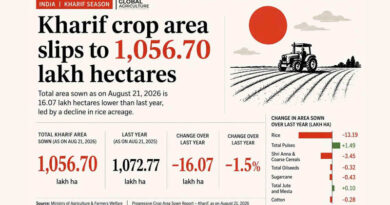
Among major crops, rice remained largely stable, with sowing at 166.41 lakh hectares, only 1.41 lakh hectares lower than the 167.83 lakh hectares recorded a year ago.
The sharpest decline was observed in the pulses category, where acreage dropped by 12.29 lakh hectares to 69.23 lakh hectares from 81.52 lakh hectares last year. Within pulses, tur (arhar) sowing declined by 5.36 lakh hectares, followed by moong (-2.97 lakh hectares) and moth bean (-2.87 lakh hectares).
Sowing of Shri Anna (millets) and coarse cereals also lagged behind last year’s pace, covering 119.03 lakh hectares, down 15.06 lakh hectares. The largest reduction in this category was recorded in bajra, where acreage fell by 9.08 lakh hectares, while maize was lower by 3.61 lakh hectares.
Oilseeds covered 147.09 lakh hectares, a decline of 8.63 lakh hectares compared with the same period in 2025. Soybean, India’s largest kharif oilseed crop, was sown across 106.02 lakh hectares, down by 5.02 lakh hectares, while groundnut acreage declined by 3.17 lakh hectares.
Among commercial crops, cotton acreage stood at 92.53 lakh hectares, 5.87 lakh hectares lower than the corresponding period last year. In contrast, sugarcane and jute & mesta recorded marginal gains, with sugarcane acreage increasing by 0.86 lakh hectares to 57.58 lakh hectares, while jute & mesta rose by 0.13 lakh hectares to 6.32 lakh hectares.
The ministry’s data indicate that kharif sowing is progressing across states as the southwest monsoon advances, although acreage in several key crops remains below last year’s levels at this stage of the season. The sowing figures are expected to change further as planting continues in major producing regions over the coming weeks.
Progress of Kharif Sowing as on July 17, 2026 (Area in lakh hectares)
Global Agriculture is an independent international media platform covering agri-business, policy, technology, and sustainability. For editorial collaborations, thought leadership, and strategic communications, write to pr@global-agriculture.com