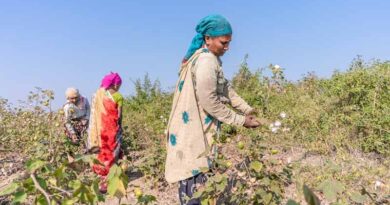
18 August 2026, New Delhi: India has crossed the 1,000 lakh hectare mark for Kharif sowing in 2026, with farmers covering 1,016.57 lakh hectares as of August 14, according to the latest data released by the Ministry of Agriculture and Farmers Welfare.
The number looks encouraging at first glance. However, it is still 20.95 lakh hectares lower than the area covered during the corresponding period last year, when 1,037.52 lakh hectares had been sown.
Compared with the five-year normal Kharif area of 1,104.46 lakh hectares, based on the average for 2020-21 to 2024-25, the current acreage is about 87.89 lakh hectares lower. In percentage terms, farmers have covered around 92% of the normal Kharif area so far.
The data also shows that the story is not simply about lower or higher sowing. Farmers are changing the crop mix. Rice has taken the biggest hit, while urad, sesame, groundnut, jowar and bajra have gained acreage. Soybean and maize, two crops that were being closely watched because of fertilizer supply concerns and the disruption around the Strait of Hormuz, have both recorded lower acreage than last year.
Area in lakh hectares. Source: Ministry of Agriculture and Farmers Welfare, Government of India. Data as of August 14, 2026.
How close is India to normal Kharif acreage?
The five-year normal provides a useful benchmark because comparing only with last year’s acreage can sometimes give a misleading picture. India’s total Kharif acreage of 1,016.57 lakh hectares is 87.89 lakh hectares below the normal area of 1,104.46 lakh hectares. That means the country is at roughly 92% of its normal Kharif acreage.
The position differs considerably from crop to crop. Rice is at around 92% of its normal area. Pulses are at about 87.5%, while oilseeds are at roughly 92.2%. Cotton is weaker at about 85.5% of normal. Maize, on the other hand, is already at about 109% of its five-year normal area. Sugarcane is also well above normal at nearly 108% of its normal acreage.
This distinction is important. Maize may be down compared with last year, but it is still being planted on a considerably larger area than the long-term average.
Rice accounts for most of the shortfall
Rice is clearly the biggest concern in the current acreage numbers. Farmers have planted 379.07 lakh hectares of rice, compared with 393.44 lakh hectares at the same point last year. The reduction is 14.37 lakh hectares. The gap becomes even more significant when compared with the five-year normal of 412 lakh hectares. Current rice acreage is 32.93 lakh hectares below normal.
The decline is spread across several major rice-growing states. Karnataka has reported a reduction of 2.86 lakh hectares, Jharkhand 2.26 lakh hectares, Maharashtra 2.25 lakh hectares and Odisha 2.09 lakh hectares. Madhya Pradesh has recorded a decline of 1.64 lakh hectares, followed by Telangana at 1.49 lakh hectares, Tamil Nadu at 1.17 lakh hectares and Andhra Pradesh at 1.14 lakh hectares.
Gujarat, West Bengal, Uttar Pradesh and Bihar have also reported lower acreage. Assam is a major exception, with rice acreage increasing by 3.93 lakh hectares.
The lower acreage does not automatically mean an equivalent decline in production. Yield will ultimately determine how much of the area loss translates into actual output. But with rice accounting for such a large share of India’s Kharif area, the acreage decline will remain one of the most closely watched numbers as the season progresses.
Soybean did not get the acreage boost many expected
One of the interesting expectations ahead of the season was that soybean could gain acreage as farmers reconsidered maize. The argument had some basis. Maize had faced concerns around supply, feed demand, ethanol demand and prices. At the same time, the disruption caused by the closure of the Strait of Hormuz raised concerns about fuel, fertiliser and wider agricultural supply chains.
There was therefore a theory in the market that soybean could emerge as one of the beneficiaries. The latest acreage data does not support that view, at least so far. Soybean has been planted on 120.84 lakh hectares, compared with 122.61 lakh hectares last year. That is a decline of 1.76 lakh hectares. It is also below the five-year normal area of 128.71 lakh hectares by almost 7.87 lakh hectares.
In other words, soybean is currently at only about 94% of its normal Kharif area. The Strait of Hormuz disruption has nevertheless been important for agriculture. The route is critical for energy and fertiliser supply chains, and concerns had emerged over the movement of fertilisers and raw materials into India. But the acreage data suggests that the disruption did not result in a major shift from maize to soybean.
Maize is lower, but still above normal
Maize acreage has fallen by 3.67 lakh hectares from last year, from 92.06 lakh hectares to 88.39 lakh hectares. This is a decline of almost 4%. However, maize remains well above its five-year normal acreage of 80.77 lakh hectares.
Current maize acreage is therefore about 7.62 lakh hectares above normal. This is an important distinction. The reduction in maize acreage does not mean that farmers have moved away from maize in a major way. The crop is still occupying substantially more land than its five-year average.
The final production picture will also depend heavily on yields and the regional distribution of the crop. Maize remains important for India’s feed, starch and ethanol industries, which means its acreage and production will continue to have implications beyond the farm sector.
The biggest acreage gainers
Among individual crops, urad has recorded the largest increase, with acreage rising by 2.73 lakh hectares to 23.52 lakh hectares. Sesame is another major gainer, increasing by 1.63 lakh hectares to 10.35 lakh hectares.
Groundnut acreage has increased by 1.02 lakh hectares, while both jowar and bajra have gained 0.69 lakh hectares each. Sunflower acreage has also increased by 0.46 lakh hectares. The increase in urad is particularly interesting because total pulse acreage has actually declined marginally.
This means the pulse story is not simply about farmers planting fewer pulses. There has been a shift within the pulse basket.
Crops that have lost the most acreage
Rice has suffered the largest decline, down 14.37 lakh hectares from last year. The next largest declines are in:
Maize: -3.67 lakh hectares
Castor: -2.35 lakh hectares
Soybean: -1.76 lakh hectares
Arhar: -1.69 lakh hectares
Ragi: -1.80 lakh hectares
Cotton: -0.96 lakh hectares
Oilseeds overall: -0.89 lakh hectares
The numbers show that the acreage reduction is concentrated in a handful of important crops rather than being spread evenly across the entire Kharif basket.
Cotton remains well below normal
Cotton is another crop that deserves attention. The area under cotton is currently 107.30 lakh hectares, compared with 108.26 lakh hectares last year. That is a decline of 0.96 lakh hectares. More importantly, the current acreage is substantially below the five-year normal of 125.51 lakh hectares. The gap is 18.21 lakh hectares, meaning cotton acreage is only about 85.5% of normal.
The biggest declines have come from Rajasthan, where acreage is down 1.09 lakh hectares, followed by Haryana at 0.90 lakh hectares and Punjab at 0.43 lakh hectares. Maharashtra has lost another 0.38 lakh hectares.
There have been significant gains elsewhere. Telangana has added 1.25 lakh hectares, Gujarat 0.64 lakh hectares and Madhya Pradesh 0.11 lakh hectares. So while the national acreage is lower, the geography of cotton cultivation is also changing.
Sugarcane remains above normal
Sugarcane is showing a very different trend. Area under the crop is 58.31 lakh hectares, only 0.31 lakh hectares lower than last year. But compared with the five-year normal of 54.20 lakh hectares, sugarcane is still 4.11 lakh hectares higher. That makes sugarcane one of the few major Kharif crops currently above its normal acreage.
The continued strength of sugarcane is also linked to the changing economics of the crop, particularly the growing importance of ethanol production alongside sugar.
Oilseeds show a mixed picture
Total oilseed acreage is down marginally at 184.46 lakh hectares, compared with 185.36 lakh hectares last year. However, the individual crop trends are quite different.Groundnut is up by 1.02 lakh hectares and sesame has gained 1.63 lakh hectares. Sunflower is also higher.
Soybean, which accounts for the largest share of the Kharif oilseed area, is down 1.76 lakh hectares. Castor has recorded an even sharper decline of 2.35 lakh hectares. As a result, the overall oilseed acreage remains 15.62 lakh hectares below the five-year normal of 200.08 lakh hectares.
What the acreage data tells us about Kharif 2026
The latest numbers point to a Kharif season that is neither a major acreage collapse nor a return to normal. India has crossed the 1,000 lakh hectare mark, which is significant. But the country is still nearly 88 lakh hectares short of its five-year normal Kharif acreage. The crop-wise picture is even more revealing.
Farmers have reduced acreage under rice, maize, soybean and cotton compared with last year. At the same time, urad, sesame, groundnut, jowar and bajra have gained. The much-discussed shift from maize towards soybean has not happened in the way some market participants expected. Both crops are below their 2025 acreage, although maize remains comfortably above its five-year normal while soybean is below normal.
Rice is the biggest area concern, with a 14.37-lakh-hectare year-on-year decline and a 32.93-lakh-hectare gap against the five-year normal. Cotton is also significantly below normal, while soybean remains weaker than its long-term benchmark.
The Strait of Hormuz disruption adds another layer to the story, particularly because of its implications for fertiliser, energy and logistics costs. But the acreage data so far suggests that Indian farmers have not responded with a wholesale shift from one major crop to another. The bigger question now is what happens to yields.
With sowing largely approaching completion, rainfall distribution, crop condition and yields will determine whether the lower acreage translates into lower production. For rice, soybean, maize, cotton and pulses, that distinction could be particularly important this year. A smaller planted area does not necessarily mean a proportionately smaller harvest if crop conditions and yields turn favourable.
For now, the clearest message from the August 14 data is that India has crossed 1,000 lakh hectares of Kharif sowing, but the country’s crop basket remains below its normal acreage and is undergoing a noticeable shift in composition.
Global Agriculture is an independent international media platform covering agri-business, policy, technology, and sustainability. For editorial collaborations, thought leadership, and strategic communications, write to pr@global-agriculture.com