Berlin Startup hexafarms Raises 4.8 Million Euros for AI Greenhouse Monitoring
23 October 2026, Berlin: Berlin-based agtech company hexafarms has raised 4.8 million euros in seed funding to expand its artificial-intelligence platform for monitoring greenhouse crops and forecasting yields, the company announced on October 6. The round was led by Ananda Impact Ventures and Green Generation Fund, with new participation from Grey Silo Ventures and better ventures, alongside existing investors Speedinvest, Mudcake and Techstars. hexafarms also secured a Startup Grant from German development bank Rentenbank and a subordinated loan of up to 800,000 euros through a federally backed program.
Founded by chief executive David Ahmed, hexafarms builds what it describes as an operating system for commercial greenhouse growers: proprietary wireless sensors paired with artificial-intelligence software designed to replace guesswork with continuous data. The hardware records climate conditions, substrate moisture, drainage and light levels every five minutes, along with fertigation data, the practice of delivering fertilizer dissolved in irrigation water rather than spreading it dry. hexafarms says commercial growers typically leave up to 30% of potential yield unrealized because growing conditions drift without anyone noticing, harvest forecasts are unreliable, or pest and disease damage is caught only once it is already visible.
The company had previously raised a smaller pre-seed round of 1.3 million euros in May 2024, led by Speedinvest, reflecting a step-up in investor confidence as hexafarms moved from early pilots toward paying customers at commercial scale. That progression mirrors a broader shift in greenhouse technology investment, away from single-purpose sensor gadgets and toward integrated platforms that combine hardware, software and, increasingly, physical monitoring robots under one subscription.
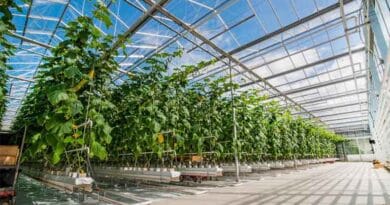
The software side of the platform processes more than 70 of those sensor parameters to generate rolling, zone-by-zone yield forecasts, rather than simply displaying raw climate data on a dashboard. The AI models currently cover roughly 50 fruiting and leafy crop varieties, including tomatoes, peppers, cucumbers, aubergines (also called eggplants) and several berry crops, all grown in protected, climate-controlled environments. As part of the same system, autonomous robots move through the greenhouse scanning every plant once a day across areas of two to three hectares, flagging early visual signs of pests or disease, extending the platform’s early-warning approach from climate data to plant health itself.
From dashboards to forecasts
A key design choice is that hexafarms’ software is built to plug directly into equipment growers already own. The company describes its system as “API-first,” meaning it is built with open connection points that let it exchange data automatically with other software, in this case the climate computers, the automated systems that control greenhouse heating, cooling, ventilation and irrigation, made by established suppliers Priva, Hoogendoorn and Ridder. Rather than asking growers to replace their existing climate-control systems, hexafarms layers its sensors and forecasting software on top of them.
The company also sells the system on a subscription basis rather than as equipment growers must buy outright. hexafarms designs, installs and maintains the hardware itself, which shifts the cost for growers from a large upfront capital expense to an ongoing operating expense. That structure is aimed at lowering the barrier to adoption for mid-sized greenhouse operations that might otherwise be priced out of advanced monitoring technology.
hexafarms says its platform is now used by more than 50 growers across 13 countries, with named customers including SanLucar, Elo and Royal ZON. Collectively, those customers managed more than 300 million euros worth of produce on the hexafarms system and hardware during 2026, according to the company’s own figures; no independent yield-accuracy data for the forecasting models has yet been published. The new funding is earmarked for further developing the wireless sensor network and the pest-and-disease-scouting robots, and for expanding sales in the DACH region of Germany, Austria and Switzerland, as well as the Benelux countries and Spain.
Controlled-environment, or protected, cultivation of high-value fruiting vegetables and berries has been expanding steadily across India and other parts of Asia, as growers chase higher and more predictable yields than open-field production allows; several Indian states have run subsidy schemes in recent years to encourage polyhouse and greenhouse construction. A platform built to turn raw sensor readings into an actual production forecast, rather than just a live climate reading, points to where the controlled-environment agriculture equipment and input industry is headed: growers, along with the equipment and agri-input suppliers that serve them, increasingly need software that predicts outcomes ahead of time, not just hardware that reports current conditions after the fact.
Also Read: Super Typhoon Champi, 2026’s Strongest Storm, Bears Down on Taiwan and East China
Global Agriculture is an independent international media platform covering agri-business, policy, technology, and sustainability. For editorial collaborations, thought leadership, and strategic communications, write to pr@global-agriculture.com