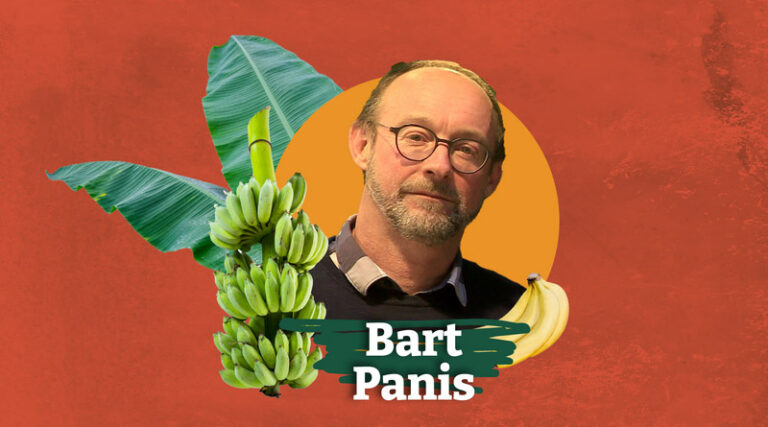
Bart Panis: Cryobank Scientist With a Marathon Vision for the Future of Bananas
23 May 2026, Belgium: In this edition of our Seed Heroes series, we recognize Bart Panis for his pioneering work on the conservation of banana diversity and for leading the establishment of the world’s largest cryobank for bananas in Leuven, Belgium.
Whether Bart Panis is at work or at play, he’s always thinking about the long haul.
A keen long-distance runner, the 62-year-old Belgian plant scientist knows that securing the future of food is a marathon, not a sprint. As manager of the world’s largest banana genebank, Dr Panis is working step by step toward the finish line of conserving the diversity of banana – a beloved food and No. 4 on the list of important crops for developing countries.
“One of the biggest challenges is to generate funding and interest for projects with a long-term goal,” he says. “Even donors want to see a quick result. But what we do is for future generations.”
Panis could be a poster child for the age-old motto “think global, act local.” His techniques to conserve the genetic diversity of bananas have been applied to a range of crops at genebanks worldwide. Yet, he has remained at his alma mater, the University of Leuven (KU Leuven), for more than 40 years, holding various leadership roles at Belgium’s oldest academic institution.
“I’ve spent my entire career in Leuven,” Panis says. “As we say in Belgium, I stick close to the church tower.”
Genebank Manager
For the past three years, Panis has managed the banana collection at the International Musa Germplasm Transit Centre (ITC), hosted at KU Leuven. He carries out these duties for the Alliance of Bioversity International and CIAT. The Alliance works with partners to evaluate the ITC crop diversity for important traits, such as nutrient content, as well as resistance to pests and diseases.
Bananas do not reproduce through seeds, so they cannot be conserved in conventional seedbanks. There are three main ways to conserve bananas:
- In field genebanks, where each plant is given space to grow in natural conditions yet is vulnerable to pests, disease and extreme weather
- In test tubes (in vitro), held as plantlets in carefully controlled conditions of slow growth at 16°C (60.8°F), often used for research and breeding
- With cryopreservation, storing plant material over the long term in liquid nitrogen at -196°C (-320.8°F).
Panis is a globally recognized authority on banana cryopreservation, a process that is anything but simple. As a tropical crop, bananas are averse to low temperatures. They also contain a lot of water, which makes up around 80 percent of a banana plant and can present problems in cryopreservation. Water forms ice crystals, which will damage cell membranes and thus kill the cells, he explains.
But cryopreservation is very effective. According to Panis, it can store genetic material for hundreds, if not thousands, of years. Once a sample is prepared for cryopreservation, it costs a genebank only about USD 2 a year to maintain it. Safeguarding that same sample in vitro costs up to USD 60 a year.
With pride in his voice, he says, “We have cryopreserved more than 1,400 of the 1,700 samples in the collection. We are, by far, the biggest banana cryopreservation facility in the world.”
Going (Beyond) Bananas
The Belgian scientist is also known for a novel cryopreservation protocol called droplet vitrification, which can be applied to more than 40 plant species. This means growing plants in test tubes and then excising, or cutting, tiny tissues of about 1 millimeter in diameter from these plants. These samples are then treated in cryoprotective solutions and plunged into liquid nitrogen for the long-term.
“Such a robust protocol for banana can easily be applied to other crops – potato, sweetpotato, cassava, yam and taro, for example,” Panis says. “Most crops are now cryopreserved using the droplet-vitrification method.”
The protocol was fine-tuned as part of a Crop Trust project to increase the world’s capacity to conserve crops through cryopreservation. Partners included genebanks working at the forefront of cryo – the International Potato Center (CIP) in Peru, the International Institute of Tropical Agriculture (IITA) in Nigeria, the Pacific Community (SPC) in Fiji and the Alliance of Bioversity and CIAT in Colombia.
Panis also established the first protocol for the vegetative propagation of coconut through shoot-tip culture. He has already secured a patent to protect smallholder farmers from exploitation by large corporations that may want to use this method, he says.
Over a long career, Panis has been on a marathon to secure the future for bananas and other crops like it. His work is the epitome of “think local, act global” and ensures we have bananas for generations. But he didn’t always know bananas were his passion.
Early Life
Bartholomeus Jozefus Panis was born in Diest, a Flemish city in northeast Belgium, in 1963. As a child, he spent his summer holidays at his grandparents’ farm.
“It’s there that I developed an interest in plants and the natural world,” Panis says. “I would then go to the library and read books about these topics.”
This interest in plants endured and became an academic pursuit. He completed an undergraduate degree in plant sciences and a certificate in biotechnology at KU Leuven before being awarded a doctorate in applied biological sciences by the same university in 1995.
It was during his studies at KU Leuven that the conservation of crop diversity first sparked his interest. Professor Edmond de Langhe’s courses introduced him to in vitro culture – plant tissue in test tubes – and the genetic makeup of tropical plants, such as bananas.
Also Read: China’s Fertilizer Trade Sees Strong Export Growth in Jan–April 2026, Potash Imports Remain Critical
Global Agriculture is an independent international media platform covering agri-business, policy, technology, and sustainability. For editorial collaborations, thought leadership, and strategic communications, write