Syngenta Expands Australian Seedcare Institute to Advance Agricultural Biologicals
New research capability to focus on biological crop solutions
31 August 2026, Wagga: Syngenta ANZ is expanding its Seedcare Institute at Charles Sturt University’s Agri Park in Wagga Wagga, New South Wales, to support the development and evaluation of agricultural biologicals, a rapidly growing area of crop innovation.
The expanded facility will focus on biological technologies designed to improve crop resilience, nutrient use efficiency and plant health, while supporting biological approaches to pest management. The initiative is expected to give Australian growers greater access to biological crop solutions tested under local growing conditions.
Biologicals encompass agricultural technologies derived from or inspired by nature, including beneficial microorganisms, natural molecules, plant extracts and other bio-based materials. Their potential applications range from improving plant performance under drought and heat stress to enhancing nutrient availability, supporting biological pest control and improving overall plant health and function.
From Seedcare to Seedcare and Biologicals
Established in 2018, the Syngenta Seedcare Institute was originally created to promote safer and more effective approaches to applying seed treatments. With its expanded remit, the facility will now undertake research and evaluation of biological products alongside its existing seedcare activities.
Garth Wickson, Head of Seedcare and Plant Health at Syngenta ANZ, said the development of a purpose-built biologicals capability would help ensure that new technologies are assessed under conditions relevant to Australian growers.
“Our aim is to test and evaluate these technologies under local conditions to answer the question that matters to growers: ‘Will it work here, in this field, in this season?’” Wickson said.
Controlled-environment research strengthens evaluation
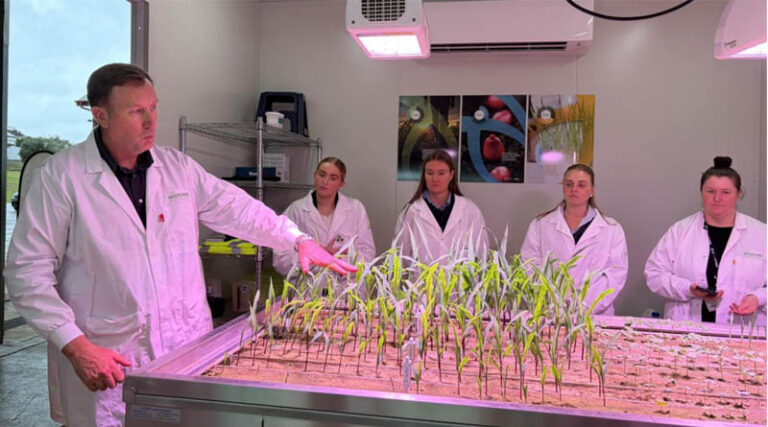
As part of the expansion, Syngenta has invested in a new environmentally controlled growth room equipped with a thermogradient table and expanded growth shelving. The facility will enable researchers to assess biological and seedcare products across a broader range of soil temperatures and other environmental variables.
Additional investment in equipment for the Institute’s existing laboratories will further strengthen its ability to evaluate and develop biological products.
The combination of controlled-environment facilities and laboratory capabilities is expected to help researchers better understand how biological technologies perform across different conditions before they are considered for broader agricultural use.
Nitrogen-fixing inoculant among first technologies to be evaluated
The first product to undergo testing at the expanded facility will be Atuva, a nitrogen-fixing inoculant intended for chickpeas, faba beans and lentils.
Inoculants are among the biological technologies attracting increasing attention in agriculture because of their potential to support nutrient availability and improve crop performance while contributing to more efficient nutrient management.
The local evaluation of Atuva will form part of Syngenta’s broader effort to understand how biological technologies can complement existing crop production systems.
Global biologicals strategy
The Australian investment forms part of Syngenta’s wider ambition to become a global leader in agricultural biologicals. The company has made significant investments in Europe and the United States, including through the acquisition of biological technologies and efforts to expand manufacturing capabilities.
The global agricultural biologicals market is forecast to exceed US$20 billion by 2030, with Australia positioned to benefit as adoption of biological products increases across horticultural and broadacre farming systems.
Syngenta plans to work closely with its global research and development teams to identify promising biological technologies for evaluation in Australian conditions.
“Expanding to become the Seedcare and Biologicals Institute is a game-changer,” Wickson said.
“We aren’t just adding products to a portfolio; we are providing the agronomic expertise to understand how biologicals complement and enhance conventional chemistry.”
The expanded facility is intended to bridge the gap between biological innovation and practical on-farm application, allowing technologies to be tested under local conditions and assessed for their agronomic value.
“It’s about making innovation something our customers can see, test, and trust,” Wickson said.
Also Read: Glyphosate Use in Caldor Fire Restoration Draws Strong Opposition at Lake Tahoe Meeting
Global Agriculture is an independent international media platform covering agri-business, policy, technology, and sustainability. For editorial collaborations, thought leadership, and strategic communications, write to pr@global-agriculture.com