Africa On Alert: Deadly Maize Disease Detected- Experts Warn Of Continent-wide Threat Will We Act Before It Spreads?
22 May 2026, Zimbabwe: A new and dangerous threat to Africa’s most important staple crop has arrived — quietly, but with the potential to trigger far-reaching consequences and scientists are warning that it could spread rapidly across the continent, threatening the staple food of hundreds of millions.
Goss’s wilt of maize, a bacterial disease once largely confined to North America, has now been officially confirmed in South Africa. South African authorities confirmed the disease in 2024, officially reporting it in 2025. By April 2026, it had already spread to eight provinces, signaling that the pathogen is adapting and establishing itself in African conditions. So far, South Africa remains the only country with confirmed cases — but experts warn that this may not last long. For a continent where maize underpins food security, incomes, and livelihoods, this is not just a plant health issue — it is a looming systemic risk.
The question is no longer whether Africa is at risk. The question is whether Africa — and the global community — will act in time.
Why this matters now
Maize is the backbone of food systems across Sub-Saharan Africa. It is being cultivated on nearly 40 million hectares, contributes around 40% of cereal production, and provides at least 30% of calorie intake for hundreds of millions of people. Any major disruption to maize production is therefore not contained to farms — it quickly translates into food price spikes, import dependency, and reduced access to food for vulnerable populations. Recent drought-induced shortages in Southern Africa have already shown how fragile the system can be. Now, a biological threat is emerging that could compound these shocks.
What makes Goss’s wilt so dangerous
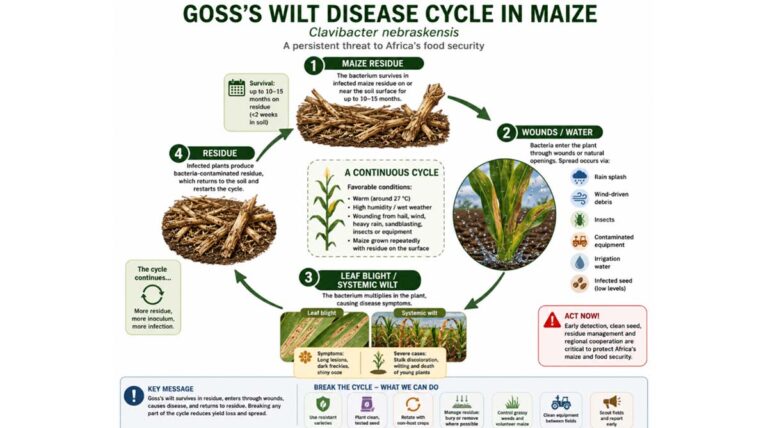
Goss’s wilt is caused by the bacterium Clavibacter nebraskensis. It spreads in ways that make it particularly difficult to contain in African farming systems:
- It survives in infected maize residue for up to a year or more
- It spreads through rain splash, wind-driven debris, and contaminated equipment
- It can move over long distances through low-level infected seed
- It enters plants through wounds caused by storms, insects, or mechanical damage
Once established, the disease can cause:
- Extensive leaf blight that reduces photosynthesis
- Stalk damage and plant weakening
- In severe cases, death of young plants
Critically, there is no curative treatment. Fungicides do not work against Goss’s wilt. There is no in-season cure once plants are infected or if there is an outbreak.
Scientists are raising a troubling possibility: in heavily infected areas, farmers may need to avoid planting maize for multiple seasons to break the disease cycle. For smallholder farmers with limited land and few alternatives, this is not just difficult — it could be devastating.
“Imagine farmers having to wait years before safely growing maize again,” says Ashish Saxena, Director of Global Maize Program at CIMMYT “That’s not just an agricultural problem — it’s a food crisis.”
A perfect storm for spread in Africa
The structure of maize systems in Sub-Saharan Africa creates ideal conditions for this disease to spread and persist:
- Informal seed systems dominate — most farmers rely on saved or locally exchanged seed
- Seed traceability and testing remain limited
- Maize is often grown continuously on the same land
- Crop residues are retained under conservation agriculture practices
- Cross-border seed trade is expanding, often faster than phytosanitary enforcement
This combination means that even a low-probability pathway like seed transmission can become significant at scale, while local spread through residue and plant material becomes difficult to control.
In such systems, a disease does not need to explode overnight to be dangerous. It can spread slowly, persistently, and widely — field by field, season by season. Now, with confirmed presence in South Africa, the disease has entered a region that is far more dependent on maize and far less equipped with uniform biosecurity systems.
What is at stake
If Goss’s wilt becomes established across Africa’s maize belts, the impacts could be profound: This is not a distant risk. It is an early-stage continental threat.
For farmers
- Yield losses that can exceed 30–50% on susceptible varieties
- Increased costs for seed replacement and management
- Pressure to abandon maize in already land-constrained systems
For markets and governments
- Rising maize prices and inflation
- Increased reliance on imports
- Strain on national food reserves
For vulnerable populations
- Reduced food access
- Heightened food insecurity
- Deepening inequality between farmers who can adapt and those who cannot
- In extreme cases, heavily affected areas may need to break continuous maize cultivation cycles, something many smallholders cannot afford to do.
What can be done — and what must be done now
The science is clear: Goss’s wilt can be managed, but only with early, coordinated, and sustained action.
For Governments
- Treat Goss’s wilt as a regional biosecurity priority
- Launch targeted surveillance and diagnostic systems in major maize belts
- Strengthen seed health testing and certification, especially for cross-border trade
- Invest in screening and deployment of resistant maize varieties
- Coordinate responses through regional platforms such as SADC and COMESA
For Donors and Development Partners
- Fund rapid-response surveillance and early warning systems by deploying digital tools and innovations
- Support breeding programs for disease resistance adapted to African conditions
- Invest in strengthening seed systems, including quality assurance and traceability
- Enable regional collaboration to match growing maize seed trade with robust phytosanitary systems
For the General Public and Farming Communities
- Learn to recognize symptoms: long wavy lesions, dark freckles, and shiny residue
- Report suspicious outbreaks early
- Avoid moving seed or crop residues from affected fields
- Use trusted, traceable seed sources whenever possible
- Practice basic field hygiene, including cleaning tools and equipment
A narrowing window of opportunity
Africa still has a critical advantage: the disease is not yet widespread across the continent. But that window will not remain open indefinitely.
If action is delayed, Goss’s wilt could follow the same trajectory seen elsewhere — moving from isolated detections to widespread establishment, with increasingly costly consequences.
If action is taken now, there is a real opportunity to contain its spread, protect farmers’ livelihoods and safeguard regional food security.
CIMMYT’s call to action
In April 2026, CIMMYT organized a maize field day in Harare under the International Maize Improvement Consortium for partners across Southern Africa. During the event, Mike Jackson of Lake Agriculture, a South Africa-based seed company, speaking from direct experience in the disease’s current hotspots, emphasized the urgent need for Goss’s wilt-resistant maize germplasm, warning that the disease could become a major threat to regional maize production if proactive measures are not taken. His concerns were strongly echoed by other private seed companies, regulatory authorities, and research partners attending the meeting, reflecting growing regional anxiety over the spread of the disease and the preparedness of African maize systems to respond.
At CIMMYT, we see this as a defining moment. This is not only about a disease outbreak — it is about safeguarding the resilience of Africa’s maize systems against emerging biological threats that could undermine food security, seed systems, and farmer livelihoods across the continent.
We therefore call on:
- Governments to act decisively and collaboratively through strengthened surveillance, diagnostics, and regional coordination;
- Donors and development partners to invest early in prevention, resistance breeding, and phytosanitary preparedness rather than responding after widespread establishment;
- Researchers, seed companies, and national programs to accelerate screening and deployment of resistant germplasm and strengthen seed health systems;
- Farmers, extension agents, and communities remain vigilant, informed, and proactive in reporting suspicious outbreaks.
The cost of inaction will be far greater than the cost of prevention. At CIMMYT, we are not only ready to provide solutions to confront this emerging threat, but are more committed than ever to safeguarding Africa’s food security through science-driven innovation, accelerated development of resistant maize germplasm, and strengthened partnerships with governments, seed companies, research institutions and donors across the continent.
The disease has arrived. The science is clear. The response must begin now.
Also Read: China’s Fertilizer Trade Sees Strong Export Growth in Jan–April 2026, Potash Imports Remain Critical
Global Agriculture is an independent international media platform covering agri-business, policy, technology, and sustainability. For editorial collaborations, thought leadership, and strategic communications, write