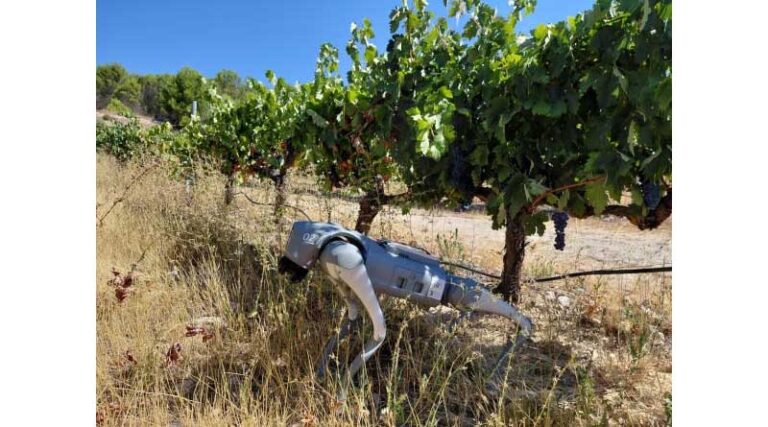
26 October 2026, Spain: A four-legged robot nicknamed Agrhound has begun walking through Spanish vineyards and berry farms as part of a research project testing whether legged machines can scout crops on ground too steep or uneven for the wheeled robots more commonly used in agriculture.
The project is led by CTAEX, Spain’s National Agri-Food Technology Centre, based in Extremadura, as part of a consortium that includes wine producer Bodegas Familiares Matarromera, berry grower Social Berries 4.0, and technology partners SpectralGeo, SOLTEL and Fundación Prodti. The work is backed by Spanish and European public funding and runs through early 2029.
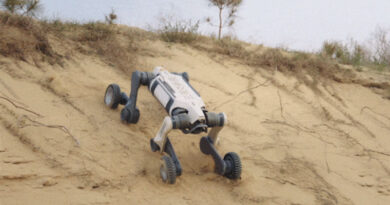
Agrhound is built on a quadruped, or four-legged, robot platform fitted with cameras and sensors. Unlike wheeled or tracked field robots, which can struggle on slopes, loose soil or the narrow, irregular rows found in many vineyards, a legged platform can place each foot individually, allowing it to cross terrain that would stop or slow a wheeled machine. As it walks between crop rows, the robot’s cameras and sensors feed data into artificial intelligence (AI) models trained to assess plant vigour, the general health and growth strength of a vine or bush, as well as its physiological state and expected yield.
Where it is being tested
The project is running its first field trials in two very different growing environments. In the Ribera del Duero wine region, the robot is being tested among Tempranillo vines at Bodegas Familiares Matarromera’s estate, where sloped, terraced vineyard blocks are common. In Huelva, in southern Spain, it is being tested among blackberries grown under macrotunnels, the long plastic-covered tunnel structures widely used to protect berry crops, at a farm run by Social Berries 4.0.
Project lead Luis Muñoz said the aim is to bring the reliability of legged robotics, already used in industrial inspection work, into agriculture, where rough or sloped terrain has limited how far wheeled robots can be deployed. No performance data has been published yet, as the field trials only recently began; the consortium has described this stage as proving the platform can navigate real vineyard and berry-tunnel conditions before adding more advanced sensing.
Legged robots of this kind are a newer category in farming than the wheeled scouting and weeding robots now common in row crops and orchards. They are generally more mechanically complex and more expensive to build and maintain, since each leg needs its own motors and balance control, and battery life under continuous walking is typically shorter than for a wheeled machine covering the same distance. Those trade-offs are part of why the consortium’s partners, which include geospatial data specialist SpectralGeo and software integrator SOLTEL alongside the two grower partners, are treating the current trial as a proving ground rather than a finished commercial product: the immediate goal is to confirm that a legged platform can reliably cover real vineyard rows and tunnel-grown berry beds over a full season, including wet soil, loose ground and the tight turns a tunnel structure forces on any ground robot, before investing further in the sensing payload.
Later phases of the project are expected to add a spectral imaging system capable of mapping fruit ripeness across a field in real time, and eventually a robotic arm that could physically collect plant or fruit samples for laboratory analysis, rather than relying only on camera-based assessment. If successful, the combination would let a single robot move through a vineyard or berry farm, flag areas of stress or disease, estimate how ripe the fruit is, and pull physical samples for confirmation, without a worker walking the rows.
Global Agriculture is an independent international media platform covering agri-business, policy, technology, and sustainability. For editorial collaborations, thought leadership, and strategic communications, write to pr@global-agriculture.com