Self-Launching Drone Station Maps Apple Crop Load Across Washington Orchards
21 October 2026, Washington: Washington State University’s Tree Fruit Extension program has completed multi-season field trials of an autonomous, self-launching drone system that maps fruit count, bloom density, and canopy health across commercial apple orchards, a tool growers could soon use to target sprays and thinning decisions by block rather than by farm.
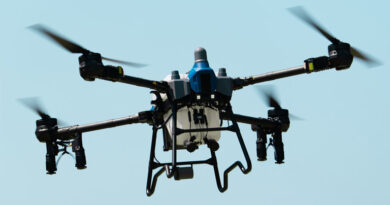
The system is built around a solar-powered “drone-in-a-box” dock supplied by UK-based Outfield Technologies and Washington ag-aviation firm Tyton Aviation. It houses a DJI Dock 2 station and a Matrice 3D drone equipped with RTK positioning, a GPS correction technology that narrows location accuracy to a few centimeters, along with multispectral cameras. Once scheduled, the drone launches on its own, flies a preset route over the orchard, lands, and recharges without an operator present. WSU researchers, including Tree Fruit Extension educator Dattatray Bhalekar, associate professor Bernardita Sallato, and precision agriculture professor Lav Khot, ran the trials under the university’s Tree Fruit Extension and Biological Systems Engineering programs, with funding from the Washington Tree Fruit Research Commission.
The trials ran in two stages. In 2024, researchers manually flew a drone over a Cosmic Crisp apple block near Mattawa, Washington, and compared the machine’s fruit counts against hand counts taken by orchard crews on three dates. The vision system came within 5 to 15 percent of the manual counts across the season. For example, it counted 16 fruit per tree (plus or minus 5) in mid-July against a hand count of 19 (plus or minus 11). In 2025, the team installed a full Drone-in-a-Box station at a cooperating Envy apple block in Zillah, Washington, flying repeated missions from April through October to check consistency over time rather than re-measure accuracy against hand counts.
Beyond counting fruit, the drone’s camera package calculates several vegetation health indices from reflected light, including NDVI and NDRE, two common measures of canopy greenness and nitrogen status, SAVI, which adjusts readings for bare soil visible between orchard rows, and NDWI, an indicator of water stress. Combined with bloom density and canopy fill readings, this data lets researchers generate variable-rate maps that can direct a sprayer or nutrient applicator to apply more or less product to specific sections of a block instead of treating an entire orchard uniformly.
Capacity to scale beyond test plots
A single dock can cover up to 250 acres a day within a two-mile radius without anyone retrieving or relaunching the drone by hand, according to the WSU team. In the Zillah trial, one flight over the 8.1-acre block took about 15 minutes. That throughput is the main commercial argument for the system over hand scouting or manually piloted drones, both of which require either a scout walking rows or a licensed operator present for every flight. Grower cooperators Northwest Farm Management LLC and Columbia Farm Service LLC hosted the trial blocks. WSU says it does not endorse specific vendors, but names Outfield and Tyton as the commercial suppliers behind the workflow used in the study.
The research team plans to add thermal imaging in the 2026-27 season using an upgraded Matrice 4T drone and a newer dock model. That upgrade would let the system flag water-stressed trees or possible pest and disease hotspots through canopy temperature differences, rather than relying only on color-based vegetation indices. WSU has not published a cost estimate for growers adopting the full station, and the trial write-up does not give numeric accuracy figures for the 2025 season, focusing instead on confirming the system could repeat its flights reliably across a full growing season.
Also Read: USDA Reports Record Soybean Yield, Bigger Corn Crop in October Forecast
Global Agriculture is an independent international media platform covering agri-business, policy, technology, and sustainability. For editorial collaborations, thought leadership, and strategic communications, write to pr@global-agriculture.com