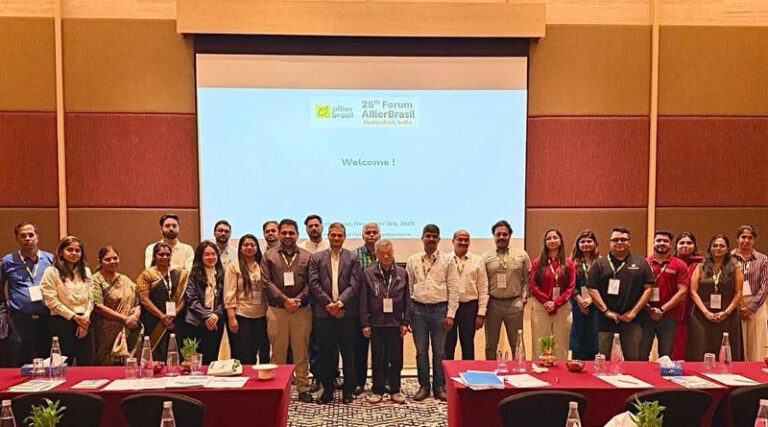
18 November 2026, Hyderabad, IN: Indian crop protection companies looking to grow in Latin America heard at the 25th AllierBrasil Forum in Hyderabad on November 3 that registration reform, tightening farm credit and the rapid rise of biologicals will decide who succeeds in Brazil, Argentina, Colombia and Paraguay. The forum was organised by AllierBrasil, a Brazilian consultancy specialising in pesticide registration and business development. It featured 16 presentations from industry executives, regulators, laboratory specialists and consultants.
Flavio Hirata, a partner at AllierBrasil, opened with an overview of Brazilian agriculture, where grain output is projected to reach 367.2 million tonnes in the 2026/27 season. Over the past four decades, the area under grain has roughly doubled while production has grown more than fivefold. Hirata said farmers are nonetheless under strain from high interest rates, falling commodity prices and tighter access to credit. He also outlined a proposal for companies to share the cost of Good Laboratory Practice (GLP) studies, which he said could cut each firm’s testing spend by up to 80%.
Agrochemical purchasing consultant Lucas Lamounier projected Brazil’s pesticide market at about US$15.7 billion in 2026, down from US$16.2 billion in 2025. He estimated that direct sales to farmers will make up 39% of the market this year, up from 30% in 2018, and advised foreign manufacturers selling directly to Brazilian buyers to run thorough credit checks and secure payment guarantees.
Credit stress featured repeatedly. Luís Rodrigo Ribon Pinotti, who writes on Brazilian agribusiness, said the sector recorded 1,990 bankruptcy protection requests in 2025, against 1,272 in 2024, under a system similar to Chapter 11 in the US. He pointed to the restructurings of distributors AgroGalaxy and Lavoro Agro as examples of how defaults can pass up the supply chain to pesticide manufacturers and foreign suppliers. Guilherme Abbud, founding partner and chief executive of Persevera Asset Management, said reforms between 2016 and 2022 had improved Brazil’s fiscal position, but persistently high real interest rates remain the main brake on growth after the 2026 presidential election.
From the distribution side, Marcelo Pedroso, supply chain manager at Grupo Agromave, said the Mato Grosso group, founded in 2005, runs 17 stores and serves more than 3,200 growers. He expects the 2026/27 season to bring tighter credit and thinner farm margins, putting a premium on product quality, technical support and reliable suppliers.
Independent agrochemical consultant Jinlong Zhang noted that Brazilian pesticide consumption nearly tripled between 2009 and 2024, while the insecticide chlorfenapyr grew about 28-fold in five years to more than 10,000 tonnes, driven largely by resistance management needs. He named pyriproxyfen and pyroxasulfone as active ingredients with similar growth potential.
Tatiane Almeida do Nascimento, a Federal Agricultural Auditor at Brazil’s Ministry of Agriculture (MAPA), explained the regulatory framework created by Law No. 15,070/2024, which sets a dedicated legal regime for bioinputs, including microorganisms, plant extracts, semiochemicals and biological control agents. It covers registration, risk-based assessment and on-farm production, and requires coordination between MAPA, health regulator Anvisa and environmental agency Ibama. She said full implementation still awaits an implementing decree and supporting regulations.
Laís Ammirabile, a sales executive at testing firm ALS, outlined the laboratory requirements for microbial products and inoculants, from strain identification and purity to toxicology, efficacy and stability. Keeping microbes viable through long transport and storage in tropical conditions remains a key challenge, alongside testing methods for microbial consortia and newer technologies such as RNA interference.
Tamires Watanabe, a regulatory specialist at AllierBrasil, described SISPA, MAPA’s electronic platform that brings pesticide submissions to MAPA, Anvisa and Ibama into one system. The 2026 migration temporarily suspended component registration, and she said system instability and incomplete data transfer make accurate dossiers essential during the transition. Lahys Caetano Tomaz, sales director at SCI-AGRO, said five-batch studies, which check manufacturing consistency and impurity profiles, are central for generics compared against reference materials, while new active ingredients require a different approach because no reference product exists.
Elsewhere in the region, Patricia Karlikowski Aranda, corporate head of regulatory affairs at DVA Agro, valued Argentina’s agrochemical market at about US$2.7 billion across roughly 35 million hectares of principal crops. New rules from plant health agency SENASA allow faster “convergence” registration for products already approved in recognised jurisdictions, alongside labelling based on the Globally Harmonized System (GHS) and updated rules for fertilizers and biostimulants.
Santiago Montoya, founder of Agriara Consulting, estimated Colombia’s pesticide market at about US$570 million in 2025, split between herbicides (39%), fungicides (34%) and insecticides (27%), with demand from coffee, flowers, bananas and avocados. India already supplies the market, though registration takes about 30 months. Claudio Pusineri, commercial director at Agrofuturo Group, presented Paraguay, where soybeans cover 3.5 to 3.7 million hectares, as a base for regional operations, citing the Paraguay-Paraná waterway, the Bioceanic Corridor, Mercosur access and the maquila manufacturing regime.
Sabrina Oliveira, a data and technology analyst at look2agro, closed with the platform’s global agribusiness directory, which lists more than 230,000 companies across over 50 business categories, including input makers, laboratories and logistics providers.
Global Agriculture is an independent international media platform covering agri-business, policy, technology, and sustainability. For editorial collaborations, thought leadership, and strategic communications, write to pr@global-agriculture.com