Is It Really Hard to Be a Farmer?
03 September 2026, London: Farming is often imagined as a simple life built around land, weather and hard work. The reality is much more complicated. Today’s farmer is agronomist, mechanic, businessman, weather watcher, financial planner and increasingly, technology user. The rewards can be substantial, but so can the risks.
There is something deceptively calm about a farm. A field of wheat moving in the wind, cattle grazing in a pasture or rows of vegetables stretching towards the horizon give the impression that farming is a straightforward occupation. Plant something, look after it and eventually harvest it. Anyone who has actually run a farm knows how far that picture is from reality.
A farmer’s working year begins long before anything is planted. Decisions about seed, soil preparation, fertiliser, irrigation and crop protection have to be made when the final selling price of the crop is still unknown. The farmer is putting money into the ground with no guarantee of what will come out of it. A good season can produce an excellent return. A bad one can wipe out months of work and a considerable amount of capital.
That uncertainty is what makes farming different from many other businesses. A factory can increase production when demand rises. A shop can change its product mix. A farmer cannot simply decide in July to start again because market conditions have changed. The crop is already in the field. The weather is doing what it wants. By harvest time, most of the major decisions have already been made.
More science, less guesswork
The modern farmer is also dealing with a level of technical complexity that would have been difficult to imagine a generation ago. Understanding the soil is essential. Farmers need to know its nutrient levels, structure, moisture and how it is likely to behave under different weather conditions. Choosing a variety involves more than simply asking which seed gives the highest yield. Disease resistance, maturity, water availability, market demand and local conditions all matter.
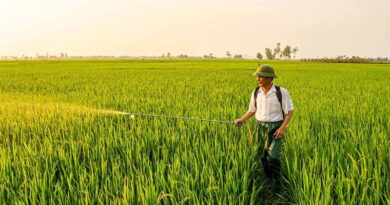
Crop protection is equally demanding. A farmer has to recognise weeds, insects and diseases and understand how they develop. Timing can make the difference between saving a crop and watching its potential disappear. Applying a product too early may waste money. Applying it too late may achieve very little. There is also growing pressure to use inputs more efficiently, both because they are expensive and because consumers, regulators and markets are demanding more sustainable production.
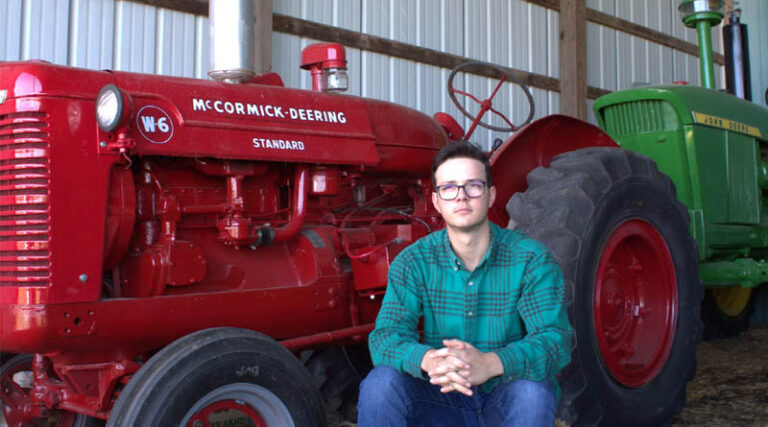
Then there is machinery. A large modern farm can involve tractors guided by GPS, automated steering, precision seeders, variable-rate fertiliser equipment, combine harvesters equipped with yield monitors and irrigation systems that can be managed remotely. Satellite imagery and drones can help identify areas of a field that are under stress. Digital farm-management systems can bring together information on fields, inputs, machinery, labour and yields.
Technology has certainly removed some of the physical burden of farming. It has not removed the need to make decisions. In many cases, it has done the opposite. A farmer now has access to enormous amounts of information and has to decide which of it matters.
The weather remains in charge
For all the advances in technology, there is one part of farming that remains stubbornly outside human control: the weather.
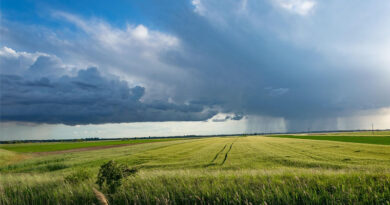
A farmer can choose the best seed, prepare the soil carefully and manage inputs precisely, but a drought can still arrive. Heavy rain can delay planting or prevent machinery from entering a field. A heatwave at the wrong stage of crop development can reduce yields. Frost can damage fruit and vegetables overnight. Hail can destroy an otherwise healthy crop in a matter of minutes.
Climate variability has made this challenge even more significant in many farming regions. Farmers are responding by changing planting dates, selecting more resilient varieties, improving irrigation, building soil health and using better weather information. Yet adaptation has limits. Agriculture remains a biological business, and biology does not always follow the business plan.
The financial consequences can be serious. A farmer pays for seed, fertiliser, crop protection, fuel, labour, machinery and often borrowed money before the crop is sold. If yields fall while prices also decline, the pressure can become severe. Even a farmer who produces a good crop may not necessarily make a good profit if input costs have risen or the market has weakened.
Farming is a business before it is a lifestyle
This is where the romantic idea of farming often meets reality. Producing a high yield is not the same as making money. Farmers have to understand the cost of producing each tonne, litre or kilogram and then work out how much of that product they need to sell, and at what price, to cover their costs.
Many farmers therefore spend almost as much time thinking about markets as they do about crops. They may negotiate contracts with processors or traders, store grain in the hope of selling later, spread production across different crops or look for premium markets. Livestock farmers face their own calculations involving feed costs, breeding, animal health and market prices.
Diversification has become an important strategy. A farm may generate income from crops, livestock, storage, processing, farm shops, agritourism or renewable energy. The idea is not necessarily to become bigger. It is to avoid depending entirely on one source of income.
For some farmers, government support and tax treatment also form part of the financial picture. It is often said that farm income is tax-free, but that is not a rule that applies everywhere. Tax systems differ widely. In many countries, however, agriculture receives special treatment through deductions, exemptions, investment allowances, income averaging or favourable treatment of certain farm expenses. Governments use these measures partly because farming carries unusual levels of risk and because maintaining domestic agricultural production is considered strategically important.
The benefit can be meaningful, particularly for capital-intensive farms. Machinery, buildings, irrigation systems and other investments can involve large sums of money, so the tax treatment of those investments can influence how and when farmers spend.
The most valuable machine may be the one that gives the farmer time
There is another side of modern farming that is becoming increasingly important. Farmers want a life outside the farm too.
For generations, the farm often depended on the farmer being physically present for almost everything. Today, that is changing. Contractors can be hired for spraying, harvesting, planting and other specialised jobs. Farm managers can take responsibility for day-to-day operations. Automated irrigation can deliver water according to a schedule or respond to sensor data. Livestock systems can automate feeding and monitoring. Machinery can work with increasingly little intervention once it has been set up correctly.
Remote technology has added another layer. A farmer can receive an alert about an irrigation system, check a weather station or look at a field through a camera without getting into a vehicle and driving across the farm.
The purpose is not simply convenience. Time has economic value. If a farmer can spend two hours planning next year’s cropping strategy instead of driving a tractor for two hours, the business may benefit. If a contractor can harvest a crop quickly during a narrow weather window, the farmer may avoid a much larger loss.
The most successful farms are increasingly designed around this idea. The farmer does not have to perform every task. The farmer has to make sure that the right task is done by the right person or machine at the right time.
That requires trust, planning and capital. It also requires a change in mindset. Farming is no longer necessarily about being the hardest-working person on the property. It is about building a system that works well even when the owner is not standing in the field.
What does the farmer get in return?
The financial reward varies enormously. Some farms are highly profitable businesses. Others operate on thin margins and survive because the family contributes labour or has income from outside agriculture. A farmer’s income can also change dramatically from one year to the next.
The greater reward for many successful farmers is the asset they build.
Land can appreciate over time. A productive farm can become a valuable family business. Machinery, buildings, livestock, irrigation infrastructure and established relationships with customers all add to the value of the operation. In many farming families, the objective is not simply to make money this year but to leave a stronger business for the next generation.
There is also the freedom that comes with ownership. A farmer may decide what to grow, where to invest and how to develop the business. That independence is difficult to measure in financial terms.
Yet it should not be confused with an easy life. A farmer may not have a traditional boss, but there are plenty of forces demanding attention. The weather does not care about weekends. Crops cannot always wait for a convenient day. Markets move whether the farmer is ready or not.
That is perhaps the best answer to the question of whether it is hard to be a farmer.
Yes, it is hard. But the nature of that difficulty has changed. The farmer of today is not simply working the land. The farmer is managing a complex biological and financial enterprise, often worth millions of dollars, while making decisions under conditions that cannot be fully controlled.
And perhaps the smartest farmers are learning that success is not measured only by yield or revenue. It is also measured by resilience, by the ability to survive a bad season, by the strength of the business left for the next generation and, increasingly, by something that farmers have historically had very little of: time.
A farm that produces well but consumes every waking hour of the person running it may be a successful business. It may not, however, be a successful life.
The real achievement is to build both.
Also Read: Syngenta Welcomes Trevor Watson As Turf Territory Manager For Mid-atlantic And Northeast Region
Global Agriculture is an independent international media platform covering agri-business, policy, technology, and sustainability. For editorial collaborations, thought leadership, and strategic communications, write to pr@global-agriculture.com