02 September 2026, Uttar Pradesh: The World Bank and the Government of Uttar Pradesh continued to show its support to the Uttar Pradesh Agriculture Growth and Rural Enterprise Ecosystem Strengthening (UP-AGREES) project and engages on scaling sustainable and climate-resilient rice innovations during a recent visit in its innovation sites.
UP-AGREES project is supported by the World Bank and implemented through the Uttar Pradesh Diversified Agriculture Support Project (UPDASP), in coordination with the Department of Agriculture (DoA), Government of Uttar Pradesh, with the International Rice Research Institute (IRRI) serving as a knowledge partner.
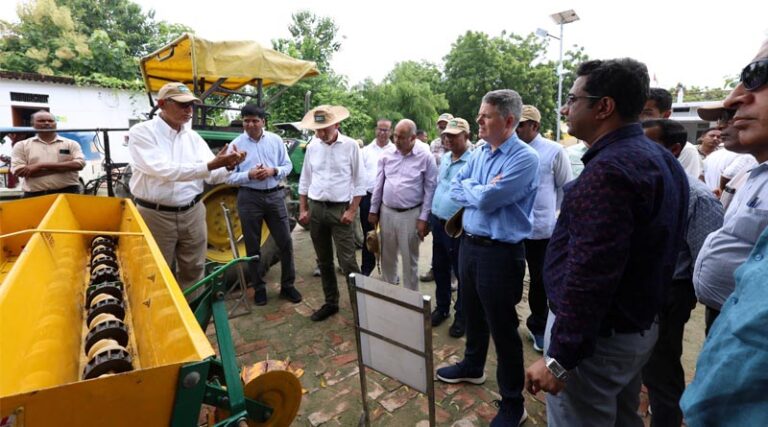
The visit provided the delegation an opportunity to interact with the farming communities, service providers, and other private stakeholders at the field, assess progress in climate-resilient technologies, farm mechanization, digital and AI-enabled solutions, carbon credit opportunities, and stronger farmer institutions across the region.
“My interactions with farmers highlighted the importance of improving access to timely information, expert advice and market opportunities. Through initiatives such as UP-AGREES and AgriConnect, we are working with partners to strengthen these connections and support better livelihoods for farmers” said Mr. Paschal Donohoe, Managing Director at the World Bank.
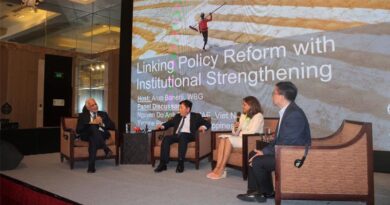
During the interaction with Farmer Producer Organizations (FPOs) on the AI-enabled advisory system and Open Network for Agriculture (ONA), Shri Pratyush Pandey, Additional Project Coordinator, UPDASP, Government of Uttar Pradesh, highlighted that the vision behind digital component of UP-AGREES.
“Under the digital component of UP-AGREES, our goal is to bring essential agricultural information and services, from market prices and weather forecasts to soil information, expert advice and private-sector solutions, together on a single, farmer-friendly platform,” Shri Pandey emphasized. “This will enable farmers and FPOs to access timely, relevant, and actionable information and services to make better decisions and improve their productivity and market opportunities,” he added.
Eastern Uttar Pradesh is emerging as a key focus area for transforming agriculture into a more progressive, sustainable, and climate-resilient sector. Through the UP-AGREES project, the Government of Uttar Pradesh, with IRRI as the knowledge partner, is promoting sustainable rice-based production technologies, modern mechanisation, resource-efficient farming practices, stronger farmer institutions, and improved market linkages across the districts. The region’s Kalanamak rice also offers strong potential for value addition, branding and rural entrepreneurship, creating new opportunities to increase farmers income.
Former ISARC Director, Dr. Sudhanshu Singh also expressed support for the project. “Under UP-AGREES, our interventions aim to address key challenges affecting rice-wheat system productivity by promoting timely rice establishment and timely wheat sowing. Along with Direct Seeded Rice (DSR) and shorter-duration varieties, we are strengthening healthy seedling and nursery systems to support improved productivity,” he said.
“As a technical partner in UP-AGREES, IRRI, through ISARC, is supporting the development, validation and scaling of improved rice-based technologies and interventions. Our role is to help translate research into practical solutions that work under real farming conditions, while strengthening the partnerships, institutions and service ecosystems needed for their wider adoption,” said Dr. Vikas Kumar Singh, Interim Director, ISARC.
Dr. Vikram Patil, IRRI Scientist & Project Lead highlighted a range of IRRI supported innovations being promoted under UP-AGREES project. In addition to Direct Seeded Rice (DSR) and mechanised interventions, these include the strengthening seed system, traditional premium quality rice value chain such as Kalanamak rice, product- and service-based rural entrepreneurship development, regenerative agricultural practices and other initiatives aimed at building a more productive, resilient, and sustainable agricultural ecosystem in Eastern UP.
Field and Research Engagements: Demonstrations of Direct Seeded Rice (DSR) and related technologies and ISARC facilities
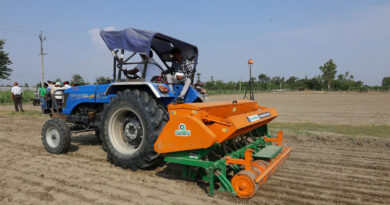
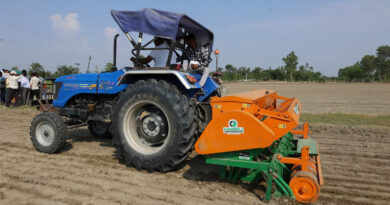
At Ghosila, the team observed field demonstrations of DSR and other climate-resilient technologies, along with live demonstrations of agricultural drones, GHG evidence generation, and other operations. The delegation engaged with farmers, service providers, FPOs, and climate tech companies on DSR adoption experiences, crop-residue management and climate-resilient practices.
In Varanasi, the delegation visited ISARC to explore its research facilities and innovations, including GIS remote sensing, the IRRI Education centre, GHG laboratory, Speed Breed facility, mechanization, and other facilities. Scientists and technical staff shared ongoing research, technology validation, and technical support being provided under UP-AGREES project.
The field demonstrations and interactions reinforced confidence in the project’s potential to deliver meaningful outcomes at scale, strengthening commitment among partners, farmers, FPOs, services provider, and technical teams.
It also demonstrated how research-driven innovations and technologies are being translated from science to field-level application and, ultimately, positioned for scale, creating a strong pathway from innovation to impact.
Going forward, UP-AGREES will build on this momentum by strengthening the integration of climate-smart agriculture, mechanization, digital solutions, farmer institutions and partnerships to accelerate a more productive, inclusive, and climate-resilient agricultural ecosystem across Eastern Uttar Pradesh.
Global Agriculture is an independent international media platform covering agri-business, policy, technology, and sustainability. For editorial collaborations, thought leadership, and strategic communications, write to pr@global-agriculture.com