FAO Food Outlook: Global Food Commodity Market Trends Face Rising Geopolitical And Weather Risks
18 June 2026, Rome: The outlook for global food commodity markets continues to be relatively favourable, with the 2026/27 cereal production forecast to remain historically elevated, though easing from record highs. However, market prospects remain highly contingent on weather developments, including the emergence of El Niño, volatility in energy and fertilizer markets roiled by conflict, geopolitical tensions, uncertainty surrounding trade policies and broader macroeconomic headwinds, according to a new report published today by the Food and Agriculture Organization of the United Nations (FAO).
Worldwide harvests of wheat, coarse grains and rice are set to decline from record levels in the year ahead, but remain elevated, with supply to be buoyed by ample stocks, according to the new FAO Food Outlook.
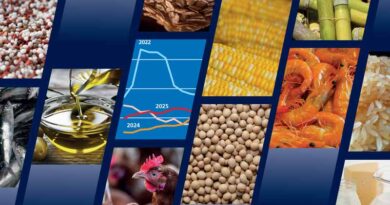
The biannual publication provides updated market assessments and forecasts for the production, utilization, trade, and stocks of major food commodities including cereals, oil crops, sugar, meat, dairy products, and fisheries. The new edition offers additional insights into the implications of alternative fuels and clean energy regulations in international maritime shipping, the linkages between sugar prices and energy products as mediated by ethanol, fertilizer markets, and the global food import bill.
“Agrifood systems appear robust at a production level, but risks are growing and many of them have the potential to have rapid and adverse effects for global supply and access,” said FAO Chief Economist Maximo Torero. “We need to double down on resilience by keeping trade flows open and supply chain functioning, while preparing for local weather shocks.”
Aggregate global cereal output is forecast to decline by 2.0 percent in 2026 from the previous year to 2 982 million tonnes, while utilization is expected to continue to grow, with a 1.0 percent increase in output used for human consumption. Per capita cereal consumption in Low-Income Food-Deficit Countries is expected to decline marginally, by 0.4 percent.
Salient takeaways from the commodity analyses include:
- Global wheat production 2026/27 is anticipated to dip by 3.8 percent to 810.9 million tonnes, due to smaller harvest among major exporting countries and regions, notably Australia, the European Union, and the United States of America, where a 21.3 percent decrease is currently expected.
- World coarse grain production in the coming year is expected to decline by 1.2 percent to 1 619 million tonnes, due to lower plantings and yields in North America, even as prospects in South America appear robust, notably for maize in Argentina.
- Global soybean production in 2025/26 is predicted to set a fresh record of 432.3 million tonnes, as continued growth in Brazil and the Russian Federation will likely more than offset anticipated reductions in Argentina, India and North America.
- Global meat production is expected to rise by 1.0 percent to 391.3 million tonnes, with poultry output rising by 2.5 percent while bovine output set to decline.
- Global vegetable oil consumption is forecast to outpace production in 2025/26, resulting in tighter market conditions and ending stocks declining for the third consecutive season.
- Global fisheries and aquaculture production is set to expand by 1.0 percent in 2026 to 200.5 million tonnes, with aquaculture output rising by 2.9 percent led by shrimp, salmon and carp, even as capture fisheries dip by 1.1 percent, largely due to reduced quotas for important North Atlantic stocks including mackerel, herring and possibly cod, as well as Peru’s anchoveta.
Special focus on shipping fuels and SIDS, biofuel dynamics and fertilizer markets
The International Maritime Organization’s transition toward the use of alternative fuels and energy sources can be pivotal for achieving net-zero greenhouse gas emissions goals, but it may also have important implications for agrifood markets, especially in Small Island Developing States (SIDS), according to a special chapter in this edition of the Food Outlook.
The publication also offers a look at how the relationship between ethanol and sugar prices has evolved since 2012, finding that while short-term adjustments are limited by harvest cycles, processing capacity and contracts, production and inventories respond more gradually to expected profitability.
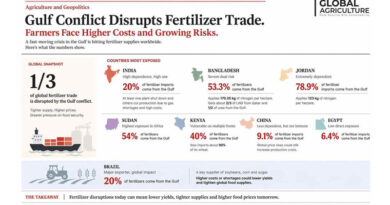
Another chapter examines fertilizer market trends, documenting a 20 to 25 percent drop in global fertilizer trade volumes between January and April 2026 compared to the same period a year earlier. While there has been some recent abatement of rising prices, concerns remain for the upcoming 2026/27 agricultural season due to stalled buying in key markets such as Europe and North America, particularly for nitrogen and phosphate. Market conditions remain highly sensitive to developments affecting transit through the Strait of Hormuz.
Food import bill
The Food Outlook also presents FAO’s updated estimate for the global food import bill (FIB) in 2025, now estimated to have risen by 7.9 percent from the previous year to reach a new record USD 2.22 trillion.
The increase in the global food import bill came despite declining import costs for cereals, sugar and oilseeds, and was driven by a large increase in the prices of higher-value products, notably coffee, cocoa and spices, animal products, fish and fruits and vegetables, primarily imported by high-income countries (HICs).
Food import expenditures by HICs, which accounted for more than two-thirds of the total, rose by 9.3 percent, compared to 4.0 percent for upper-middle income countries, 7.9 percent for lower-middle-income countries and 6.7 percent in low-income countries.
FAO’s previous analysis showed that, under high geopolitical risk, the food import bill response to a given oil price shock can be almost twice as large as under normal conditions. Uncertainty, risk premia, insurance costs, and logistics frictions strengthen the transmission of energy shocks to food import costs.
Also Read: FMC and Corteva Partner to Expand Rimisoxafen Herbicide Access Across the Americas
Global Agriculture is an independent international media platform covering agri-business, policy, technology, and sustainability. For editorial collaborations, thought leadership, and strategic communications, write to pr@global-agriculture.com