The Normal Season Agribusiness Is Waiting For Is Not Coming Back
By Nimish Gangrade, Editor, Global Agriculture
18 November 2026, New Delhi: Ask any agribusiness executive what a good year looks like and the wish list is familiar. No El Niño. A normal monsoon for rain-fed farms. Fertilizer that is available and affordable. An open Strait of Hormuz and open shipping lanes everywhere else. Agrochemicals and their intermediates priced by the market, not by one supplier country. Tariffs that do not single out half the world. Farmers earning fair prices for their produce, with demand and supply in balance. Any one of these can happen in a given season. Getting all of them together is a combination the industry has not seen in three years, and 2026 is no exception.
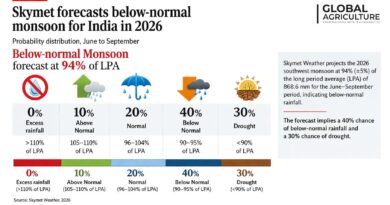
The weather alone has ruled out a normal year. The World Meteorological Organization expects tropical Pacific sea surface temperatures to run as much as 3.8°C above average between November 2026 and January 2027, far beyond the 0.5°C threshold at which an El Niño is declared. In India, the southwest monsoon closed at 759.4 mm, a 12.6% shortfall against the long-period average and the weakest season since 2015, while east and northeast India had their driest monsoon since 1901.
Inputs have been just as disrupted. According to the World Trade Organization, fertilizer shipments through Hormuz stopped almost completely once the Gulf conflict began in February, cutting a route that normally carries about a third of global seaborne fertilizer trade. The International Trade Centre found that urea exports from economies dependent on the strait fell 83% by volume in April. Even after a June arrangement, the WTO’s tracker showed fertilizer flows through the strait still close to zero into early September. The World Bank now expects fertilizer prices to rise 14% in 2026, driven by urea, and projects food commodity prices up about 10% this year and a further 7% in 2027, citing conflict-hit grain shipments, El Niño and high fuel and fertilizer costs.
The Black Sea has not recovered either. Before the war, Ukraine shipped close to 19 million tonnes of wheat a year and ranked among the world’s top exporters. The US Department of Agriculture’s Foreign Agricultural Service puts its 2025/26 wheat exports at 14.3 million tonnes. FAO trimmed its 2026/27 cereal trade forecast, pointing to lower wheat and maize exports because of constrained Black Sea shipping. Its Food Price Index averaged 133.9 points in October, still 5.9% above a year earlier, and FAO counts 41 countries, 31 of them in Africa, that still need outside food assistance.
Trade policy adds another layer of uncertainty. The US Supreme Court ruled 6 to 3 in February that the emergency powers law used for the reciprocal tariffs does not allow the President to levy duties, but the administration replaced them within hours with a new across-the-board tariff under Section 122 of the Trade Act. The legal basis changed. The uncertainty for exporters did not.
Balance sheets tell the story
The pressure shows up quarter after quarter in listed agribusiness results. Bayer’s Crop Science sales slipped 2% in the third quarter, with core crop protection down 6%, as hot, dry weather in Europe and Asia hit fungicide demand. FMC was hit harder. Its third-quarter revenue came in at $106 million, $436 million lower than a year earlier, including about $639 million from pricing and rebate actions, and even excluding India and those actions, revenue fell 22% to $745 million. The company now expects full-year free cash flow of negative $150 million to negative $350 million.
Whoever controls manufacturing leads
If the old normal is not returning, the question becomes who is best placed in the new one. The answer increasingly points to whoever controls manufacturing and does not depend on others for raw materials and finished goods.
China has spent decades building exactly that position. Its share of global manufacturing value added rose from 6% in 2000 to 28% by 2024, more than the US, Germany and Japan combined, and UNIDO projects it could reach about 45% by 2030. The International Energy Agency puts China’s share of global rare earth refining at 85%. In crop protection, industry estimates credit China with over 35% of global pesticide production, more than 65% of pyrethroids and more than half of neonicotinoids. That scale gives Beijing levers over price as well as volume. China scrapped export VAT refunds on certain phosphorus-chemistry pesticide products from April 1, 2026, a single policy decision that reprices supply for formulators worldwide.
China has also tied this build-out to tighter environmental enforcement in recent years. Stricter rules have favoured large, technologically advanced producers, and environmental inspections and factory closures have at times cut global supply of specific active ingredients. Critics note that China remains the world’s largest emitter and that much of its capacity was built before today’s standards applied. Either way, any country trying to replicate that path now would have to do so under COP commitments, international environmental treaties and far stricter domestic norms, making the same speed and scale very hard to repeat.
That does not make the effort pointless. It makes the starting point clear: governments need to treat manufacturing and capacity building, from fertilizer plants to agrochemical intermediates, as the core of reducing import dependence, not as an optional industrial policy.
Also Read: Mahindra Launches 50 HP Compact Harvester Harvest Yuva for Small Farms
Global Agriculture is an independent international media platform covering agri-business, policy, technology, and sustainability. For editorial collaborations, thought leadership, and strategic communications, write to pr@global-agriculture.com