14 September 2026, Pakistan: New research identifies where smarter fertilizer management could help Pakistan reduce agricultural emissions while supporting food production.
Pakistan’s agriculture faces the dual challenge of producing enough food while reducing its environmental footprint. One part of that challenge is nitrous oxide (N₂O), a greenhouse gas with 273 times the global warming potential of carbon dioxide. Agricultural soils are a major source of N₂O, with synthetic fertilizer among the key contributors.
A new study by ICARDA, the University of Agriculture Faisalabad, the Global Change Impact Studies Center, and the United States Department of Agriculture (USDA) revisits Pakistan’s 2018 agricultural N₂O emissions baseline using the latest Intergovernmental Panel on Climate Change (IPCC) global warming potential and verified national data.
The analysis estimates a revised baseline of 62.26 million tons of CO₂ equivalent (Mt CO₂e), closely aligning with the 62.4 Mt CO₂e reported in Pakistan’s 2021 National Inventory Report. A consistent baseline provides a stronger foundation for tracking progress and targeting mitigation efforts. But the study goes beyond the national total to identify where emissions are concentrated.
Wheat is a key hotspot
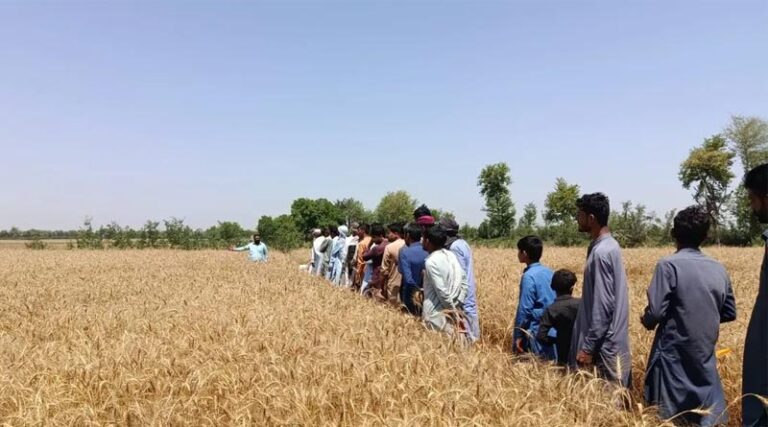
Synthetic fertilizer is the largest direct source of agricultural N₂O emissions, contributing an estimated 14.72 Mt CO₂e. Among the five major crops assessed — wheat, cotton, sugarcane, rice, and maize — wheat accounts for an estimated 50% of N₂O emissions attributed to synthetic fertilizer, equivalent to 7.36 Mt CO₂e. Cotton follows at 25%, with smaller shares from sugarcane, rice, and maize.
Wheat’s large share reflects its extensive cultivation across Pakistan. Importantly, sensitivity analysis found that wheat remained the largest emission source even when the study varied assumed nitrogen application rates substantially, making wheat systems a clear priority for improving nitrogen use efficiency.
Keeping nitrogen where crops need it
Not all agricultural N₂O emissions occur directly where fertilizer is applied; the study estimates that 35% of the revised baseline (22.04 Mt CO₂e) comes from indirect emissions, largely associated with nitrogen lost through processes such as leaching and volatilization.
This means reducing emissions is not simply about applying less fertilizer, but about using nitrogen more efficiently so more crops are grown and less is lost to the environment. The 4Rs of Nutrient Stewardship — right source, right rate, right time, and right place — provide a practical framework for doing this.
“Reducing agricultural emissions entails using nitrogen more efficiently, applying the right source, at the right rate, at the right time, and in the right place. By identifying where emissions are concentrated, we can better target solutions that support both climate action and productive agriculture in Pakistan.” — Dr. Muhammad Imtiaz, Seed System Specialist Scientist and Country Coordinator-Pakistan, ICARDA
The study estimates that a 20% improvement in nitrogen use efficiency across wheat-growing districts could reduce N₂O emissions by approximately 1.1 Mt CO₂e annually. This is a modeled estimate, but it illustrates the potential scale of improved nitrogen management.
From better data to targeted action
Because detailed crop-specific fertilizer-use data is limited, the study estimates crop-level emissions using national fertilizer offtake, crop areas, and an assumed average nitrogen application rate. The researchers note that more detailed field data and country-specific emission factors would improve future estimates.
Even with these limitations, the central finding is robust: wheat remains the largest synthetic-fertilizer N₂O hotspot across the scenarios tested.
Pakistan can move beyond measuring agricultural emissions as a single national figure and begin identifying which crops, practices, and sources offer the greatest opportunities for action. For wheat and other major cropping systems, improving nitrogen use efficiency can help reduce emissions and nutrient losses while supporting productive, sustainable agriculture.
Through Fertilize Right, a USDA-funded ICARDA project in Pakistan, this evidence is helping ICARDA translate a better understanding of agricultural emissions into smarter fertilizer management for farmers, food systems, and the climate.
Global Agriculture is an independent international media platform covering agri-business, policy, technology, and sustainability. For editorial collaborations, thought leadership, and strategic communications, write to pr@global-agriculture.com