14 October 2026, Singapore: Japan’s wholesale prices for chemicals and related products in September rose by 13.3% year on year, accelerating from a revised 13.0% increase in August, with continued strong inflationary pressures likely to prompt another round of monetary tightening by the central bank.
PX, synthetic rubber, ethylene lead Sept chem export price increase
2026 GDP growth to slow to 0.7% on higher energy costs – IMF
On a month-on-month basis, the chemicals sub-index of Japan’s Producer Price Index (PPI), increased by 0.3%, reversing a revised 0.6% decline in August, amid higher prices for benzene, xylene and vinyl chloride monomer (VCM), according to Bank of Japan’s (BOJ) September Corporate Goods Price Index report released on Tuesday.
September plastic product prices rose by 12.8% year on year and by 1.1% month on month, compared with revised increases of 11.3% and 0.9%, respectively, in August, BOJ data showed.
Meanwhile, petroleum and coal product prices increased by 11.5% year on year but fell by 2.2% from August, as prices for heavy fuel oil, gas oil and jet fuel declined, according to the report.
Japan’s broader all-commodities PPI rose by 6.8% year on year in September, slowing from a revised 7.6% increase in August, while falling by 0.3% month on month, the BOJ said.
Agriculture, forestry and fishery products made the largest negative contribution to the monthly movement, while electric power, gas and water made the largest positive contributions.
SEPT CHEMICAL EXPORT PRICES RISE Chemical export prices in contract-currency terms in September rose by 11.4% year on year and by 1.6% month on month, BOJ data showed.
On a Japanese yen basis, chemical export prices increased by 16.4% year on year, up from a revised 15.0% increase in August, while rising by 0.7% month on month, reversing a revised 1.9% decline in August.
Chemicals price increases on a month-on-month basis were led by paraxylene (PX), synthetic rubber and ethylene, the BOJ said.
The overall contract-currency export price index in September rose by 12.4% year on year and by 1.4% month on month, with electric and electronic products making the largest positive monthly contribution, according to the report.
Chemical import prices in contract-currency terms rose by 0.3% year on year and were unchanged month on month.
On a yen basis, they increased by 5.0% year on year but fell by 0.8% from August, the BOJ said.
Crude oil and petrochemical feedstock prices have remained elevated amid supply disruptions since the start of the Middle East conflict in late February.
Meanwhile, Tokyo’s core consumer price index (CPI), which excludes fresh food, rose by 2.7% year on year in September, accelerating from 1.8% in August, according to Japan’s Statistics Bureau on 2 October.
Tokyo’s CPI is regarded as a leading indicator of nationwide inflation trends. Excluding both fresh food and energy, CPI increased by 3.0%, up from 2.0% in August.
GDP GROWTH TO SLOW ON HIGHER ENERGY PRICES Japan’s economic growth is projected to slow to 0.7% in 2026 and remain at 0.7% in 2027, down from 1.2% in 2025, according to the International Monetary Fund (IMF) in its October World Economic Outlook released on Tuesday.
Japan’s GDP growth is projected to slow to 0.7% in 2026, with fiscal support measures partly cushioning the impact of higher energy prices, the IMF said.
The forecast this year was revised up from 0.6% previously as Japan is among the Asian countries benefitting from the AI boom.
Japan’s heavy reliance on imported energy has left it vulnerable to surging energy costs stemming from the Middle East war, adding to domestic price pressures.
However, the country could benefit from an ongoing regional technology upturn, with increased technology exports from South Korea and Taiwan expected to generate supply-chain spillovers for Japan’s manufacturing and services sectors, the IMF said.
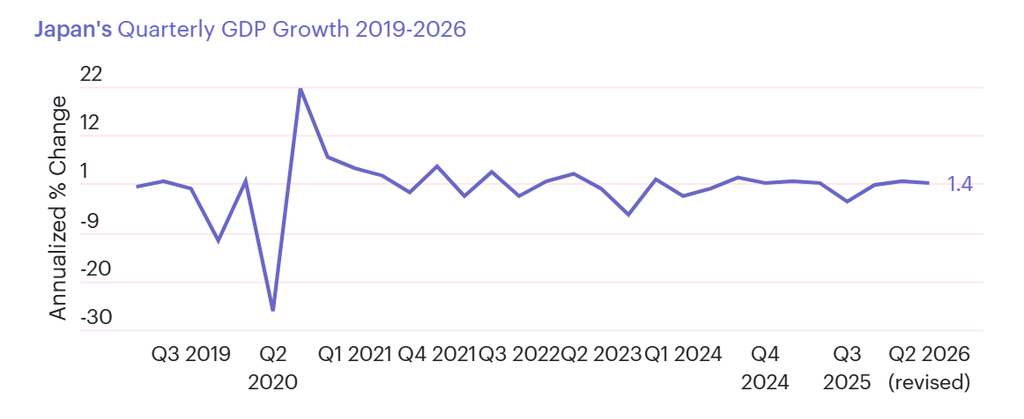
The IMF noted that Japan’s second quarter GDP turned out better than expected, with the economy expanding by an annualized rate of 1.4%, according to preliminary estimates from Japan’s Cabinet Office on 8 September.
Source: Japan Cabinet Office
GDP growth is expected to stabilize at 0.7% in 2027 “as the energy shock dissipates and monetary policy gradually normalizes”, the IMF added.
The IMF expects Japan’s consumer inflation to ease to 2.6% in 2026 from 3.2% in 2025. The figure, however, remains above the central bank’s 2.0% target, which calls for monetary tightening.
The BoJ will next decide on monetary policy on 29-30 October, after raising its key interest rate on 18 September to 1.25%, the highest level in 31 years.
Japan’s central bank policy rate should gradually move toward a neutral setting – a level that neither stimulates nor restricts economic activity – while core inflation is projected to return to 2% by the end of 2027, the IMF said.
Global Agriculture is an independent international media platform covering agri-business, policy, technology, and sustainability. For editorial collaborations, thought leadership, and strategic communications, write to pr@global-agriculture.com