Introducing Four New Committee Chairpersons, Starting With CCPFV
25 August 2026, Rome: New work on a group standard for millets and on camel milk has seen the reactivation of the Codex Committee on Cereals, Pulses and Legumes (CCCPL) and the Codex Committee on Milk and Milk products (CCMMP) respectively. In addition, we have seen a change in the host country for both the Codex Committee on Processed Fruits and Vegetables (CCPFV) and the Codex Committee on Fish and Fishery Products (CCFFP). With this, the Codex family welcomes four new Chairpersons.
In a short series of interviews, we will introduce our new Chairpersons. We’ll find out a bit about who they are, what brings them to Codex and what their expectations are for their new role as custodians of some of Codex’s commodity standards.
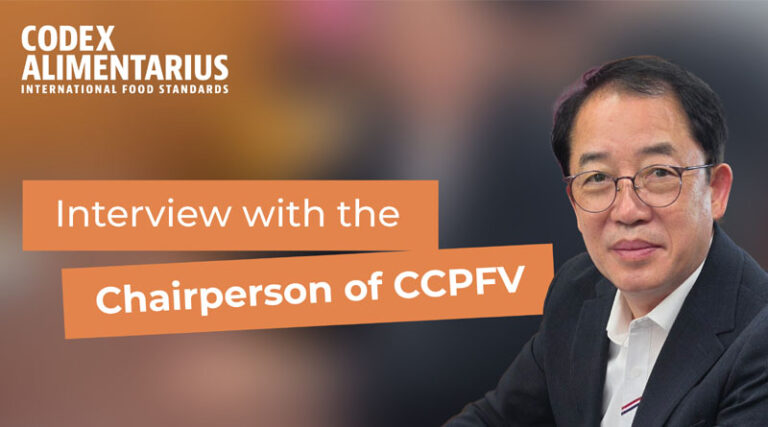
In this article, we start by introducing you to Mr Kyu-seob Oh / Director General, Food Safety Policy Bureau, Ministry of Food and Drug Safety and Chairperson of CCPFV.
Q1. Mr Kyu-seob Oh, thank you for taking the time to answer our questions! And welcome to the Codex family! Can we start by asking you a bit about yourself – where you come from, both geographically and professionally. How do you get to be chairing CCPFV?
Thank you for the warm welcome. It is a true privilege to join the Codex family, to contribute to the global dialogue on international food safety and quality standards, and especially to greet you all as the Chairperson of the Codex Committee on Processed Fruits and Vegetables (CCPFV).
I grew up in Naju, Jeollanam-do, Republic of Korea. Growing up in a region where agriculture and the food industry are an integral part of everyday life naturally shaped my keen interest in food and food safety.
Professionally, I have served in several key leadership roles at the Ministry of Food and Drug Safety (MFDS) of the Republic of Korea, including Director of the Agro-Fishery Products Safety Policy Division, the General Food Management Division, and the General Affairs Division, as well as Commissioner of the Daejeon Regional Office of Food and Drug Safety. I currently serve as Director General of the Food Safety Policy Bureau. My hands-on and policy experience in formulating and overseeing food safety across the entire supply chain, from raw material production to processing, distribution, and consumption, is my greatest asset in leading this Committee.
The Republic of Korea has consistently supported science-based standard setting within Codex and sought to contribute actively to the international community. Recognizing the growing importance of the global processed fruits and vegetables sector, we have steadily prepared to take on the role of host country for CCPFV. Building on the dedicated leadership of the United States of America, which successfully guided the Committee for the past 60 years, the Republic of Korea was designated as the new host country at the 48th Session of the Codex Alimentarius Commission (CAC48) in 2025 with the broad trust and support of Members.
To ensure the smooth and systematic operation of CCPFV, Korea has established a robust expert support framework spanning standard setting, risk assessment, and food safety policy, alongside a dedicated Secretariat. Grounded in transparent communication and consensus among Members, we are fully committed to leading CCPFV in developing credible international standards for processed fruits and vegetables that all Members can trust.
Q2. What was the driver behind the Republic of Korea’s interest in and commitment to taking over as host country of CCPFV?
The Republic of Korea’s decision to serve as the host country for CCPFV is driven by our firm commitment to advancing the harmonization of global food safety standards and facilitating fair practices in food trade, grounded in our accumulated food safety policy expertise and scientific capabilities.
The processed fruits and vegetables sector holds special significance in Korea’s culinary culture and food industry. Korea has developed a wide range of processed fruit and vegetable products, such as kimchi, gochujang, ginseng products, and dried persimmons, while establishing rigorous and advanced safety management standards. In recent years, global demand and cross-border trade for regional culinary specialties, including K-Food, have grown rapidly. In this light, we are confident that our hands-on experience and scientific data will significantly enhance the practical effectiveness and relevance of international standards.
Furthermore, the Republic of Korea has demonstrated proven leadership and technical expertise in chairing Codex committees and task forces, successfully serving as the host country for the Ad hoc Intergovernmental Task Force on Antimicrobial Resistance (TFAMR) and co-hosting the 55th Session of the Codex Committee on Food Additives (CCFA55). The deep trust built with the international community through these milestones has been the primary driving force behind our assumption of the CCPFV host country role. Looking forward, we remain dedicated to leading the Committee with stability and inclusiveness, embracing the diverse perspectives and interests of all Members.
Q3. Korea has long been an active participant in Codex work. How will these strengths and experience help support the work and future development of CCPFV?
The Republic of Korea has long been an active participant in Codex, accumulating extensive experience in organizing international meetings alongside advanced regulatory science capabilities. These strengths will enable Korea to make a pivotal contribution to establishing practical, credible global standards as CCPFV navigates a rapidly evolving food environment.
First, our proven committee management experience and balanced consensus-building leadership.
Having previously served as the host country for the Ad hoc Intergovernmental Task Force on Antimicrobial Resistance (TFAMR) and the FAO/WHO Coordinating Committee for Asia (CCASIA), the Republic of Korea has consistently built consensus among Members with divergent views, grounded in sound science. Leveraging this transparent and inclusive approach, we will facilitate broad engagement across Members and build broad agreement efficiently within CCPFV.
Second, our advanced regulatory science infrastructure and technical expertise.
The processed fruits and vegetables sector is undergoing significant technological transformation, including novel processing techniques, advanced testing and analytical methods, and sustainable production practices. By sharing the robust data analytics and scientific risk assessment capabilities developed by the Ministry of Food and Drug Safety (MFDS), we will lead efforts to develop modern, practical international standards that reflect the latest technological trends.
We commit to injecting renewed momentum and establishing a modern, forward-looking structure that advances the strategic objectives of the Commission.
Q4. It is often remarked in Codex that each committee has its own character or “personality”. How would you characterize CCPFV, and what would you consider a successful outcome for CCPFV over the next few years?
The unique identity of CCPFV can be defined as a committee that honours the tradition of international standardization while consistently pioneering innovative approaches.
Since its establishment in 1964, CCPFV has led procedural innovation by introducing working by correspondence for the first time in Codex, setting a precedent for operational efficiency, and pioneering the development and adoption of group standards to consolidate complex commodity standards. At the same time, the Committee plays a pivotal role in advancing the sustainability and resilience of the global food supply chain–reducing post-harvest loss and food waste, extending product stability, and ensuring robust safety standards across processed commodities.
Building on these historical achievements, the Republic of Korea aims to achieve three key outcomes during our tenure as the host country:
First, completing the modernization and systematic reorganization of standards to reflect market and technological shifts.
In response to the rapidly expanding global market driven by urbanization, growing demand for convenience, and novel processing technologies, we will thoroughly review existing standards to ensure their currency and fitness for purpose. By expanding horizontal approaches and group standards, we will establish a modern, practical framework that the food industry can implement with ease.
Second, leading science-based, inclusive global standards aligned with the Codex Strategic Plan 2026–2031.
In line with the Codex Alimentarius Commission’s fundamental purpose of protecting consumer health and facilitating fair practices in the food trade, we will strengthen coordination with general subject committees. Grounded in sound science, we will actively promote the balanced participation of all Members, including developing countries.
Third, taking a new step forward for CCPFV through continuity and reactivation.
Korea’s assumption of the host country role marks a vital turning point in injecting new vitality into CCPFV. While deeply honouring and upholding the rich legacy of leadership and technical expertise built by the United States of America over the past 60 years, we will incorporate flexible approaches responsive to a changing environment, fostering a sustainable committee that seamlessly balances continuity with reactivation.
Q5. The Codex Alimentarius Commission (CAC) addresses a vast range of topics, with a constant eye on emerging issues and the need for efficient workflows. How will Republic of Korea ensure CAC is able to do this in relation to CCPFV?
As the global market for processed fruits and vegetables continues to expand, it is imperative that CAC and CCPFV establish a modern standard-setting framework in a timely manner to keep pace with rapidly evolving industrial and technological landscapes.
As highlighted in the discussions across the last three CAC sessions, processed fruits and vegetables remain a sustained priority for Members, serving as essential commodities not only for international trade but also for global food security. In this regard, the “reactivation” of CCPFV does not imply past stagnation; rather, it reflects our commitment to injecting renewed momentum and establishing a modern, forward-looking structure that advances the strategic objectives of the Commission.
To facilitate efficient and coherent decision-making at the Commission level, the Republic of Korea plans to extend proactive support in the following areas:
First, ensuring standard coherence through inter-committee consolidation and coordination.
Processed fruits and vegetables are closely linked with fresh fruits and vegetables and intersect with various horizontal areas, including food additives, contaminants, food hygiene, and labelling. CCPFV will strengthen coordination with the Codex Committee on Fresh Fruits and Vegetables (CCFFV) and general subject committees, thereby minimizing redundant discussions at the Commission level and ensuring the adoption of harmonized, consistent standards.
Second, introducing flexible and innovative working mechanisms, including hybrid meetings.
To maximize operational efficiency and enhance Member engagement within limited resources, such as expert pools and budgets, we will actively promote hybrid formats that combine physical and virtual participation, thereby supporting a seamless workflow for the Commission.
Q6. What are you most looking forward to about this new role?
As CCPFV embarks on this exciting new chapter, following its adjournment in 2020 and the transition to a new host country, what inspires me most is the opportunity to shape the Committee’s future side by side with our fellow Members.
Our role as the Republic of Korea is not simply about picking up past discussions where they left off; it is about charting a forward-looking path that genuinely responds to today’s rapidly evolving industrial and consumer landscape. To build a trusted, science-based, and well-balanced Committee, we are dedicated to pursuing five core priorities anchored in our very name, C-C-P-F-V:
C – Criteria Based on Science: Grounding every standard firmly in scientific evidence.
C – Country Balance & Inclusiveness: Fostering balanced regional representation and expanding inclusive collaboration.
P – Practical and Predictable Process: Ensuring efficient, predictable, and transparent committee operations.
F – Future-oriented Scope: Proactively anticipating emerging food environments and technological innovations.
V – Value for Trade & Consumers: Delivering tangible value to protect consumer health and ensure fair practices in the food trade.
By listening closely to the voices of all Members, we will transform CCPFV into a dynamic, engaging platform that truly leads the way in global food safety and fair food trade.
Also Read: ASSOCHAM to Host 4th Agritech Summit 2026 in New Delhi on October 26
Global Agriculture is an independent international media platform covering agri-business, policy, technology, and sustainability. For editorial collaborations, thought leadership, and strategic communications, write to pr@global-agriculture.com