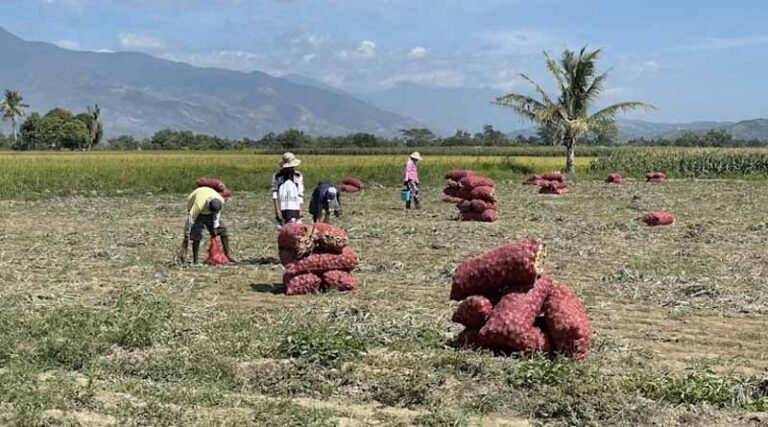
29 September 2026, Manila, Philippines: El Niño has inflicted ₱6.87 billion (roughly $120 million) in damage on Philippine agriculture, according to figures the Department of Agriculture released this week, with corn and rice bearing the brunt of losses spread across 14 of the country’s 18 regions.
The department’s tally, reported on September 26 and 27, shows 223,214 farmers affected and 249,028 hectares of farmland hit, with total production losses of 163,812 metric tons. Corn absorbed the largest share of the damage, at ₱4.90 billion across 170,605 hectares, followed by rice at ₱1.53 billion across nearly 75,000 hectares. High-value crops such as vegetables, bananas and pineapples lost close to ₱397 million, while livestock, poultry and cassava accounted for smaller shares. The affected regions span Luzon, Visayas and Mindanao, from the Cordillera and Cagayan Valley in the north to Caraga in the south.
There is a partial silver lining in the numbers. The department estimates that about 77 percent of the affected land, roughly 193,000 hectares, can still recover with the right support, while the remaining 23 percent, more than 56,000 hectares, is considered beyond repair for this cropping cycle. Officials have also cautioned that because the dry spell is still unfolding, the damage figures are likely to rise before the episode runs its course.
Manila’s relief package
The government has moved to get ahead of the damage with a response package that officials put at roughly ₱9.7 to ₱11 billion, funded partly through a Special Allotment Release Order already issued by the Department of Budget and Management. Of that, ₱6.2 billion is earmarked for fuel and fertilizer support, split between ₱2.2 billion for biofertilizers, ₱1 billion each for fuel assistance to farmers and to fisherfolk, ₱1 billion under the Presidential Assistance for Farmers and Fisherfolk program, and ₱1 billion in agricultural transport fuel subsidies. A further ₱3.5 billion has been requested for solar-powered irrigation facilities, alongside cloud seeding operations and the installation of 338 water pumps in drought-hit areas. The Philippine Crop Insurance Corporation has already paid out ₱427 million to 42,383 farmers under existing crop insurance policies.
Agriculture Assistant Secretary and department spokesperson Arnel de Mesa described the shift in approach as moving toward “location-based, specific interventions” rather than a “one-shot deal,” signaling that the government intends to tailor its response region by region rather than apply a single blanket program.
A bigger El Niño may still be coming
The current damage estimate is well below the ₱15.3 billion the Philippines suffered during the severe El Niño of 2024, which cut agriculture and fisheries output by 3.3 percent that year. But officials are bracing for worse, with forecasters anticipating a “very strong” El Niño episode beginning in October, meaning the current ₱6.87 billion figure may represent an early stage of a longer and costlier event rather than its peak.
The immediate market consequence is tighter domestic supply of corn and rice at a time when the Philippines is already one of the world’s largest rice importers. Officials and local trade press have flagged that reduced domestic production is likely to translate into firmer market prices for these staples in the coming months, adding to food inflation pressure that the government’s relief spending is partly designed to offset.
The Philippine situation is a useful early warning for other Asian producers, including India, because El Niño episodes often bring interlinked weather effects across the region rather than isolated, country-specific ones. A strong El Niño pattern forming in the Pacific this year raises the odds of an uneven Indian monsoon in the following season, which matters directly for kharif planning and for the pulses, oilseed and cereal price outlook that Indian input suppliers track closely. It is also relevant on the trade side: the Philippines is historically one of the top destinations for rice exports from Vietnam, Thailand and, when policy allows, India, so a supply squeeze there can lift regional rice prices and reshape where exporters choose to sell. For agri-input companies, a damage event of this scale usually triggers a wave of replanting demand for seed, fertilizer and crop protection products in the affected regions once the weather stabilizes, a pattern Indian and Latin American input exporters watching Southeast Asian markets will want to track.
Global Agriculture is an independent international media platform covering agri-business, policy, technology, and sustainability. For editorial collaborations, thought leadership, and strategic communications, write to pr@global-agriculture.com