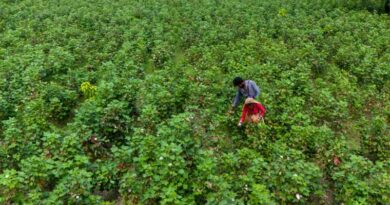
26 August 2026, Vietnam: For years, the end of a rice harvest at Tien Thuan Agricultural and Service Cooperative was marked by smoke. With few buyers for loose straw and little information about what else could be done with it, farmers often burned what remained in their fields. The practice was quick and familiar. It also made rice straw seem like a problem to be removed rather than a resource with value.
Mr. Nguyen Cao Khai, the cooperative’s director, remembers the uncertainty behind that old routine. Farmers worried that taking straw away might harm the soil. Their attention stayed fixed on the next rice crop: protecting yield, managing costs, and hoping their income would hold. Straw was rarely part of the business calculation. At most, a few people bought it in raw form; more often, it disappeared in flames.
The effects were visible beyond the smoke. Mr. Khai recalls that beneficial insects became scarce in the rice area and field crabs disappeared. Chemical-intensive production added to concerns about farmers’ health. Yet changing a practice followed for years required more than instructions. Farmers needed evidence they could see in their own fields.
A different future for straw
That evidence began to take shape when the International Rice Research Institute (IRRI), through the Rice Straw-Based Circular Economy for Improved Biodiversity and Sustainability (RiceEco) Project worked with local partners and farming communities in Vietnam and Cambodia. Funded by the Mekong-Republic of Korea Cooperation Fund (MKCF), Mekong Institute, the project combines research, technology, training, business development, stakeholder engagement and policy support to reduce straw burning and build circular-economy uses for rice residues.
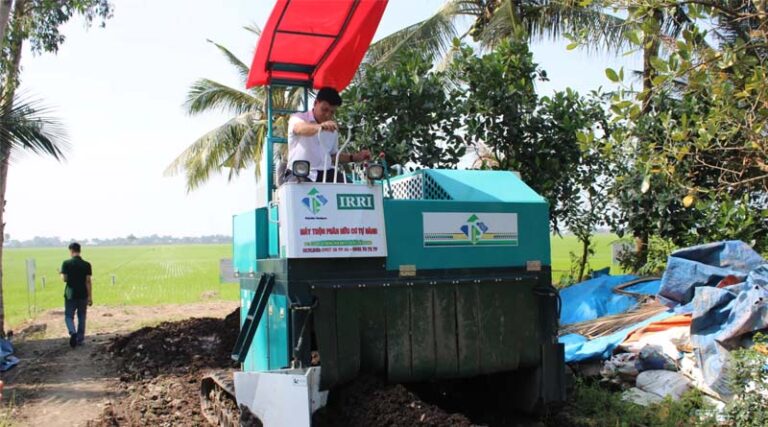
At Tien Thuan, IRRI introduced off-field technologies and practical training for straw collection, mushroom cultivation, and mechanized composting as well as in-field technology of mechanized straw incorporation combined with microbial technology for rapid straw decompostion. In June 2024, IRRI and Can Tho’s agriculture authorities launched the replicated circular agriculture model at the cooperative and handed over a self-propelled organic fertilizer turner. The intervention was connected to Vietnam’s wider One Million Hectares of High-Quality and Low-Emission Rice (1Mha) Program, which seeks to lower production costs and emissions while supporting greener growth in the Mekong Delta.
Mr. Khai approached the innovation with curiosity, but not without concern. Operating unfamiliar machinery was the first challenge. Cooperative members also needed the knowledge and confidence to use new techniques correctly. What persuaded him was the combination of training and scientific proof. IRRI’s recommendations, he said, had been tested and backed by evidence. Gradually, a question that once sounded risky – what happens if straw is removed from the field? – became another question: how much more value could farmers create from it?
The change can now be measured in both space and activity. Before RiceEco, the cooperative had no dedicated straw-processing machinery and only about 240 square meters for production. It has since developed roughly 1,000 square meters for composting, 540 square meters for storage, and access to another 4,000 square meters for mushroom production outside Mr. Khai’s home. By September 2025, IRRI reported that the cooperative was producing about 12-15 tons of organic fertilizer a month. A mushroom cycle using 600 to 700 rolls of straw yielded around 900 to 1050 kilograms in 40 to 42 days.
The cooperative’s legal structure did not change, but its daily life did. Once focused mainly on rice cultivation, it began developing a rice-straw business model. Board members came to the cooperative more often because there was more to manage: compost, mushrooms, storage, machinery, packaging, branding, and potential buyers. Straw products first made for household use began to look like marketable goods and a second stream of income.
As the business model expanded, its benefits began reaching beyond the cooperative itself. Collecting and handling straw for mushroom production created additional employment for villagers, particularly women in the community. Straw that was once burned in the field now moves through a local chain of work, from collection and transport to storage, mushroom cultivation, and compost production. This gives local families more opportunities to earn alongside rice farming while helping the cooperative secure the labor needed to grow its circular business.
For Mr. Khai, the benefits also changed the rhythm of farming. With healthier plants and reduced inputs, he no longer felt he had to check the crop every day or two; visits could sometimes be spaced three or four days apart, giving him time for other work. Cooperative members saw that lower seed and fertilizer use could reduce costs and disease pressure. They also began to recognize that the harvest did not end with grain. IRRI has estimated that circular straw practices at Tien Thuan can add about USD 50 to USD 70 per hectare compared with simply burning straw or selling all the loose material for about USD 25.
The landscape offered its own signs of recovery. Mr. Khai says field crabs have returned, along with more earthworms, as burning and chemical use declined. Farmers also experienced less smoke and dust. These observations reflect RiceEco’s larger purpose: to improve livelihoods while protecting biodiversity and lowering emissions through more sustainable straw management.
Leadership built on seeing and believing
Mr. Khai did not keep the learning inside the cooperative. He borrowed IRRI’s demonstration-based approach and took it directly to farmers. He rented land to show the techniques in practice, worked with advanced farmers as local examples, and encouraged households to compare pilot plots with conventionally managed fields. To ease their fear of failure, he even offered guarantee money for field trials. None of the participating farmers had to claim it.
“I bring innovation to the fields of rice farmers,” he said. His principle is simple: seeing is believing. The cooperative has organized learning exchanges with farmers from other villages, while Mr. Khai has been invited to speak at meetings and events more than 20 times a year. Each invitation allows him to share Tien Thuan’s experience, but he also treats it as another chance to learn.
His advocacy matters because changing behavior across a community is slow. Mr. Khai estimates that only 30 to 40 percent of farmers in the surrounding area have adopted some promoted practices, such as lower seeding rates through mechanized direct seeding. Local authorities can communicate low-emission goals, he said, but farmers still need a working example close to home. Tien Thuan is becoming that example.
Women gain time, knowledge, and a stronger voice
The new model has also opened space for women, both through additional work in straw-based activities and through training. Ms. Nhung, a woman farmer who joined the cooperative in 2024, learned about mechanized direct seeding, lower seed and fertilizer rates, mushroom cultivation, and composting. She started small, producing mushrooms for her family’s meals and compost for the vegetable garden. For her, the process was learning by doing – observing Mr. Khai’s practices, trying them at home, and sharing what she learned with her husband.
Her experience shows how technical knowledge can shift roles within a household. Ms. Nhung noted that women do apply innovations, even if many are shy about speaking publicly and spend much of their time at home. By carrying information on input reduction and composting back to her family, she became not just a participant in training but a source of farm decisions. The new practices reduced the physical labor once required to clear roots and residues from the field, while savings from lower production costs created possibilities for children’s education. Her family now hopes that its small straw activities can grow into something closer to the larger model at Tien Thuan. Empowerment here is practical: more knowledge, less drudgery, more time, a voice in household choices, and a pathway toward income.
The next chapter
The cooperative’s progress has not removed every constraint. Mr. Khai believes rice cultivation under the new practices is already successful, but scaling the straw business remains difficult because collection, transport, and processing require costly machinery. Support from Thien Tam Capital Investment under Vingroup, after the RiceEco ended, has helped the cooperative obtain equipment, including a straw baler, a drone, a decomposing machine, and a pellet-making machine. Still, Mr. Khai sees long-term, five- to seven-year financing as essential if cooperatives are expected to invest, mechanize, and serve much larger areas for scaling.
His vision is ambitious: remove and productively use all rice straw from participating fields, expand mushroom production and bale sales, build larger storage facilities, mechanize collection and transport, and test pelletized organic fertilizer that is easier to carry and apply. An electricity company has even approached the cooperative about the possibility of generating energy from straw. He also wants stronger business-administration training for the cooperative board and wider skills training for the community, alongside careful evaluation of the economic and agronomic effects of organic compost.
This local ambition now sits within a broader policy shift. RiceEco contributed to Vietnam’s national technical guideline on sustainable, circular, and low-emission rice straw management, issued in 2023 for the Mekong Delta. Across Vietnam and Cambodia, the project reported reaching 5,084 unique farmers and related stakeholders (73% male, 27% female) and helped establish business models that turn discarded straw into fertilizer, mushrooms, and other useful products.
For Mr. Khai, however, the deepest change is easier to express in human terms. Before, farmers worried almost entirely about the yield and income from a single rice crop. Today, straw provides added value, healthier surroundings, and another layer of security. The anxiety has not vanished, but it has eased. In a cooperative once accustomed to watching straw go up in smoke, farmers can now see income, soil improvement, biodiversity, and opportunity taking its place. That, Mr. Khai believes, is a better quality of life – and a future worth scaling.
Global Agriculture is an independent international media platform covering agri-business, policy, technology, and sustainability. For editorial collaborations, thought leadership, and strategic communications, write to pr@global-agriculture.com