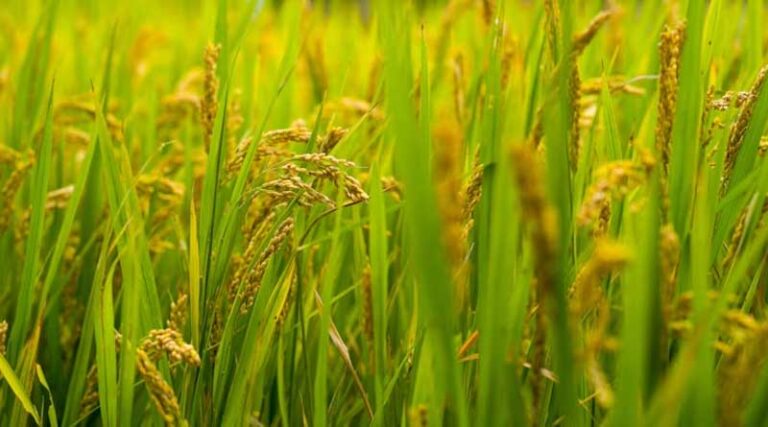
18 September 2026, Illinois, United States: Scientists at the University of Chicago have developed a gene-editing technique that increased rice yields by 20 to 25 percent while also improving the plants’ tolerance to drought and heat, by modifying existing rice genes rather than inserting foreign DNA. The research, led by Chuan He, the John T. Wilson Distinguished Service Professor of Chemistry and Biochemistry and Molecular Biology, was published in Nature Genetics on July 23, 2026, with first author Liudan Jiang and six other co-authors.
The technique targets two rice genes, called ALKBH9 and ALKBH10, which belong to a family of proteins that modify RNA molecules, the intermediate genetic messages a cell reads to build proteins. These particular proteins carry a structural feature known as an intrinsically disordered region, a floppy segment of the protein that is not folded into a fixed shape. He’s team found that removing just the end section of this floppy region, called the C-terminus, allows the ALKBH9 and ALKBH10 proteins to spread more broadly through the cell and interact with chromatin, the packaged form of DNA inside the nucleus.
An off switch for growth restraint
In practical terms, that broader activity appears to loosen molecular constraints that normally hold back plant growth, similar in concept to how a well-studied human gene called FTO regulates growth and metabolism. Removing the restraint let rice plants grow faster and larger while also coping better with heat and water stress, a combination that does not usually come easily in plant breeding, where yield gains and stress tolerance often trade off against each other.
The method the team used to make the edit is known as base editing, a form of gene editing that changes only one or a few individual DNA letters in a plant’s existing genome rather than cutting and inserting new genetic material, as older CRISPR techniques typically do. Because no foreign DNA is added, He’s team argues the resulting plants sidestep the regulatory classification and consumer concerns that apply to conventional genetically modified organisms in many markets, a distinction regulators in several countries, including India, have used to treat gene-edited crops differently from transgenic GMOs.
Beyond rice
The ALKBH9 and ALKBH10 genes are not unique to rice. Related versions exist in other major crops, including wheat, maize, and soybean, which the Chicago team says makes the approach a potential template rather than a one-crop fix. Extending the technique to other species would require re-identifying the equivalent disordered protein regions and confirming the same growth and stress-tolerance effects hold up outside a single genetic background, work that has not yet been reported.
The finding is also notable because plant breeders have long struggled to combine higher yield with better stress tolerance in a single variety, since the two traits often pull against each other: pushing a plant to grow faster and bigger typically leaves it with fewer reserves to cope with heat or drought. By working through an RNA-modification pathway rather than a single growth-hormone gene, the Chicago team’s edit appears to relax that trade-off in their rice trials, which is part of why the result has drawn attention beyond typical incremental yield studies.
The research remains at the greenhouse and controlled-trial stage rather than commercial field deployment. Questions that typically follow a finding like this, including performance across multiple rice varieties and growing seasons, interaction with existing high-yield breeding lines, and the regulatory pathway in each target market, have not yet been addressed in the published work.
Global Agriculture is an independent international media platform covering agri-business, policy, technology, and sustainability. For editorial collaborations, thought leadership, and strategic communications, write to pr@global-agriculture.com